


Manas Dasgupta
NEW DELHI, July 25: In a bid to blunt the BJP criticism why the Congress governments in the past did not carry out caste census, the Congress leader Rahul Gandhi on Friday acknowledged his “mistake” that he earlier did not understand the issues confronting the Other Backward Classes (OBCs) and protect their interests as much as he should have.
The Leader of the Opposition in the Lok Sabha said in his 21 years of political carrier so far staring from 2004, he did something’s right but his biggest mistake was that he did not understand the issues of the OBCs deeply and advocated for conducting a caste census. “It was not mistake of the Congress that they could not get a caste census conducted earlier. It was my mistake not to press for a caste census. But now I am going to correct that mistake,” he said.
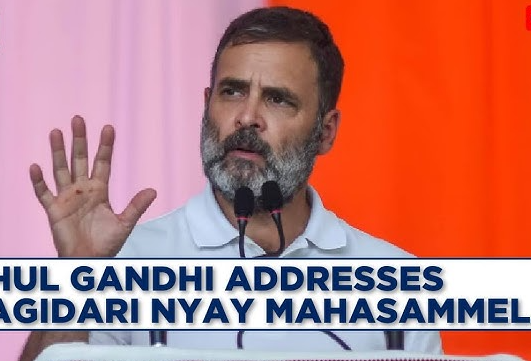
Addressing a ‘Bhagidari Nyay Sammelan’ of OBCs Talkatora Stadium in New Delhi where the Telangana Congress leaders gave a presentation to party MPs on the state’s caste survey, Mr Gandhi said even though the Narendra Modi government at the centre had been forced to go for caste census along with the next population enumeration, the Centre would not conduct a caste survey in the right way.
Claiming that the caste census in Telangana conducted by the Congress government in the state was a “political earthquake that will cause a huge aftershock” in the country, Mr Gandhi said the BJP feared the implications of breaking the 50% ceiling on reservations.
“Enhancing reservations in education, politics and employment has the potential to disrupt the politics of Hindutva. The BJP knows it, and so do we. That is why, when we exerted pressure, the BJP had no choice but to listen. But they still cannot conduct a proper caste census. They cannot tell the truth about the condition of OBCs, Dalits, tribals, or even general castes in this country. If they do, their entire ideological foundation will collapse,” he said.
“I have been doing politics since 2004, it has been 21 years, and when I look back and do a self-analysis, where all I did the right thing and where I fell short. I see two-three big issues — land acquisition bill, MGNREGA, food bill, fight for tribals, I did these things right.
“When it comes to Dalits, tribals and minorities, I should get good marks. On women’s issues, I should get good marks. “But when I look back, I can see clearly that in one thing I was lacking, I committed one mistake — I did not protect the OBC section the way I should have,” Mr Gandhi said.
He said he could not understand the issues of the OBC section deeply 10-15 years ago. “I understood Dalit problems, which are clear; one can understand issues of STs also clearly. The issues of OBCs are hidden. “I regret that if I had known more about your history and issues, I would have gotten the caste census done. That is my mistake and not that of the Congress. I am going to correct that mistake,” Mr Gandhi said.
He, however, added that in a way, it was better that the caste census was not done earlier, as it would not have been done in the manner it would be done now following the Telangana example. “The caste census in Telangana is a political earthquake. It has shaken the political ground of the country. You have not felt its aftershock but the impact will be there,” Mr Gandhi said. “We will conduct a caste census and an X-ray of the population in all Congress-ruled states,” he said.
Hailing the Socio-Economic, Employment, Education, Political and Caste (SEEEPC) survey conducted by the Telangana government, Mr Gandhi revealed that he had initial doubts about whether the chief minister Revanth Reddy would be able to push the caste survey. “When I started raising the issue in Telangana, I was conscious that it might be difficult for Revanth Reddy as his community may not approve. But they exceeded my expectations,” he said.
Calling the SEEEPC survey a “milestone for social justice,” Mr Gandhi said it would now serve as a benchmark for how a national caste census should be conducted.
Mr Reddy also said he saw the caste survey as a personal mission. “Sonia Gandhi wrote a letter to me appreciating the caste survey. That letter is like a lifetime achievement award for me. It is like a Nobel or an Oscar,” he said.
Telangana Deputy Chief Minister Mallu Bhatti Vikramarka and Minister N Uttam Kumar Reddy delivered the presentation in the presence of AICC president Mallikarjun Kharge, Chief Minister A Revanth Reddy, PCC president B Mahesh Kumar Goud, and other party leaders.
“This was not done behind closed bureaucratic doors. Input was taken from lakhs of people — from communities, associations, occupational groups and women — on what questions should be asked. Finally, 56 key questions were selected to assess power, discrimination, assets, education and more, and these were posed to every individual,” Mr Gandhi said.
He argued that data had become a source of power in the modern world. “In the 1950s to 70s, power came from oil — black gold. Today, power comes from data. Ask Bill Gates or Donald Trump, they’ll tell you the same. Now, Telangana has 21st-century data in its hands. It can target development based on caste, education, health and other parameters. No other state in India can do that today. It is a social, financial and economic tool, and the BJP does not like it,” he added.
The Leader of the Opposition also strongly advocated for English medium education. “Education is the single most important factor for success in Telangana. English medium is far more powerful today than education in Hindi or other regional languages. Ask the BJP leaders where their children study. The answer will be English medium schools. Then why shouldn’t poor, Dalit, Adivasi or OBC children have the same opportunity?”
He criticised the Centre for not approving Bills passed by the Telangana Assembly that sought to raise the reservation cap beyond 50%. “The Centre says no. Our job is to raise this in Parliament and push to break the 50% ceiling,” he said.
Meanwhile, Mr Reddy described Prime Minister Narendra Modi as a “legally converted OBC.” “Modi says he is an OBC Prime Minister. But he was not OBC by birth. After becoming chief minister in Gujarat, he got his caste included in the OBC list,” he said.
Revanth alleged that the BJP had no intention of conducting a caste census. “In 2020, the Centre told the Supreme Court via affidavit that it would not conduct one. In Parliament, Rajnath Singh said the same. It was only due to Congress pressure that the Centre finally agreed. This is Rahul Gandhi’s success. He promised during the Bharat Jodo Yatra that the Congress would conduct a caste census, and we fulfilled it in Telangana,” he said.
The Cabinet Committee on Political Affairs, chaired by Prime Minister Modi, has decided to conduct caste enumeration in the upcoming Census. As per Article 246 of the Constitution, the Census is a Union subject listed in the 7th schedule. The caste census must be viewed beyond binaries of “for or against” to envision a more transformative idea — as a foundational tool for what might be called a social management approach to governance.
The Bihar caste survey (2023) found that Other Backward Classes (OBCs) and Economically Backward Classes (EBCs) together make up over 63% of the population, with EBCs alone at 36.01%. Scheduled Castes (SC) account for 19.65%, and Scheduled Tribes (SC) for 1.68%. The general category comprises only 15.52%. Additionally, over 34% of Bihar’s families live on less than ₹200 per day, with nearly 44% of SC households below that line.
In Telangana’s 2025 survey, Backward Classes (BCs) constituted 56.33% of the population, with BC Muslims forming a substantial 10.08%. These numbers reveal a stark reality: India’s marginalised communities form the majority but are significantly underrepresented in education, employment, and governance.
Data shared by the Union Minister of State for Education in Parliament reveals that only 4% of professors and 6% of associate professors in 45 Central Universities are OBCs, while 85% are from the general category. This imbalance exists despite the Central Educational Institutions (Reservation in Teachers’ Cadre) Act, 2019.
Yet, the policy response is hindered by the absence of reliable data. India hasn’t conducted a full caste census since 1931. The 2011 Socio-Economic and Caste Census (SECC) was marred by data inconsistencies and its findings were withheld. Without up-to-date caste data, affirmative action and development policies remain speculative.