


Manas Dasgupta
NEW DELHI, Feb 24: Amidst the turmoil over the Youth Congress activists staging “naked” demonstration at the AI summit ruining India’s prestige in front of the foreign dignitaries, the Congress leader Rahul Gandhi on Tuesday demanded the Prime Minister Narendra Modi scrap the India – US Trade Deal which he claimed was against the interests of the Indian farmers.
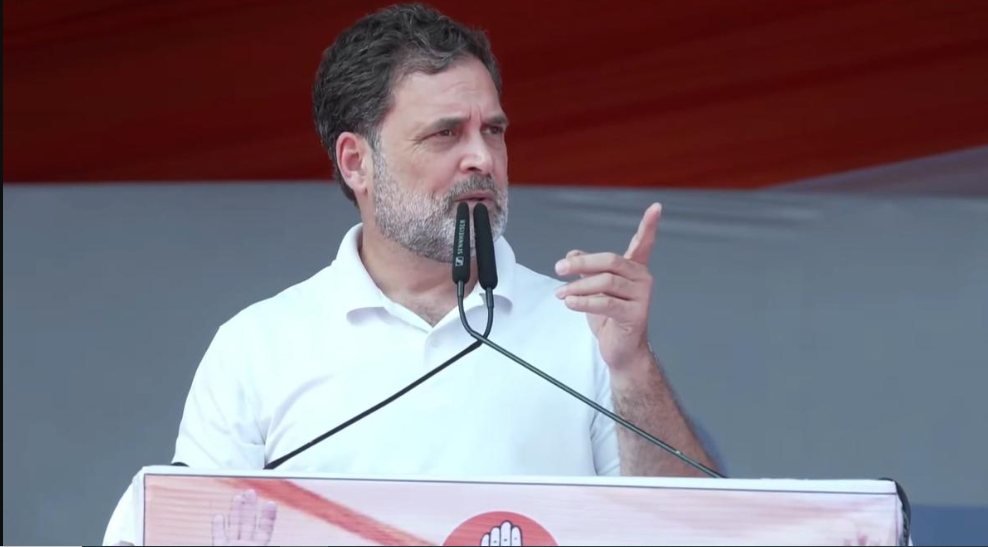
Addressing ‘Kisan Mahachaupal,’ a farmers’ rally, in Bhopal, Mr Gandhi likened the interim trade deal to an arrow piercing the hearts of Indian farmers. “After the U.S. Supreme Court ruling on the trade deal, I challenge PM Modi to scrap it…but he won’t be able to do so,” the Leader of Opposition in the Lok Sabha said.
“The Indo-U.S. trade deal is against the interests of our farmers and was done by PM Modi under the pressure of U.S. President Donald Trump because of Epstein files and to save industrialist Adani,” he alleged. The Congress leader also accused PM Modi of agreeing to sign the Indo-US trade deal without taking Union ministers Rajnath Singh (Defence), Shivraj Singh Chouhan (Agriculture) and Nitin Gadkari (Road Transport and Highways) into confidence.
“This is not a deal, but an arrow struck in the hearts of the country’s farmers,” Gandhi said. He also alleged that through the trade deal, the PM had compromised the interests of India’s agriculture, data, textile and import sectors. Congress president Mallikarjun Kharge, who was also present at the event, said the PM was coward, and added that the Indo-US trade deal showed the government’s surrender.
Mr Gandhi had earlier also alleged that the NDA government had compromised India’s energy security, data, and the future of its farmers by signing the Indo-U.S. interim trade agreement. Mr Gandhi, who was prevented in the Lok Sabha from speaking on the Motion of Thanks to the President’s address amid a stand-off with the Treasury benches, had used the discussion on Union Budget to up the ante. For the first time in history, he said, “our farmers are facing the storm. You have opened the doors to crush our poor farmers. This is disgraceful.”
The government was quick to respond, with Parliamentary Affairs Minister Kiren Rijiju asserting that it would move a privilege motion against Mr Gandhi for his “useless and false allegations” against the government and the Prime Minister. The LoP accused the government of allowing the U.S. to weaponise India’s finances against itself. “You are handing our data over. How can you even make these statements? Are you not ashamed of yourselves?” he asked.
He claimed that if the Opposition INDIA bloc had been negotiating with U.S. President Donald Trump, it would have insisted that the U.S. treat India as an equal partner. “The first thing we would say [to Trump] is that the most important asset in this equation is Indian data. If the U.S. wants to protect the dollar, it must recognise that Indian data is the biggest asset. Second thing, we would say to President Trump is that ‘if you want access to it, then you will talk to us as an equal, not talk to us as if we are your servants’,” he said.
Meanwhile, in Maharashtra, the budget session of the state Assembly began without a recognised Leader of the Opposition in both the Legislative Assembly and the legislative Council, allegedly caused by the factional weaknesses among the opposition parties and apathy of the ruling “Mahayuti” alliance prompting intense debate over democratic norms and legislative oversight.
Traditionally, the role of the Leader of Opposition is intended to provide institutional balance and scrutiny of the government. In many parliamentary systems, including India’s, the LoP plays a crucial role in legislative committees, appointments, and accountability mechanisms.
Under convention, a party generally needs at least 10% of the total members of a House to claim the LoP post. In the current 15th Maharashtra Legislative Assembly, following the 2024 state elections, no single opposition party has achieved this threshold in the 288-member House. As a result, the post remains unfilled. In the 78-member Legislative Council, the situation has been further complicated by the resignation of Congress MLC Pradnya Satav, whose departure reduced the party’s strength below the eligibility benchmark.
Leaders of the Maha Vikas Aghadi (MVA) alliance, mainly the Shiv Sena (UBT) and the Congress have voiced sharp criticism of this anomaly. MP Sanjay Raut described the situation as a “mockery of democracy.” questioning how a parliament or legislature can function without a recognised opposition head and suggesting the government may be avoiding accountability. He said, “To run any House without a Leader of Opposition is against democratic principles. There have been three sessions so far, and yet LoP has not been appointed. Isn’t this against the constitution?”
Shiv Sena (UBT) MLA Bhaskar Jadhav charged that the ruling Mahayuti alliance’s sheer dominance and political inaction on facilitating recognition was an intentional weakening of democratic processes. He pointed to past instances where even smaller parties had been accorded the LoP role. Largely, opposition MVA feels the absence of LoPs signals institutional imbalance at a time the government holds a commanding majority, a development they argue undermines the legislature’s check-and-balance function.
The ruling alliance led by Chief Minister Devendra Fadnavis and his Deputy CMs has largely treated the issue as a procedural matter. According to Fadnavis, the decision to recognise a Leader of Opposition wrest with the Speaker of the Assembly and the Chairman of the Council and was contingent on established conventions rather than strict constitutional compulsion. “The government remains focused on legislation, not internal opposition disputes,” he said.
A senior Mahayuti minister added that the matter was an internal affair of the opposition parties and that the government would instead focus on delivering the legislative agenda and fiscal priorities outlined in the budget. But the political analysts suggest that this situation exposes gaps in legislative conventions versus constitutional prescriptions.
The Indian Constitution does not explicitly mandate a Leader of Opposition, and the recognition is often shaped by parliamentary conventions and internal Rules of Procedure. However, the absence of such a leader in both Houses, especially during a budget session, raises questions about institutional accountability. The LoP vacancy also reflects deeper fractures within the opposition bloc in Maharashtra. “The MVA alliance’s inability to secure the 10% threshold underscores electoral setbacks and organisational weaknesses,” the BJP sources said.