


Manas Dasgupta
NEW DELHI, Nov 20: In a crucial clarification, the Supreme Court on Wednesday held that the President and Governors of states cannot be bound by timelines when it comes to approving Bills, but also told the governors that could not indefinitely held on a bill “in a deliberate bid to thwart the people’s will expressed through proposed laws passed by State legislatures.”
A five-judge Constitution bench stressed that the actions of the President or Governors are not “justiciable” and judicial review can be invoked only when a Bill becomes a law. The five-judge Bench of the Supreme Court delivered the verdict with none of the judges claiming sole authorship but fashioning it as the ‘Opinion of the Court’, opined that the apex court cannot fix timelines for Governors and the President to deal with the state bills under Articles 200 and 201, but also clarified that the Governors could also not use their discretion to resort to “prolonged and evasive constitutional inaction.”
But the court at the same time also struck down the two-judge bench’s ‘deemed assent’ verdict under , which the constitution bench said amounted to virtual takeover of the executive functions by the judiciary “through judicial pronouncement, which is impermissible within the contours of our written Constitution.”
The five-judge bench order comes in response to President Droupadi Murmu’s questions to the top court following a two-judge bench’s verdict in the Tamil Nadu Governor case that effectively set a deadline for the President and Governors to clear Bills passed by the legislature.
Seeking the court’s opinion under Article 143 of the Constitution, the President had asked, “In the absence of a constitutionally prescribed time limit, and the manner of exercise of powers by the Governor, can timelines be imposed and the manner of exercise be prescribed through judicial orders for the exercise of all powers under Article 200 of the Constitution of India by the Governor?”
The President had also asked if the exercise of constitutional discretion by the President under Article 201 of the Constitution of India is justiciable.
“Is the Governor bound by the aid and advice tendered by the Council of Ministers while exercising all the options available with him when a Bill is presented before him under Article 200 of the Constitution of India?” the President had asked. She had cited Article 361 of the Constitution, which says the President or the Governor shall not be answerable to any court for the exercise of the powers and duties of office.
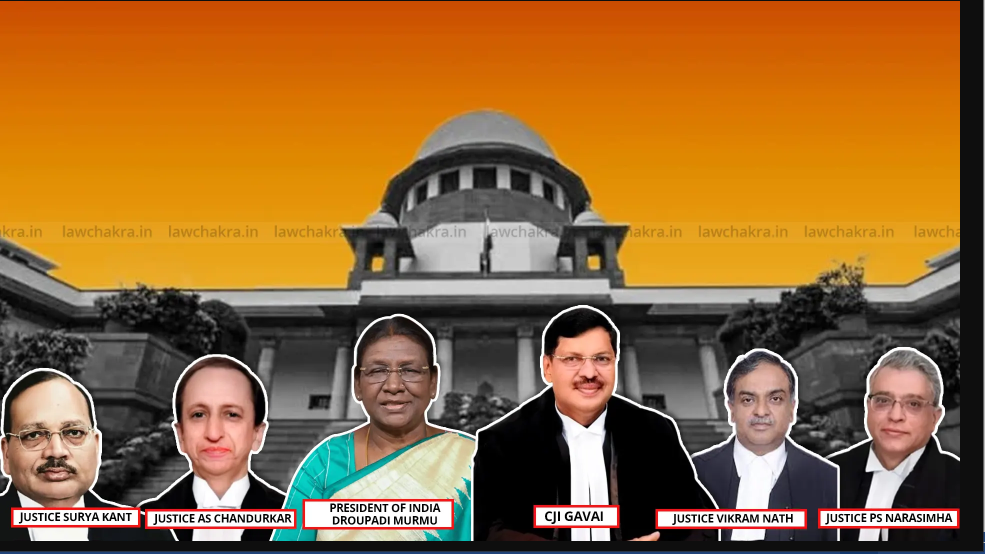
The bench led by Chief Justice of India BR Gavai said the imposition of a timeline was “strictly contrary” to the Constitution. The other judges on the bench were Justice Surya Kant, Justice Vikram Nath, Justice PS Narasimha, and Justice AS Chandurkar.
The court also struck down the arguments regarding ‘deemed assent’ made in the two-judge bench’s judgment. It said “deemed consent of the Governor, or President, under Article 200 or 201 at the expiry of a judicially set timeline, is virtually a takeover, and substitution, of the executive functions by the Judiciary, through judicial pronouncement, which is impermissible within the contours of our written Constitution.”
On April 8 this year, a bench of Justice JB Pardiwala and Justice R Mahadevan delivered a judgment in The State of Tamil Nadu vs The Governor of Tamil Nadu case, in which the DMK government had accused Governor RN Ravi of withholding bills indefinitely. The court used its special powers under Article 142 of the Constitution to declare 10 withheld Bills “as deemed to have been assented on the date when they were presented to the Governor.”
“We are in no way undermining the office of the Governor. All we say is that the Governor must act with due deference to the settled conventions of parliamentary democracy; respecting the will of the people being expressed through the legislature as – well as the elected government responsible to the people,” the judgment noted.
During the two-month long hearings in the Presidential Reference saw the five-judge Supreme Court Bench headed by Chief Justice of India B.R. Gavai repeatedly clarify that it is not sitting in appeal over an April 8 judgment in the Tamil Nadu Governor case nor is it planning to overrule the two-judge Bench verdict.
“We will only be expressing our view on the questions of law raised in the Reference, and not pronounce a judgment in the Tamil Nadu case,” Chief Justice Gavai had addressed the Centre and Attorney General R. Venkataramani, who were supporting the Reference.
The hearings which followed this comment made it clear that the Supreme Court had no intention to remain a mute spectator in the face of Governors or the President delaying State legislations. The court underscored, time and again, that competent State legislatures cannot be made defunct and democratic will of the people cannot be thwarted by Governors sitting on Bills for years together.
The strongly worded judgment of the two-judge bench in April came under criticism from some ruling party leaders, who said the court’s remarks amounted to judicial overreach. The court had said in cases where a Bill was reserved on the grounds of “not being in consonance with the constitutional principles and involves questions of constitutional validity, the executive is supposed to exercise restraint.”
“It is expected that the Union executive should not assume the role of the courts in determining the vires of a bill and should, as a matter of practice, refer such question to the Supreme Court under Article 143. We have no qualms in stating that the hands of the executive are tied when engaging with purely legal issues in a bill and only the constitutional courts have the prerogative to study and provide recommendations as regards the constitutionality of a bill,” the court had said.
A month after the top court’s judgment, the President wrote to the Supreme Court and sought its opinion on whether timelines can be imposed on Governors and the President. President Murmu also asked if a Governor’s exercise of constitutional discretion is justiciable — subject to a trial in court. “In the absence of a constitutionally-prescribed timeline and the manner of exercise of powers by the President, can timelines be imposed and the manner of exercise be prescribed through judicial orders for the exercise of discretion by the President under Article 201 of the Constitution of India?” President Murmu asked the Supreme Court.
The President’s letter came amid a discussion in power corridors on whether the top court’s Tamil Nadu judgment was an example of judicial overreach.
The five-judge bench has said the text of Articles 200 and 201 of the Constitution has been framed in a manner that provides a “sense of elasticity, for constitutional authorities to perform their functions, keeping in mind the diverse contexts and situations, and by consequence the need for balancing that might arise in the process of law making in a federal, and democratic country like ours.” The imposition of timelines would be strictly contrary to this elasticity that the Constitution so carefully preserves,” the bench has said.
“There is no denying, that judicial review too, is a part of the basic structure of the Constitution of India. This judicial review, however, is not an unbridled scope that can negate or destroy the separation of powers doctrine,” the court said. The Constitution bench, however, added a rider. “We are of the considered opinion that while the merits of action taken by the Governor under Article 200 cannot be looked into by Courts – inaction that is prolonged, unexplained and indefinite, will certainly invite limited judicial scrutiny,” it said.
The court said no constitutional organ or authority can function by itself. “The working of our constitutional scheme is premised on constitutional authorities – who are each assigned specific but inter-dependent roles – performing their duties, akin to cogs that keep a clock ticking. They depend on each other, to keep the Constitution humming, and thus, working,” the court observed.
The apex court had earlier also said the Supreme Court would not “sit idle” and powerless if a constitutional authority fails to discharge his duties, no matter how high he may be, the CJI Gavai had voiced the court’s firm resolve on the final day of the Presidential Reference hearing, which has brought into sharp focus the schism between Opposition-ruled States and their Governors over delay in clearing crucial laws.
“Howsoever high an authority may be, he is not above the law… I am a strong believer in the doctrine of separation of powers. I believe that judicial activism must not turn into judicial terrorism. But at the same time, if one wing of democracy fails in the discharge of his duties, would the court, which is the custodian of the Constitution, be powerless and forced to sit idle,” Chief Justice Gavai asked the Union government, represented by Solicitor-General Tushar Mehta in September. The Union government has used the platform of the Presidential Reference to criticise the apex court for encroaching into the domains of the Governors and the President.
On August 20, the second day of the hearing, Chief Justice Gavai said elected State governments cannot be left to the mercy or whims and fancies of Governors, who sit endlessly over Bills sent to them for assent. The next day, the Chief Justice reminded the Centre again of the powers of the Supreme Court as a custodian of the Constitution.
“When this Court could set aside the very Constitutional Amendment [The Forty-second Constitutional Amendment Act of 1976], which had limited the power of judicial review as a violation of the Basic Structure, are you saying this court is powerless in the face of inaction by a Governor?” the Chief Justice had asked the Union government.
On August 26, the Chief Justice came back with another question at the Centre, asking if the Supreme Court could review a Governor’s recommendation for President’s rule under Article 356, what stopped it from examining the conduct of a Governor sitting on crucial State Bills for years together. Tamil Nadu Governor R.N. Ravi had set on 10 re-passed State Bills for five years, leading to the April 8 judgment.
The Court backed up its earlier observations on September 2, with multiple judges on the Bench remarking that Governors could neither delay the wisdom of the legislature indefinitely nor impede the functioning of the Constitution. “No organ can impair the functioning of the Constitution,” Justice P.S. Narasimha, one of the five judges, said. On September 9, Chief Justice Gavai said Governors were meant to be “true guides and philosophers” rather than a stumbling block for State governments.
Following were the 14 points raised in the Presidential Reference and the clarifications given by the apex court:
- What are the constitutional options before a Governor when a Bill is presented to him under Article 200 of the Constitution of India?
The Governor has three constitutional options under Article 200, namely to assent, reserve the Bill for the President’s consideration, or withhold assent and return the Bill to the Legislature with comments. The first proviso to Article 200 is bound to the substantive part of the provision, and restricts the existing options, rather than offering a fourth option. Pertinently, the third option — to withhold assent and return with comments — is only available to the Governor when it is not a Money Bill.
- Is the Governor bound by the aid and advice tendered by the Council of Ministers while exercising all the options available with him when a Bill is presented before him under Article 200 of the Constitution of India?
The Governor enjoys discretion in choosing from these three constitutional options and is not bound by the aid and advice of the Council of Ministers, while exercising his function under Article 200.
- Is the exercise of constitutional discretion by the Governor under Article 200 of the Constitution of India justiciable?
The discharge of the Governor’s function under Article 200 is not justiciable. The Court cannot enter into a merits review of the decision so taken. However, in glaring circumstances of inaction that is prolonged, unexplained, and indefinite, the Court can issue a limited mandamus for the Governor to discharge his function under Article 200 within a reasonable time period, without making any observations on the merits of the exercise of his discretion.
- Is Article 361 of the Constitution of India an absolute bar to judicial review in relation to the actions of a Governor under Article 200 of the Constitution of India?
Article 361 of the Constitution is an absolute bar on judicial review in relation to personally subjecting the Governor to judicial proceedings. However, it cannot be relied upon to negate the limited scope of judicial review that this Court is empowered to exercise in situations of prolonged inaction by the Governor under Article 200. It is clarified that while the Governor continues to enjoy personal immunity, the constitutional office of the Governor is subject to the jurisdiction of this court.
- In the absence of a constitutionally prescribed time limit and the manner of exercise of powers by the Governor, can timelines be imposed and the manner of exercise be prescribed through judicial orders for the exercise of all powers under Article 200 of the Constitution of India by the Governor?
In the absence of constitutionally prescribed time limits, and the manner of exercise of power by the Governor, it would not be appropriate for this Court to judicially prescribe timelines for the exercise of powers under Article 200.
- Is the exercise of constitutional discretion by the President under Article 201 of the Constitution of India justiciable?
For similar reasoning as held with respect to the Governor, the President’s assent under Article 201 too, is not justiciable.
- In the absence of a constitutionally prescribed timeline and the manner of exercise of powers by the President, can timelines be imposed and the manner of exercise be prescribed through judicial orders for the exercise of discretion by the President Under Article 201 of the Constitution of India?
For the same reasons as indicated in the context of the Governor under Article 200, it is clarified that the President, too, cannot be bound by judicially prescribed timelines in the discharge of functions under Article 201.
- In light of the constitutional scheme governing the powers of the President, is the President required to seek advice of the Supreme Court by way of a reference under Article 143 of the Constitution of India and take the opinion of the Supreme Court when the Governor reserves a Bill for the President’s assent or otherwise?
In our constitutional scheme, the President is not required to seek advice of this Court by way of reference under Article 143, every time a Governor reserves a Bill for the President’s assent. The subjective satisfaction of the President is sufficient. If there is a lack of clarity, or the President so requires advice of this Court on a Bill, it may be referred under Article 143, as it has been done on numerous previous occasions.
- Are the decisions of the Governor and the President under Article 200 and Article 201 of the Constitution of India, respectively, justiciable at a stage anterior into the law coming into force? Is it permissible for the Courts to undertake judicial adjudication over the contents of a Bill, in any manner, before it becomes law?
The decisions of the Governor and President under Articles 200 and 201, respectively, are not justiciable at a stage anterior into the law coming into force. It is impermissible for the Courts to undertake judicial adjudication over the contents of a Bill, in any manner, before it becomes law. Pertinently, discharge of its role under Article 143, does not constitute ‘judicial adjudication’.
- Can the exercise of constitutional powers and the orders of/by the President/Governor be substituted in any manner under Article 142 of the Constitution of India?
The exercise of constitutional powers and the orders of the President/Governor cannot be substituted in any manner under Article 142, and we hereby clarify that the Constitution, specifically Article 142 even does not allow for the concept of ‘deemed assent’ of Bills.
- Is a law made by the State legislature a law in force without the assent of the Governor granted under Article 200 of the Constitution of India?
Question 11 is answered in accordance with our opinion tendered on Question 10, i.e., there is no question of a law made by the State Legislature coming into force without assent of the Governor under Article 200. The Governor’s legislative role under Article 200 cannot be supplanted by another constitutional authority.
- In view of the proviso to Article 145(3) of the Constitution of India, is it not mandatory for any bench of this Hon’ble Court to first decide as to whether the question involved in the proceedings before it is of such a nature which involves substantial questions of law as to the interpretation of constitution and to refer it to a bench of minimum five Judges?
We have already indicated in our opinion that Question 12 relating to Article 145(3) and the composition of benches in this Court that hear cases of constitutional importance is irrelevant to the functional nature of this reference, and is returned unanswered.
- Do the powers of the Supreme Court under Article 142 of the Constitution of India limited to matters of procedural law or Article 142 of the Constitution of India extend to issuing directions/passing orders which are contrary to or inconsistent with existing substantive or procedural provisions of the Constitution or law in Force?
We have also indicated in our opinion that Question 13 concerning the power under Article 142 is overly broad, and not possible to answer in a definitive manner. Our opinion on the scope of Article 142 in the context of the functions of the Governor and President has already been answered as a part of Question 10.
- Does the Constitution bar any other jurisdiction of the Supreme Court to resolve disputes between the Union Government and the State Governments except by way of a suit under Article 131 of the Constitution of India?
Question 14 — pertaining to this Court’s jurisdiction to resolve disputes between the Union and State Governments outside of Article 131 — is also found to be irrelevant to the functional nature of the reference and hence returned unanswered.