


Manas Dasgupta
NEW DELHI, Oct 4: With the Assembly elections in Bihar just weeks ahead, both the ruling and the opposition parties have urged the Election Commission of India to complete the polling process in a single or a maximum of two phases and also hold the elections immediately after the Chhath festival to increase voter participation.
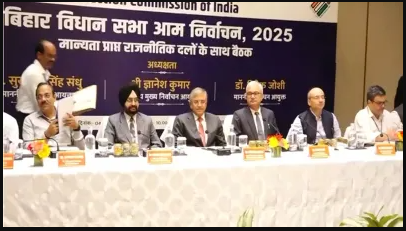
The suggestion was given by the parties during their meeting with the Chief Election Commissioner (CEC) Gyanesh Kumar and Election Commissioners Vivek Joshi and Sukhbir Singh Sandhu on Saturday. The delegation of the ECI reached Patna on Friday night for a two-day visit to review poll preparedness for the upcoming Bihar Assembly elections. On the first day, the ECI met the representatives of twelve recognised political parties, of which six were national parties and six were regional parties.
The JD(U) state president Umesh Kushwaha said, “Our party has suggested that the assembly elections should be held in single phase.” Former union minister Pashupati Kumar Paras-led Rashtriya Lok Janshakti Party (RLJP) also advocated a single-phase election. RLJP leader Pramod Kumar told the media that though his party has suggested a single phase, the process could be extended to not more than two phases.
The RLJP further raised concerns over the state’s law and order situation. “As the law and order is a big issue, the law enforcing agencies must be asked to tighten the noose around troublemakers before the election,” an RLJP leader said.
Union minister Chirag Paswan’s Lok Janshakti Party (Ram Vilas) also suggested that the elections be held in no more than two phases. Similarly, the Bahujan Samaj Party (BSP) demanded that announcements to woo the electorate during the election must be stopped. BSP leader Suresh Rao said his party has also suggested relaxation in the publication of criminal records of candidates facing charges in newspapers. “It becomes expensive for the poor candidates to publish criminal records in three different newspapers,” he added.
The BJP also demanded that the ECI direct central para-armed police forces to conduct flag marches in villages inhabited by Dalits, Extremely Backward Classes (EBCs) and Other Backward Classes (OBCs) to instil a sense of confidence among voters.
In addition, the BJP demanded patrolling in Diara land (riverine belt) by Mounted Military Police (MMP) personnel to prevent the possibility of booth capturing. These demands were placed during a meeting between a BJP delegation, led by Jaiswal, and the visiting ECI team.
“We have given a few suggestions to the ECI that prior to the voting, either one or two days in advance, to carry out a flag march of the paramilitary forces in certain villages for confidence building,” Bihar BJP president Dilip Kumar Jaiswal said while speaking to the press after the meeting.
He further said the party also suggested the ECI to make arrangements for horse patrolling in the riverine areas as the chances of booth capturing is more in those areas. Mr Jaiswal added, “We have suggested that voting in the Bihar election should be completed either in one or a maximum of two phases so that the expenditure of the candidates could be reduced. Many institutions also get affected due to the poll.
“Our party has suggested that the officials must identify women turning up at polling booths in burqa,” Mr Jaiswal said. The faces of the women voters in Burqa must be matched with the voter ID cards with the help of women officers on duty so that genuine voters get the chance to vote.” The BJP also said dates of voting should be 28 days after the announcement of poll dates. The Janata Dal (United) working president Sanjay Jha, who attended the meeting on behalf of the party, also demanded that voting should be completed in one phase after the Chhath festival.
The RJD demanded that the voting be completed in two phases. RJD national general secretary Chitranjan Gagan and party’s Lok Sabha member Abhay Kushwaha attended the meeting and demanded to reveal the names and reasons of 3.66 lakh voters whose names have been deleted in the final list under “Special Intensive Revision” (SIR) of electoral rolls.
The RJD also asked who the 21.53 lakh voters who have been added are, and whether they are new voters or individuals whose names were deleted from the draft list. The Opposition demanded to provide the number of Form-6 (claims and objections) filed for new (first-time voters) and re-inclusion separately. The ECI urged the parties to ensure that they do not forget to nominate their agents at every polling booth.
Several new initiatives recently taken by the Election Commission of India, such as counting of postal votes and provisions related to Form 17C, were widely appreciated. The six national parties consulted on Saturday included BJP, Congress, Aam Aadmi Party, the Bahujan Samaj Party, the Communist Party of India (Marxist), and the National People’s Party (NPP).
The six regional parties were the Communist Party of India (Marxist-Leninist) Liberation, the Janata Dal (United), the Lok Janshakti Party (Ram Vilas), the Rashtriya Janata Dal (RJD), the Rashtriya Lok Janshakti Party (RLJP) and the Rashtriya Lok Samata Party (RLSP). The Vikassheel Insaan Party (VIP), led by Mukesh Sahani, and Jitan Ram Manjhi’s Hindustani Awam Morcha (Secular) were not invited to the meeting because they are non-recognised parties.
After meeting with the political parties, the ECI held a separate meeting with Divisional Commissioners, Inspector Generals, Deputy Inspector Generals (DIG) of Police, District Election Officers (DEOs), Senior Superintendents of Police (SSP) and Superintendent of Police (SPs) of Bihar.
Most of the parties in seem to be eyeing for women’s votes and have announced several exclusive welfare measures for them and mulling over giving them tickets in more number, apparently to woo their crucial votes.
The Bihar Chief Minister Nitish Kumar on Friday transferred Rs 10,000 to the bank accounts of over 25 lakh women across the State under Mukhyamantri Mahila Rojgar Yojna. Earlier on September 26, Prime Minister Narendra Modi had done the same under the same scheme, through video conferencing, to 75 lakh women.
Under the scheme, a woman of each family is given the opportunity to start a business of her own choice. So far, a total of ₹10,000 crore has been transferred to the accounts of 1 crore women beneficiaries in the poll-bound State. As of January 2025, women accounted for 48% of Bihar’s electorates, and over 1 crore of them have registered under the scheme, which is open to women aged between 18 and 60 years. On the occasion, the Chief Minister of Bihar also announced that the financial assistance to the remaining eligible women would be transferred to their accounts on October 8, 2025.
Similarly, the Opposition Mahagathbandhan (grand alliance) allies like Rashtriya Janata Dal and Congress, too have been following the footsteps to woo the caste-neutral women voters in Bihar, a group that has consistently outnumbered male voters in the State, since 2010. In the 2020 Assembly election, as many as 62 women candidates contested, out of which 26 emerged victorious. In 2024 Lok Sabha elections women accounted for 59.45% against men’s 53% voter turnout. Similarly, in 2019 parliamentary elections out of the total voter turnout of 57.33%, the women voters accounted for 59.58% against 54.09% men voters.
In the 2015 Assembly elections, the voter turnout among women was 60.48% against 53.32% among men, contributing to an overall turnout of 56.88%. In the 2010 Assembly election, 54.49% was the women’s turnout, while that of men was just 51.12%. In 2015, there were 28 women MLAs in state assembly while in 2010 the number was 34.
In last 2020 Assembly election, BJP had given party ticket to 13 women candidates out of which 9 had won the poll while, the alliance partner JD(U) had put 22 women in the fray and of them 6 had won the poll. Similarly, RJD had put 16 women candidates in poll arena but, only 7 had won their seats while, Congress had given 7 party tickets to women, out of which 4 had won the poll. The other smaller parties too have fielded women candidates.
“With the women voters consistently outnumbering men voters in the past elections in Bihar, all political parties have now started promising slew of schemes to woo them,” political analysts said.
“Bihar has total 10.75 lakh women Self-Help Groups (SHGs). Members of these groups are also known as Jivika Didis and they act as a ‘strong link’ between the ruling party JD(U) and women voters, making the party as the political force in the State”, a senior JD(U) leader and Minister in Nitish Kumar’s Cabinet said.
Earlier, the RJD and Congress parties (of Mahagathbandhan) had announced the Mai Bahin Samman Yojna under which a monthly financial assistance of ₹2,500 to women coming from financially vulnerable and backward communities was announced “when the coalition would form the government in the State.”