


- A Gujarat government official’s first work of fiction arrives as a quiet but powerful reckoning with son preference, self-discovery, and what it means to become yourself on your own terms.
Ahmedabad, 12 May 2026.
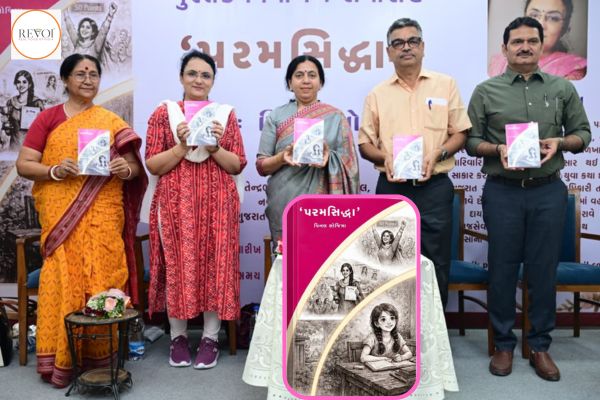
Ms Pinal Sojitra, a class-I government official working in the state secretariat at Gandhinagar has published her debut novel ‘Paramsiddha’. The novel arrived before a packed audience at the Jitendra Desai Memorial Hall of Navjivan Trust in Ahmedabad — and left its mark. There is a particular kind of commitment and courage required to write first novel while working in an intensive job with the state government, where the hours are long, responsibilities are considerable, and the inner life of a fictional young woman competes — daily — with the demands of the state.
The launch was no quiet, bibliophile affair. It drew senior academics, literary critics, government officials, and readers who had been waiting to see whether this new voice could deliver on its promise. By the evening’s end, the consensus was clear: it could, and it had.
The book was formally unveiled by Dr. Ami Upadhyay, Vice Chancellor of Dr. Babasaheb Ambedkar Open University — a fitting choice, given the novel’s preoccupation with gender, ambition, and the quiet violence of being born the wrong sex in a family that wanted a son. Dr. Upadhyay did not mince words in her assessment, calling Parmasiddha an “inspiring narrative of a daughter’s struggle and triumph” in precisely such a social landscape. Coming from the head of an institution named after India’s most celebrated champion of equality, the endorsement carried unmistakable weight.
“This novel is an inspiring narrative of a daughter’s struggle and triumph in a society still burdened by the mindset of ‘son preference’,” she said.
At the heart of the novel is Rishita — a young woman whom her creator describes as an authentic representative of the Gen-Z generation of the 2020s. She is not a heroine in the conventional, triumphant sense. She stumbles. She is rejected — by family expectations, perhaps by love, certainly by a world that had already decided what she was worth before she had a chance to prove it. But she rebuilds. The novel’s arc, as Sojitra described it, moves “from rejection to acceptance, from dependence to self-reliance, and from emotional brokenness to reconstruction.” In its quiet, insistent way, it is a manifesto.
The evening’s speakers were not merely ceremonial. Each brought a distinct lens to the novel. Renowned poet and critic Usha Upadhyay spoke in careful, admiring detail about the language of Parmasiddha — how Sojitra’s prose carries both intimacy and controlled strength, qualities rarely found together in a debut. “This is a writer…”, Upadhyay suggested, “…who did not arrive at fiction in a hurry; the emotional intelligence on the page took years of watching and listening to accumulate.”
Dr. Jayendrasinh Jadav, Mahamatra of the Gujarati Sahitya Akademi — the body that towers over Gujarati literary world — offered what amounted to a structural appreciation of the novel’s architecture. He spoke of how Sojitra connects one emotional moment to the next with a jeweller’s precision, building a cumulative world that the reader enters gradually and leaves reluctantly. In the context of Gujarati literary tradition, where craft is as prized as content, this was high praise indeed.
Dr. Shirish Kashikar, Director of NIMCJ, and senior Gujarat Government officer Pradeepsinh Rathod rounded out the evening’s literary conversation by placing the novel in a wider context, drawing threads between Parmasiddha and the preoccupations of world literature. Their argument was straightforward: the emotional terrain that Sojitra maps is that of identity, gender, healing, resilience and it is not merely that of Gujarati literature. It belongs to any literature that takes women seriously as subjects rather than supporting characters. They made the case, with enthusiasm, for why this novel deserves to be read well beyond Gujarat.
“Parmasiddha is the life journey of an ordinary girl becoming an extraordinary woman — a story of every young Indian woman finding her way back to herself,” said the author Pinal Sojitra. When the author herself finally spoke, the room was attentive. Sojitra described Parmasiddha in terms that were both personal and precise. It is, she said, “the life journey of an ordinary girl becoming an extraordinary woman.” The phrase sounds simple. It isn’t. In it lives the entire project of the novel, the insistence that ordinariness is not a deficit, that becoming is more interesting than having arrived, and that a young woman’s interior life is worth the full attention of literature.
Her protagonist, Rishita, was drawn, one suspects, from careful observation — of friends, of contemporaries, of a generation that has grown up online and offline simultaneously, negotiating aspiration and anxiety in roughly equal measure. Gen-Z women in India face a particular convergence of pressures: they are better educated and more ambitious than any generation before them, and yet they still routinely encounter a domestic world that views their ambitions as secondary. Rishita is a fictional answer to that contradiction.
What gives Parmasiddha its unusual credibility is who wrote it. Pinal Sojitra is not a full-time literary figure working in the comfortable margins of academia. She is a functioning Class-1 officer of the Gujarat government — a bureaucrat, in the best sense of the word: someone who deals, daily, in the governance machinery of a society. She knows, from the inside, how institutions shape lives; how policy, paperwork, and power interact with the very personal stories of ordinary people. That knowledge seeps, quietly, into the fiction.
The launch concluded, as good literary events tend to, with conversation that resisted ending — readers lingering, critics debating, the author surrounded by those who wanted to know what comes next. What comes next, for Gujarati literature, may be exactly this: a new generation of writers who bring professional lives, social awareness, and emotional intelligence to the page, and who write not despite their full lives but because of them.
Parmasiddha is available now. It is, by every account offered on the evening of its launch, a novel that earns its time.