


Manas Dasgupta
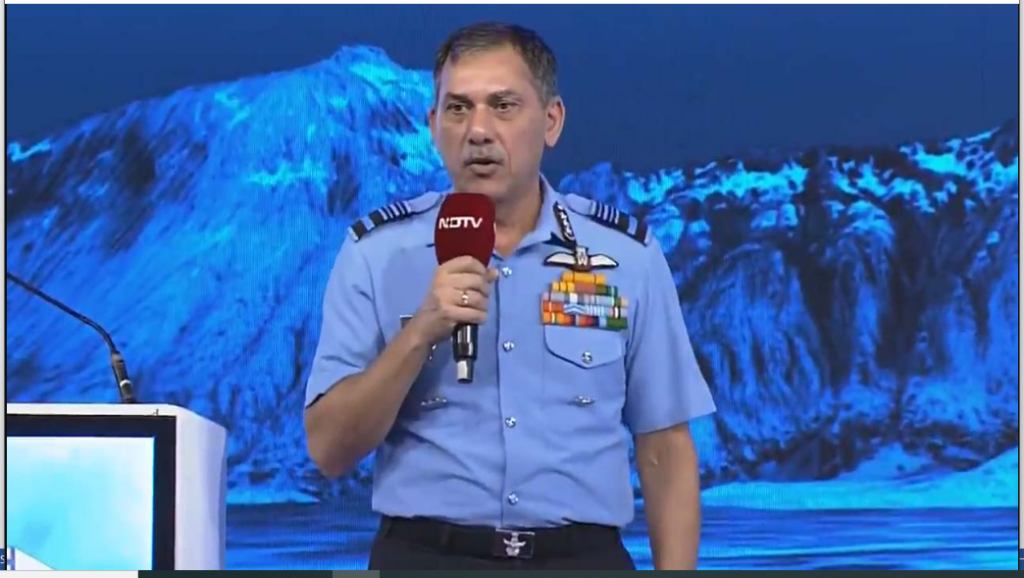
NEW DELHI, Aug 30: It took fewer than 50 weapons and missiles for the Indian Air Force to fire to bring Pakistan to its knees and compel the neighbouring country to beg for a ceasefire during the recent “Operation Sindoor,” Indi’s retaliatory response to the Pahalgam terror attack, the Vice Chief of the Indian Air Staff Air Marshal Narmdeshwar Tiwari said on Saturday.
Speaking a defence summit organised by a media house, he also said it was a big accomplishment for the Indian defence forces that in less than 50 weapons, it was able to achieve conflict elimination. “From the list of options presented, we had a large number of target sets. And finally, we boiled down to nine,” said Air Marshal Tiwari. “Key takeaway for us, that in less than 50 weapons, we were able to achieve conflict elimination. So this is the essential part which I want you to take away.”
He further said it was simple to begin a war, but much harder to finish one. “It is very easy to start a war, but not easy enough to end it. And that was an important consideration to keep in mind so that our forces were activated, they were deployed, and they were ready for any eventuality that would have come about,” he added.
He attributed the success to India’s Integrated Air Command and Control System (IACCS), which formed the backbone of both offensive and defensive operations. He explained that the system allowed India to absorb initial impacts and respond with a “hard-hitting reply” that compelled Pakistan to agree to de-escalation.
Earlier inaugurating the summit, the Defence Minister Rajnath Singh said the world was a witness to India’s defence capabilities. “The way our forces, with indigenous equipment, carried out precise strikes on their targets shows no mission can succeed without a vision, long-term prep, and coordination.” “Op Sindoor may seem like just a few days’ war, and a story of India’s victory and Pakistan’s defeat, but behind it lay years of strategic preparation and a long role of defence preparedness.”
Underlining a renewed push towards an ‘aatmanirbhar Bharat’ to boost the country’s military profile and might amid global economic and geopolitical challenges, Mr Singh said India’s warships would be made in India. The call-out to the Indian Navy comes days after the commissioning of two ‘made-in-India’ Nilgiri-class stealth frigates – INS Himgiri and INS Udaygiri – each with significant upgrades in weapon and sensor systems and capable of executing a full spectrum of maritime missions.
This level of indigenous development – 75 per cent of each of the new warships were designed locally – can only strengthen India’s strategic autonomy, the Defence Minister said. A particular highlight of Op Sindoor was also the use of indigenously developed air defence system modules that protected civilian and military assets from the storm of Pak missiles and drones.
The Defence Minister also touched on another aspect of increased in-house military development – revenue from export of weapons and weapons systems. “In 2014, our defence export was less than Rs 700 crore. Today it has increased to nearly Rs 24,000 crore, reaching a record level. This shows that India is no longer just a buyer… it is becoming an exporter.” “This very approach will keep us secure in the times to come and also secure us a leading position among the world’s emerging powers,” he said.
Highlighting the operational freedom the Indian armed forces was given by the government during “Operation Sindoor,” Air Marshal Tiwari said the Centre’s higher directives were threefold: punitive action had to be “visual and visible,” messaging had to deter future attacks, and the armed forces were to be given full operational freedom with preparations made for possible escalation into conventional war.
“The important aspect which worked in our favour was that we were given complete operational freedom to plan any response to enemy actions. And that was a big positive because that shortened our decision cycles. And as you would see in the future when things panned out, we were up to speed with events that were occurring in real time,” Air Marshal Tiwari said.
In the early hours of May 7, Indian Defence Forces launched precision strikes at nine terror camps in Pakistan and Pakistan-occupied Kashmir (PoK) under “Operation Sindoor” in response to the dastardly Pahalgam terror attack which claimed 26 lives.
In a late-night press statement on May 7, the Indian Defence Ministry said, “A little while ago, the Indian armed forces launched ‘Operation Sindoor’ hitting terrorist infrastructure in Pakistan and Pakistan-occupied Jammu and Kashmir from where terrorist attacks against India have been planned and directed.”
The strikes killed over 100 terrorists, including 10 family members of Jaish-e-Mohammed (JeM) chief Masood Azhar and four close aides. Targets included Jaish’s Markaz Subhan Allah in Bahawalpur, Sarjal camp in Tehra Kalan, Markaz Abbas in Kotli, and the Syedna Bilal camp in Muzaffarabad. Lashkar’s strongholds — Markaz Taiba in Murdike, Markaz Ahle Hadith in Barnala, and Shwawai Nalla camp in Muzaffarabad — were also hit. Hizbul Mujahideen’s facilities at Makaz Raheel Shahid in Kotli and Mehmoona Joya in Sialkot were among those targeted.
The operation sparked four days of cross-border fighting involving fighter jets, missiles and artillery. After four days of precision missile strikes, drone incursions, and artillery battles across the Line of Control (LoC), India and Pakistan agreed to halt all military actions on land, air, and sea, with effect from the evening of May 10. Hours later, Pakistani drones were sighted and intercepted in various locations in Jammu and Kashmir, including Srinagar, and parts of Gujarat.
India said Pakistan has violated the ceasefire, adding that the armed forces were giving an “adequate and appropriate response”. Foreign Secretary Vikram Misri, in a press briefing shortly after that, stressed that India takes “very, very serious notice of these violations.”
At dawn on May 10, IAF aircraft launched BrahMos-A (air-launched) cruise missiles targeting key Pakistan Air Force (PAF) bases. The first confirmed impacts were at Chaklala near Rawalpindi and Sargodha in Punjab province. Both installations hold strategic aviation and logistics value for the Pakistan military. Confirmation of strikes on additional bases in Pakistan and Pakistan-occupied Kashmir (PoK) – Jacobabad, Bholari, and Skardu – came only later in the evening after agencies concluded damage assessments through human and open source intelligence.
By the afternoon of May 10, after several of Pakistan’s more aggressive tactical postures had been repelled by India, Major General Kashif Abdullah, Pakistan’s DGMO, placed a direct call to his Indian counterpart, Lieutenant General Rajiv Ghai. The timing of the call, 1535 hrs IST, was later confirmed by Foreign Secretary Misri at a press briefing.