


Manas Dasgupta
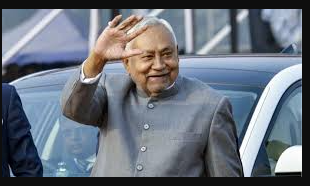
NEW DELHI, Mar 5: The Janata Dal (United) President Nitish Kumar, Bihar’s longest-serving Chief Minister with over two decades in office, is all set to move to the Rajya Sabha leaving Bihar to its alliance partner the BJP to rule for the remaining of the current five year term.
Mr Kumar on Thursday filed the nomination papers for the March 16 Rajya Sabha election making a big shift from the Assembly returning to Parliament after two decades of leading the Bihar government. Union Home Minister Amit Shah and Deputy Chief Ministers Samrat Choudhary and Vijay Sinha were with him.
Kumar announced the decision in a post on X this morning. He said he long harboured a wish to become a member of both Houses of Parliament and both Houses of the state legislature. He has already been a Lok Sabha MP, an MLA, and an MLC, and a Rajya Sabha stint would complete the quartet. The 75-year-old leader also affirmed that the new government in Bihar would have his complete backing.
The opposition parties hit out at Kumar, calling it “betrayal of people’ mandate” since Nitish’s exit means a BJP chief minister of Bihar. Tejashwi Yadav, the Leader of the Opposition in the state assembly, alleged that the BJP has consistently opposed Dalits and OBCs and claimed that with Kumar stepping down as CM, the party would attempt to push its agenda in what he described as a socialist stronghold of Bihar.
“The BJP has done a Maharashtra in Bihar. We have been saying from the very beginning that the BJP will not let Nitish Kumar remain the chief minister after the elections. This is exactly what has happened. This development is against the mandate of the people and amounts to a betrayal of it,” he stated.
“For the past two decades, you have trusted and supported me, and I have served you with full dedication. It is your trust and support due to which Bihar is setting new standards in development,” Mr Nitish Kumar wrote in his post on X. “Since the beginning of my parliamentary career, I had a desire in my heart to become a member of both Houses of state legislature, as well as both Houses of Parliament. That’s why I want to become a Rajya Sabha MP in the upcoming election,” Kumar wrote. “I assure you that my relationship with you will continue, and I will keep working for a developed Bihar. The new government will enjoy my full support and guidance.”
Kumar has been a member of the Assembly, the Legislative Council, and the Lok Sabha, but not the Rajya Sabha. This transition will help him achieve the rare record held by Lalu Yadav and Sushil Modi: membership in all four houses of the Indian parliamentary and state legislative system.
Bihar’s political circles are abuzz with speculation over which BJP leader would replace Nitish Kumar as the Chief Minister. The favourites are Deputy Chief Minister Samrat Choudhary, Union Minister Nityanand Rai and Bihar minister Dilip Kumar Jaiswal.
Choudhary, who also handles the key home portfolio, is among the most influential BJP leaders in Bihar and the Number 2 in the government. He has been a former state party chief. Nityanand Rai is the junior Home Minister in the central government. Also a former Bihar BJP chief, he is a three-term MP and a former MLA. Jaiswal is a three-time member of the legislative council and has also served as the Bihar BJP chief. Another name doing the rounds is Digha MLA Sanjiv Chaurasiya. The BJP, however, is known to spring surprises and it is highly probable that it might come up with a name not doing the rounds.
The Opposition has accused the BJP of carrying out a “political abduction” in Bihar, and said the core voter of the JD(U) feel cheated now. Manoj Kumar Jha, RJD’s Rajya Sabha MP, said the party’s leader Tejashwi Yadav had repeatedly said during the Assembly polls campaign last year that Nitish Kumar would be a “temporary Chief Minister.” “But this is too temporary. I read his post (on X). Don’t call it Nitish ji’s post. Each word has been chosen in Delhi,” he said implying that Kumar has taken the decision under pressure from the BJP. “A man who served as Chief Minister for 21 years now wants to come to Rajya Sabha. This is childish. At least, make a good argument,” Jha said.
Tejashwi Yadav accused the BJP of being against OBCs and Dalits and claimed that it did not want leaders from these communities to hold the top post and instead prefers a chief minister who would act as a rubber stamp for its central leadership. Using a metaphor to illustrate his point, he said that although Kumar had been made to mount the horse like a groom, someone else was being made to take the wedding vows, implying that the real authority lay elsewhere.
Nana Patole, a Congress MLA from Maharashtra, criticised the BJP, accusing it of “deceiving” its alliance partners after Kumar confirmed that he would file his nomination for the Rajya Sabha elections. Addressing reporters, Patole compared Kumar’s situation to that of Maharashtra Deputy Chief Minister Eknath Shinde, who did not return as Chief Minister after the Mahayuti alliance secured a majority in the 2024 Maharashtra Assembly elections.
He said, “Maharashtra is the biggest example of this. Elections were fought under the leadership of Eknath Shinde, and the government came to power, but Eknath Shinde did not become the Chief Minister. In Bihar, elections were fought under the leadership of Nitish Kumar; they (the BJP) won there as well… Now he is being removed from the post of Chief Minister. The BJP has always deceived its alliance partners,” he said.
Kumar first became Bihar’s Chief Minister in 2000, but his government fell within eight days. He returned to office in 2005 and remained in power until 2014, when he stepped down following the JD(U)’s poor performance in that year’s Lok Sabha elections. However, he was later sworn in again as Chief Minister. Most recently, he took the oath of office in November 2025. In Bihar though the BJP was the senior partner in the National Democratic Alliance (NDA).
The BJP solidified its electoral performance by emerging as the largest party in Bihar for the first time, winning 89 seats out of the 101 it contested during 2025 polls. The NDA won 202 seats in the 243-member assembly, delivering a landslide victory against the Rashtriya Janata Dal (RJD)-led Mahagathbandhan.
The sudden exit of Nitish Kumar from Bihar politics has caught many in the JD(U) by surprise, as they were of the view that his son Nishant Kumar would be sent to the Rajya Sabha and gradually step into his father’s shoes. The script changed on Wednesday afternoon, with a strong buzz that instead of his son, the CM would move to the Rajya Sabha.
The move might bring several uncertainties to Bihar politics. Voices in the state’s power corridors say that the first change is that the BJP, which is now likely to have its own CM, formally becomes the dominant partner of the NDA. The challenge for the JD(U) is to find a replacement for Kumar. Some feel that Nishant’s formal entry has been delayed and that he is a simple man, lacking his father’s political acumen.
In terms of optics, with Kumar in Delhi, Bihar politics will appear somewhat bipolar: the BJP versus the RJD. The JD(U) will have to prove that it can retain the social base carved out by Kumar comprising the Kurmis and a clutch of Extremely Backward Classes (EBCs), and the proof will come only in the next elections. Till then, a sense of bipolarity is expected, though the RJD’s poor performance last time suggests that the BJP may have the edge, to begin with.
The BJP is likely to replace Kumar with a Kurmi, Kushwaha or an EBC, something that makes observers suggest that Samrat Choudhary, a Kushwaha, is the likely frontrunner for the CM’s post, barring any surprise that the BJP may throw. A senior BJP leader said the JD(U) was likely to have “significant say” on the choice of the new CM. “From Samrat Choudhary to Vijay Kumar Sinha, there are several top contenders for the post; things will become clearer by the end of the day,” the leader said.
What marked Nitish Kumar out from other leaders was the fact that he held on to power irrespective of whether his party was the biggest in the state or not. In 2005, when he first became CM for a full term, the RJD had 75 seats, the JD(U) 55, and the BJP 37. In 2010, the JD(U) had 115 seats, the BJP 91, and the RJD 22. In 2015, when Kumar contested the polls in alliance with the RJD, the RJD had 80 seats, the JD(U) 71, and the BJP 53 seats. In 2020, when Kumar was again in the NDA, the RJD won 75 seats, the BJP 74, and JD(U) 43. In 2025, the BJP had 89 seats, the JD(U) 85, and the RJD 25.
Kumar has been the fulcrum of Bihar politics since he became CM for the second time in 2005, after a seven-day stint from March 3 to 10, 2000. The only brief period when he hasn’t been CM since November 24, 2005, was the 278-day stint of Jitan Ram Manjhi as CM in 2014-15.
Kumar held the key to power in the state and the alliance he joined always won the state elections. Deftly moving from one alliance to the other that saw five flip-flops in the last 11 years — he was given the moniker Paltu Ram — Kumar had an almost unbroken stint as CM for 20 years. His appeal to Bihar had two sides to it. Internally, he emerged as the champion of the EBCs and externally, at least his first two terms offered an image change to Bihar, with people outside the state widely perceiving him as someone who reversed what was called the RJD’s “jungle raj” and improved the state’s infrastructure.