


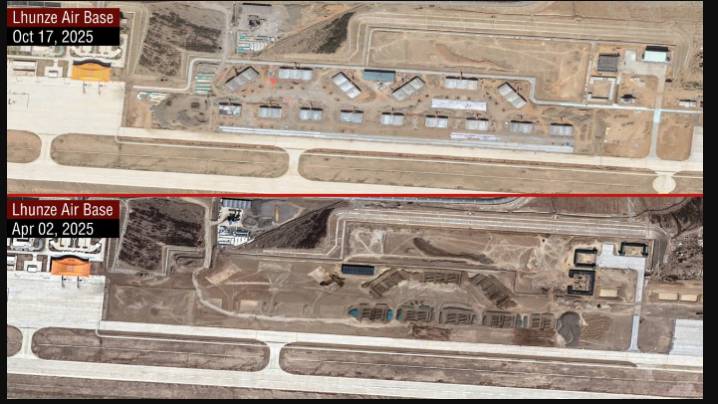
NEW DELHI, Oct 27: Amidst improvements in ties with China including resumption of direct flights between the two countries, India is saddled with a new concern, China completing construction of hardened aircraft shelters in Tibet across the borders with Arunachal Pradesh.
According to a report by NDTV, China has completed the construction of 36 hardened aircraft shelters, new administrative blocks, and a new apron at its Lhunze airbase in Tibet, about 40 kilometres north of the McMahon line – the boundary between India and China in Arunachal Pradesh.
The construction of the new hardened shelters at Lhunze, about 107 kilometres from the strategic town of Tawang in Arunachal Pradesh, gives China the option of forward-deploying fighter aircraft and a host of drone systems in its arsenal and drastically reduces the response time needed for the Indian Air Force to respond to any airborne threat from its own airbases across Arunachal Pradesh and Assam.
The report quoted Air Chief Marshal BS Dhanoa (retired), the former Indian Air Force chief, stating that the “Construction of 36 hardened aircraft shelters at Lhunze clearly indicates that during the next incident, their tactical fighters and attack helicopters operating in support of their army would be based in Lhunze.” He also said ammunition and fuel would have already been prepositioned in the underground tunnels in this area.
“I told my staff during the Doklam incident (in 2017) that the PLAAF’s (People’s Liberation Army Air Force) problem in Tibet is not aircraft but deployment. I had then prophesied that the day they start building hardened aircraft shelters in their airfields in Tibet would mean that they would be preparing for a war with us. Their key vulnerability in Tibet would get removed,” he added.
Air Marshal Anil Khosla, the former vice chief of the Indian Air Force, said the construction and upgrade of these airfields may support future Chinese war plans and represent a “serious strategic threat” to India, mainly when analysed in the context of recent geopolitical tensions, evolving Chinese military capabilities, and infrastructural patterns since the 2020 Galwan valley clashes.
”The upgrades at Lhunze carry profound implications for regional security, particularly in the context of ongoing India-China border standoffs since 2020 (like the Galwan Valley clash). The 36 hardened aircraft shelters enable the dispersal of assets, reduce vulnerability to concentrated attacks, and allow sustained operations in high-altitude conditions,” he said. Air Marshal Khosla said the hardened shelters protect against precision-guided munitions, Indian airstrikes, or missile barrages, making it “far more challenging to degrade the base early in a conflict.”
“Air Bases like Tingri, Lhunze, and Burang are located close to the Line of Actual Control (LAC), within 50-150 km. This proximity allows for the quick deployment of PLA Air Force assets to forward positions and shorter response times in case of a border escalation. These airfields enable coverage of Indian positions in Arunachal Pradesh, Sikkim, Uttarakhand, and Ladakh,” he said.
The new images from Vantor (formerly Maxar) also indicate the presence of a handful of CH-4 drones on the tarmac at Lhunze. The CH-4 Unmanned Aerial Vehicle is designed for high-altitude missions and can fire short-range air-to-surface missiles from altitudes beyond 16,000 feet, which makes it useful as an attack platform deployed in the high-altitude Tibet region. Featuring an electro-optical sensor turret, the CH-4 drone is commanded through a datalink with its ground controllers.
India’s most direct response to this drone threat will eventually start arriving in 2029 when the first General Atomics-manufactured Sky Guardian drones enter service with the IAF and Indian Army. The two forces will get eight drones each.
The Sky Guardian, a variant of the Sea Guardian, 15 of which are being acquired by the Indian Navy, is a part of an overall deal worth $3.5 billion. These US-built drones will be key in enhancing India’s intelligence, surveillance, and reconnaissance (ISR) capabilities across the Himalayas with the additional ability to carry out precision strike missions.
India’s armed forces are currently equipped with less capable Israeli-manufactured Heron and Searcher UAVs. Air Marshal SP Dharkar, also the former vice chief of the Indian Air Force, said the build-up of hardened aircraft shelters would be “challenging” for India.
“Over the years, we carefully watch development across our northern borders. We have historically taken some solace in the fact that geography, terrain, and the elevations that pertain to those regions gave us some slight advantage as regards the conduct of air operations. However, we now find that the fielding of modern and more capable platforms and the development of a greater number of airfields with larger infrastructure and longer runways is somewhat shrinking that advantage,” he said.
“We also now find that increasingly there is the build-up of hardened aircraft shelters and other hardened infrastructure that would now serve to be even more challenging for us in terms of the conduct of appropriate air operations in that zone,” Air Marshal Dharkar had said.
(Manas Dasgupta)