


Manas Dasgupta
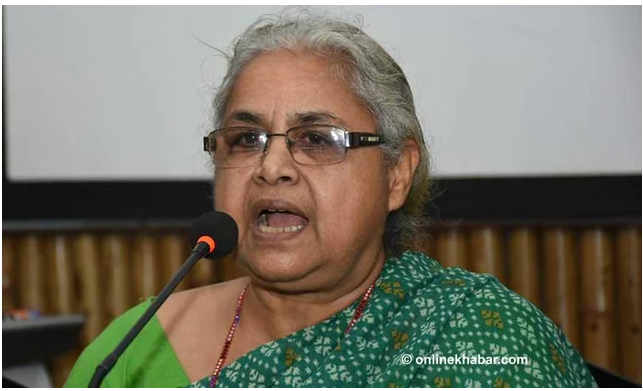
NEW DELHI, Sept 10: The former Chief Justice of Nepal Sushila Karki, known for her no nonsense attitude against corruption, would be the representative of the Gen Z protesters for negotiations with the Army on government formation as a semblance of normalcy returned to Kathmandu on Wednesday after two days of massive protests that turned violent taking a toll of 30 lives.
The protesters had arrived at the decision after a marathon 6-hour meeting this evening. The demands of the Gen Z protesters included immediate arrest and action against the then Prime Minister, Home Minister, and all involved in ordering mass killings, drawing up a new constitution which would have provision preventing anyone from becoming Prime Minister for more than two terms, immediate cancellation of politically influenced appointments in constitutional bodies like CIAA and judiciary and merit-based appointments.
Sushila Karki is Nepal’s first woman Chief Justice who was known for her zero-tolerant attitude to corruption. Ms Karki had completed her BA from Mahendra Morang Campus and her MA in Political Science from the Banaras Hindu University. Later she graduated in law from Tribhuvan University and started a career in teaching.
Then shifting to law, she became a senior advocate and was appointed the Chief Justice. Appointed on July 11, 2016, she had presided over multiple high-profile anti-corruption cases. During her tenure, then Information and Communication Minister Jaiprakash Prasad Gupta was convicted in a corruption case. She had also given a bold verdict against Lokman Singh Karki, the former Chief Commissioner of Nepal’s Commission for Investigation of Abuse of Authority. In 2017, she had faced an impeachment attempt from then Maoist-led government but the motion withdrawn after backlash from the public and the judiciary.
“This government should step down… These leaders are out of date. They have no vision, no education. Maybe they have certificates, but they do not seem educated,” she had said in a recent interview. “I am supporting this movement from today. Not yesterday, but today. Because these people killed our children. See, 19 people are dead. What is the condition of their mothers and fathers?” she had added.
Nepal is facing political uncertainty after its Prime Minister, KP Oli, resigned on Tuesday following widespread anti-corruption protests, triggered by a social media ban. The protests had started on September 8 in Kathmandu and other major cities, including Pokhara, Butwal, and Birgunj, after the government imposed a ban on major social media platforms, citing concern about revenue and cybersecurity.
They had demanded that the ban on social media platforms be scrapped, seeing it an attempt to suppress free speech. But the focus of the protests soon broadened, with the people calling for an end to institutionalised corruption and favouritism in governance. The situation escalated soon and at least 30 people were killed and 500 were injured in clashes with security forces. A curfew is now in place in several cities, including Nepal capital Kathmandu, to control the situation.
The call for the talks came late on Tuesday after President Ram Chandra Paudel accepted the resignation of the Prime Minister Oli. But shortly after, he quit, coming under the pressure of the protesters who demanded the dismantling of the government. In Nepal, the President heads the government, not the Prime Minister.
The Nepal Army took charge of the security on Tuesday night with military personnel deployed across the capital. Over the past two days, protest demonstrations escalated quickly into violence and the storming of government buildings.