


Manas Dasgupta
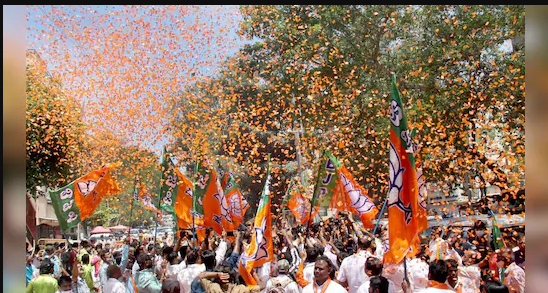
NEW DELHI, Nov 14: The ruling National Democratic Alliance (NDA) is all set to register a landslide victory in the Bihar Assembly elections, perhaps even beyond the expectations of most optimistic leaders, totally annihilating the opposition “Mahagathbandhan” on its way to retain power in the state.
The counting of votes for the two-phased Assembly elections was taken up on Friday and even as the final results of more than 200 seats are still to be officially announced, the counting trends placed the NDA at winning 204 seats in the 243-member state Assembly leaving a meagre 34 seats for the “Mahagathbandhan” with “others” including the AIMIM, expected to win only five seats.
The poll strategist Prashant Kishor, who was successfully strategizing for the victory of other parties in various elections in the past, when it came to his own party failed to read the pulse of the people in his home state. The Jan Suraaj Party (JSP) launched by him with much fanfare a few months back and was hoping to upstage both the NDA and “Mahagathbandhan” failed to even open its account despite contesting all the 243 seats.
The outcome of the elections in terms of the number of seats won by each contesting party, however, was not in commensurate with the percentage of votes each of the blocs received. According to preliminary reports, the NDA received a vote share of about 47 per cent and won 204 seats while the “Mahagathbandhan’s vote share was about 37 per cent, just about 10 per cent less than the NDA, but could win a meagre 34 seats.
More shockingly, the “Mahagathbandhan” leader Rashtriya Janata Dal (RJD) alone had a share of 22.79 per cent votes, about two per cent more than the BJP’s share of 20.52 per cent, and about three per cent more than the chief minister Nitish Kumar’s Janata Dal (United) which received 18.99 per cent of the total votes polled.
But in terms of number of seats won by each party, while the RJD bagged only 25 seats, the BJP is set to win 92 and the JD(U) 84 seats. It was also the RJD’s second worst poll results, just marginally up from 22 seats it could win in 2010 Assembly elections, though its main leader and the chief ministerial face of the “Mahagathbandhan,” Tejashwi Prasad Yadav, himself came from behind to retain his Raghopur seat.
Summing up the situation, the CPI(ML) General Secretary Dipankar Bhattacharya said the Bihar election results did not correspond to the ground reality in the state. He said it was inexplicable how a government in power for two decades was repeating its 2010 performance. “The results are absolutely unnatural; it does not correspond at all to the ground reality of Bihar,” Mr Bhattacharya said.
The NDA’s massive victory is credited to a multiple of factors, particularly the unified approach of the alliance on its governance record, the cultivation of women as a dependable support base through welfare measures, and a high degree of micro-management by Union Home Minister Amit Shah on issues that could otherwise have derailed the campaign.
The collapse of the Indian National Developmental Inclusive Alliance (INDIA) bloc in Bihar prompted the Opposition leaders to revive the debate on vote chori (theft) and the special intensive revision of the electoral rolls in the State, while the Prime Minister Narendra Modi claimed it was a “victory of good governance.”
“The victory of good governance, the victory of development has been achieved. The victory of the spirit of public welfare has been achieved. The victory of social justice has been achieved,” Mr Modi said while congratulating the NDA leaders for the massive victory. Mr Amit Shah saluted the voters of Bihar. “This is a mandate for women’s safety, good governance, and welfare of poor in Bihar. This resounding mandate is people’s seal of approval on NDA’s commitment to serve for development in Bihar,” Mr Shah said.
The “Mahagathbandhan” (MGB) performance reveals a curious stagnation. Despite incorporating smaller parties such as the Vikassheel Insaan Party (VIP), targeting the Mallah community, and the Indian Inclusive Party, aimed at the Tanti-Paan community (listed among the Extremely Backward Classes), the alliance could not improve upon its 2020 vote share of 37.23%. The promised arithmetic of caste-based mobilisation failed to translate into additional votes.
In contrast, the NDA registered a remarkable surge, increasing its vote share by nearly 10 percentage points. This was largely driven by the return of the Lok Janshakti Party (Ram Vilas) to the NDA fold, which alone contributed 5.5% of the votes. Additionally, the BJP and the JD(U) each expanded their vote shares by 1.5 and 3 percentage points respectively.
The JD(U)’s gains merit particular attention. The party benefited from two reinforcing factors: transferable votes from LJP (RV) supporters, which in 2020 had fielded candidates exclusively against JD(U) nominees under Chirag Paswan’s leadership, and a surge in women voters, many of whom favoured the party, likely influenced by its welfare schemes targeted at women.
Bihar’s political landscape has historically been characterised by fragmentation, with multiple parties competing vigorously across constituencies. This meant that vote shares translated inefficiently into seat shares, as votes were dispersed across multiple contestants.
A decisive shift began with the 2019 Lok Sabha elections, when the consolidation of Bihar’s political forces into two principal alliances, the NDA and the MGB, dramatically reduced fragmentation. The 2024 Lok Sabha elections demonstrated the electoral potency of consolidated alliances. With LJP (RV) back in the NDA fold and facing the same alliance structure that would persist into 2025, the NDA reaped the benefits of this consolidation, dominating in Assembly segments across the state.
The JSP’s performance proved decisive in shaping the final outcome. Securing 3.5% of the vote, the party—along with the All India Majlis-e-Ittehadul Muslimeen (AIMIM)—split the anti-incumbency vote. The MGB’s vote share declined from the 40.1% it registered in the 2024 Lok Sabha elections to 37.3% in 2025, a drop of 2.8 percentage points, closely mirroring the JSP’s vote share.
In a fragmented party system, such vote splits might have limited consequences. But in a bipolar contest operating under first-past-the-post rules, even small vote share differences translate into disproportionate seat gains for the leading alliance.
The NDA has built a more diverse coalition based on caste identities: The BJP has consolidated its support among the upper castes. The JD(U) stitched together support from the EBCs, non-Yadav OBCs, and “Mahadalits” besides targeting women as a category. The LJP(RV) catered to the Pasi and other Dalit communities, while smaller parties attracted votes from the Dalit and Koeri communities. The MGB’s counter mobilisation — the RJD’s Yadav-Muslim base, and the Congress’ and the Left’s eclectic support — was not numerically enough to overcome this, the poll analysts believe.