


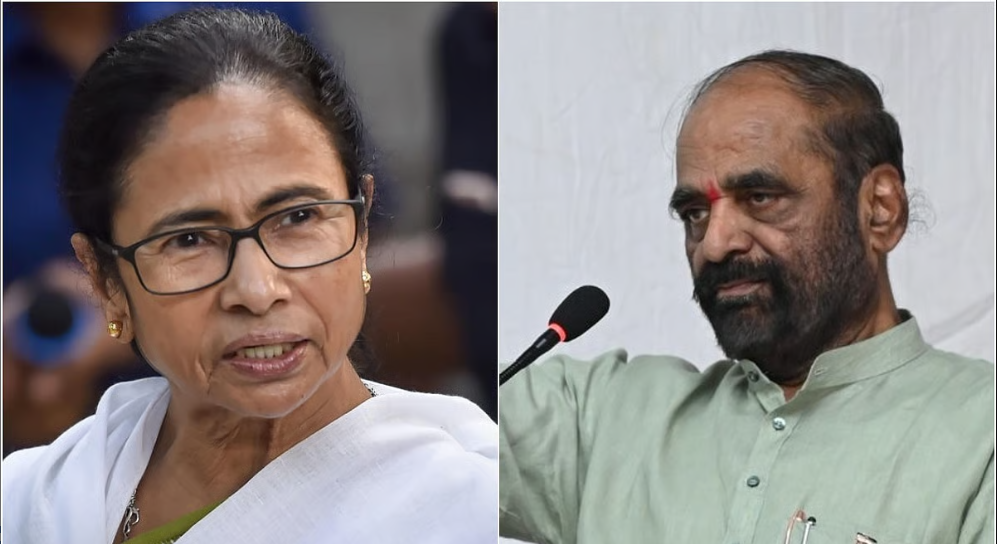
NEW DELHI, Dec 3: Even as the Supreme Court is hearing matters related to increasing share of Muslims in West Bengal’s OBC List, the National Commission for Backward Classes (NCBC) has recommended to the Union government to exclude 35 communities from the State’s Central OBC list, most of which are Muslim.
“This recommendation was made in continuation of the NCBC’s scrutiny of West Bengal’s OBC list in light of a high number of Muslim communities being listed as OBCs. Most of the communities in the list of 35 recommended for exclusion are such Muslim communities. One or two of them may be non-Muslim communities,” said Hansraj Gangaram Ahir, who was the chairman of the NCBC till Monday when his tenure ended. West Bengal is just few months away from its next Assembly election.
The Union Social Justice Ministry had informed Parliament this week about the NCBC’s recommendation to exclude 35 communities from the Central OBC list of West Bengal. Mr Ahir, however, refused to specify the communities recommended for exclusion, saying: “That is a matter for the government to decide.”
The recommendation to exclude these communities came months after the NCBC initiated a probe into 37 communities included in the Central OBC list of West Bengal in 2014, just ahead of the Lok Sabha elections. Of these, 35 were Muslim communities. Responding to direct questions about the NCBC’s scrutiny of these 37 communities in Lok Sabha, the Social Justice Ministry had said on Tuesday that 35 communities had been recommended for exclusion from West Bengal’s Central OBC list.
The government said the NCBC tendered its advice on the exclusions in West Bengal in January this year. As per the modalities of inclusion and exclusion of communities from Central OBC lists, any advice of the Commission must be signed by the Chairperson, Vice-Chairperson, and all Members. However, at the time this advice was tendered, the Commission had just a Chairperson and one Member, and no Vice-Chairperson.
The 102nd Constitution Amendment Act prescribes that once advice has been received from the NCBC, the government is required to pass any changes to the Central OBC lists in Parliament so that the President can notify the amended lists. Government sources said the Social Justice Ministry was currently in possession of NCBC advice for inclusion and exclusion in Central OBC lists of nine States.
Ever since Mr Ahir took charge in December 2022, the Commission has focused on scrutinising OBC lists in States such as West Bengal, Karnataka, and Kerala. This began with a field trip to West Bengal in February 2023, following which Mr Ahir raised the issue of a “high number of Muslim communities” in the State OBC lists there.
The NCBC’s scrutiny of OBC lists in Opposition-ruled States like West Bengal and Karnataka eventually also fed the ruling BJP political rhetoric that the Opposition parties had been appeasing Muslims just ahead of the 2024 Lok Sabha elections.
On Wednesday, BJP leader Amit Malviya shared the response of the Social Justice Ministry on social media, and claimed that all 35 communities recommended for exclusion were Muslim, further attacking Chief Minister Mamata Banerjee over her government’s “regressive politics.” Mr Malviya argued that the Narendra Modi-led government at the Centre was “correcting decades of appeasement-driven distortions and ensuring true social justice based on backwardness, not vote-bank politics.”
For the last one year or so, the NCBC has been focused on triggering a pruning of State OBC lists in a bid to re-evaluate the continued inclusion of communities that might have progressed due to years of accruing benefits.
This exercise has led the Commission to now question the “abundance” of Muslim communities in the OBC lists in Karnataka and West Bengal and has also taken up the task of reviewing the OBC lists of Kerala, Odisha, Bihar, Maharashtra and other States, where it also intends to ensure that the maximum available OBC reservation within the 50% limit is granted.
And while the NCBC repeatedly asks States to justify continued inclusions in their OBC lists, it faces a singular hurdle — that of absent data on current socio-economic conditions of OBCs — and is pressing on States like West Bengal and Karnataka to produce this information. The Congress’ key social justice plank for the ongoing elections has been the promise of a nation-wide socio-economic caste census.
(Manas Dasgupta)