


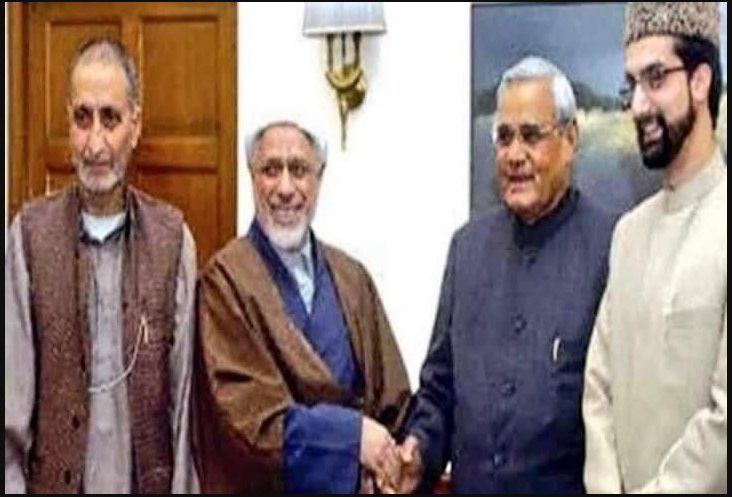
NEW DELHI, Sept 19: Yasin Malik, the convicted terrorist and separatist leader, and leader of the banned group Jammu and Kashmir Liberation Front (JKLF), has made a series of claims in a detailed affidavit filed before the Delhi High Court, which include past engagements with big political figures and religious leaders.
According to a report in the NDTV which claims to have access to the affidavit, Malik’s signed document read like a chronicle of Malik’s interactions over two decades, recounts high-level dialogues involving two Shankaracharyas, extensive contact with leaders of the Rashtriya Swayamsevak Sangh (RSS), meetings with Indian intelligence officials, and his alleged role in supporting former Prime Minister Atal Bihari Vajpayee’s 2000-01 Ramzan ceasefire.
These are Malik’s assertions in court. None of the leaders or the organisations that he has mentioned have acknowledged or issued any responses. One of Malik’s central claims is that at least two Shankaracharyas from different maths visited his residence in Srinagar “umpteen numbers of times” and even held a press conference alongside him.
“Two Shankracharyas hailing from two different maths had separately visited my residence in Srinagar, not once but umpteen numbers of times and also held a press conference with me. Isn’t it intriguing and a point to ponder over, that instead of keeping someone like me at bay, such representatives of the majority community decided to associate their good name with someone facing such grave and heinous allegations?” Malik claims in the affidavit. Malik did not specify the names of the Shankaracharyas or the dates of these visits.
Malik also mentions a “marathon” five-hour meeting with RSS leaders at the India International Centre in New Delhi in 2011. The meeting, he claims, was facilitated by the Centre for Dialogue and Reconciliation (CDR), a Delhi-based think tank. He adds that Admiral KK Nair, then chairperson of the Vivekananda International Foundation, invited him on multiple occasions for “luncheons” both at Mr Nair’s residence and at the India International Centre.
“Again, the question arises that instead of keeping an arm’s length distance from me or rather not touching someone like me with a ten-foot pole, be it RSS’s leadership or even RSS Organisation’s think tank Vivekananda Institute’s chairperson Admiral KK Nair frequently invited me to his residence in New Delhi for luncheons and also at India International Centre,” Malik claimed in the affidavit.
Malik then goes on to mention his purported role during former Prime Minister Atal Bihari Vajpayee’s announcement of a unilateral Ramzan ceasefire in 2000-01. Malik says he met Ajit Doval in Delhi, who introduced him to then-IB Director Shyamal Dutta and National Security Adviser Brajesh Mishra. Both, he claims, told him that the Prime Minister was serious about resolving the Kashmir issue and urged him to support the ceasefire.
Another track of engagement, according to Malik, was led by RK Mishra, a close aide of PM Vajpayee, who allegedly hosted Malik at his residence in Delhi’s Vasant Vihar and arranged a breakfast meeting with Brajesh Mishra.
Malik claims he contacted JKLF General Secretary Rafeeq Darr in Pakistan-occupied Kashmir (PoK) and arranged a call with United Jihad Council (UJC) chief Syed Salahuddin. He urged Salahuddin to welcome the ceasefire, with the caveat that it must be followed by unconditional dialogue. According to Malik, Salahuddin agreed to consult the UJC leadership.
On the Hurriyat front, Malik says he called Prof Abdul Gani Bhatt to convene an executive council meeting. The next day, leaders including Syed Ali Shah Geelani, Abdul Ghani Lone, Mirwaiz Umar Farooq, Abbas Ansari, and Malik himself issued a joint statement supporting PM Vajpayee’s ceasefire — again with the rider that talks should follow. Malik claims this was coordinated with UJC leaders via a phone call from Muzaffarabad in Pakistan-occupied Kashmir during the meeting. He argues that the process created a “positive atmosphere” in Kashmir.
According to Malik, both PM Vajpayee and then Home Minister LK Advani supported his peace initiatives and in 2001 issued him a passport for the first time in his life. He says he travelled openly on valid visas to the United States, United Kingdom, Saudi Arabia, and even Pakistan, speaking on “non-violent democratic peaceful struggle” and the resolution of Kashmir through dialogue. “It was the first time in my life to have a passport to travel abroad,” he writes in the affidavit.
(Manas Dasgupta)