


Manas Dasgupta
NEW DELHI, Sept 20: Amidst the US president Donald Trump imposing a 10-fold increase in H-1B worker visa fees to crackdown on immigration, the Prime Minister Narendra Modi on Saturday underlined the importance of self-reliance stating that biggest enemy for India would be depending on other countries.
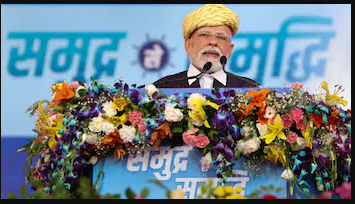
He was addressing a public meeting in Bhavnagar in his home state of Gujarat after virtually inaugurating and laying the foundation stone of multiple development projects worth more than ₹34,200 crore in the maritime sector and other projects in Gujarat.
Mr Modi said nobody in the world could be considered a major enemy of the country. “We have no major enemy in the world. If we have an enemy, it is the dependence on other countries.” “If we have to defeat that enemy and see that our 140 crore people are not left at the mercy of other countries and they live with pride, we have to become ‘Atma Nirbhar’ by 2047,” he said.
He went ahead to say that every shop should sell products that are totally ‘Swadeshi’. “We have to become completely self-reliant and self-sufficient,” he said. The event ‘Samundar se Samridhi’ (Transforming Maritime Sector) was jointly hosted by Make in India, Ministry of Ports Shipping and Waterways, Gujarat Government and Gujarat Maritime Board.
In his speech, PM Modi focused on encouraging India to strive for a Aatmanirbhar Bharat (self-reliant India). He also highlighted the government’s efforts in the maritime sector and the potential India has. He also noted that the “greater the foreign dependence, the greater, the nation’s failure,” calling attention to the significance of self-reliance in India.
Talking about the wide variety of products that need to be made in India, PM said, “From chips to ships, we must make everything.” He also noted that self-reliance is essential to maintain peace, stability and wealth, especially in the country with the highest population in the world. “There is only one medicine for all problems of India and that is atmanirbharta (self-reliance),” he said.
He also talked about the Indian ports that act as the “backbone of the nation.” The prime minister said his government had taken a historic decision to strengthen India’s maritime sector by recognising large ships as infrastructure. “India’s ports are the backbone of our nation’s rise as a global maritime powerhouse,” he asserted.
He also gave examples of the huge potential for self-reliance in, India, citing the example of INS Vikrant, made from steel in India. “More than 40 ships and submarines have been introduced, and except for a few, all of them have been made in India,” he said.
Underscoring that India has never lacked capability, Mr Modi remarked that after independence, the then ruling party consistently ignored the country’s inherent strengths. “As a result, even after six to seven decades of freedom, India could not achieve the success it truly deserved,” he said.
The Prime Minister identified two major reasons for this: prolonged entanglement in the license-quota regime and isolation from global markets. He added that when the era of globalisation arrived, the then ruling governments focussed solely on imports, which led to scams worth thousands of crores.
Talking about the maritime sector, Mr Modi remarked that India was historically a leading maritime power and one of the world’s largest shipbuilding hubs. Ships built in India’s coastal States once powered domestic and global trade. Even fifty years ago, India used domestically built ships, with more than 40% of import-export conducted through them.
But the sector later fell victim to their misguided policies and instead of strengthening domestic shipbuilding, they preferred paying freight to foreign vessels. This led to the collapse of India’s shipbuilding ecosystem and forced dependence on foreign ships. As a result, the share of Indian ships in trade dropped from 40% to just 5%. The Prime Minister emphasised that today, 95% of India’s trade relies on foreign ships — a dependency that has caused significant loss to the nation.
Stating some facts he pointed out, today, India pays nearly $75 billion — approximately six lakh crore Rupees — every year to foreign shipping companies for shipping services, which is close to India’s current defence Budget. “Just imagine how much money has been paid as freight to other countries over the past seven decades and the outflow of funds has created millions of jobs abroad,” he said.
He also said reforms would be introduced related to the documentation on Indian ports. He said a historic decision had been taken to strengthen India’s maritime sector, the government now recognises large ships as infrastructure sector and this will transform the sector. He announced that from today, all major ports in the country will be freed from multiple documents and fragmented processes. The implementation of ‘One Nation, One Document’ and ‘One Nation, One Port’, this will simplify trade and commerce.
“If we can revive the ancient glory of being top ship builders, it will have a chain reaction, as ship building industry, is not just an industry, it brings in other industries under its fold and generates huge employment. It is the ‘Mother of all Industries’,” he said.
He informed that more than ₹70,000 crore would be invested in these schemes in the coming years. Noting that in the past eleven years, India has doubled its port capacity, he highlighted that prior to 2014, the average ship turn-around time in India was two days, whereas today it has been reduced to less than one day.
He remarked that recently, India’s first deep-water container trans-shipment port has commenced operations in Kerala. Additionally, the PM announced that the Vadhavan Port in Maharashtra is being developed at a cost exceeding ₹75,000 crore, and it will rank among the top ten ports in the world.
He informed that large ports are being developed across the country to accommodate large vessels, and connectivity is being enhanced through initiatives such as Sagarmala. Mentioning that India currently accounts for 10% of global maritime trade, the PM emphasised the need to increase this share and declared that by 2047, India should aim to triple its participation in global sea trade.
The Prime Minister emphasised the importance of preserving and showcasing this heritage for future generations and the world. He announced that a world-class maritime museum is being developed at Lothal, which, like the Statue of Unity, will become a new symbol of India’s identity.
Mentioning that he arrived in Bhavnagar at a time when the auspicious festival of Navratri is about to begin, Mr Modi stated that due to the reduction in GST, markets will witness increased vibrancy and festive enthusiasm. In this celebratory atmosphere, the Prime Minister highlighted that the nation is celebrating a grand festival of Samudra se Samriddhi. He emphasized that 21st-century India views the ocean as a major avenue of opportunity. Mr Modi informed that projects worth thousands of crores have just been inaugurated and foundation stones laid to accelerate port-led development. He added that to promote cruise tourism, the International Cruise Terminal in Mumbai has also been inaugurated on Saturday. The Prime Minister noted that development projects linked to Bhavnagar and Gujarat have also commenced.
In a major boost to the maritime sector, Prime Minister inaugurated and laid the foundation stone for multiple development projects related to the maritime sector worth over Rs 34,200 crore. He inaugurated the Mumbai International Cruise Terminal at Indira Dock. He laid the foundation stone of a new container terminal and associated facilities at Syama Prasad Mookerjee Port, Kolkata; new container berth, cargo handling facilities, and associated developments at Paradip Port; the Tuna Tekra Multi-Cargo Terminal; firefighting facilities and modern road connectivity at Kamarajar Port, Ennore; coastal protection works including sea-walls and revetments at Chennai Port; sea-wall construction at Car Nicobar Island; a multi-purpose cargo berth and Green Bio-Methanol Plant at Deendayal Port, Kandla; and ship repair facilities at Patna and Varanasi.
In line with his commitment to holistic and sustainable development, Prime Minister inaugurated and laid the foundation stone of multiple projects of the central and state government, worth over Rs 26,354 crore, catering to various sectors in Gujarat. He inaugurated HPLNG Regasification Terminal at Chhara Port, Acrylics & Oxo Alcohol Project at Gujarat IOCL Refinery, the 600 MW Green Shoe Initiative, PM-KUSUM 475 MW Component C solar feeder for farmers, the 45 MW Badeli Solar PV Project, complete solarization of Dhordo village among others. He laid the foundation stone of LNG infrastructure, additional renewable energy projects, coastal protection works, highways, and healthcare and urban transport projects, including expansions at Sir T. General Hospital in Bhavnagar, Guru Govind Singh Government Hospital at Jamnagar, and the four-laning of 70 km of national highways.