


Manas Dasgupta
NEW DELHI, Oct 31: The Prime Minister Narendra Modi on Friday claimed that the first Home Minister of India Sardar Vallabhbhai Patel wanted to unite the entire Kashmir, just as he did with other princely states, into India, but the then Prime Minister Jawaharlal Nehru did not allow it to happen.
“Sardar Patel believed that one should not waste time writing history but we should work hard to create history,” Mr Modi said, addressing a gathering after the “Rashtriya Ekta Diwas” parade near the Statue of Unity of Sardar Patel in Ekta Nagar in Kevadiya Colony in the Iron Man’s home state of Gujarat.
“Sardar Patel wanted to unite the entire Kashmir, just as he did with other princely states. But Nehru ji stopped his wish from being fulfilled. Kashmir was divided, given a separate Constitution and a separate flag – and the nation suffered for decades because of Congress’ mistake,” Mr Modi said.
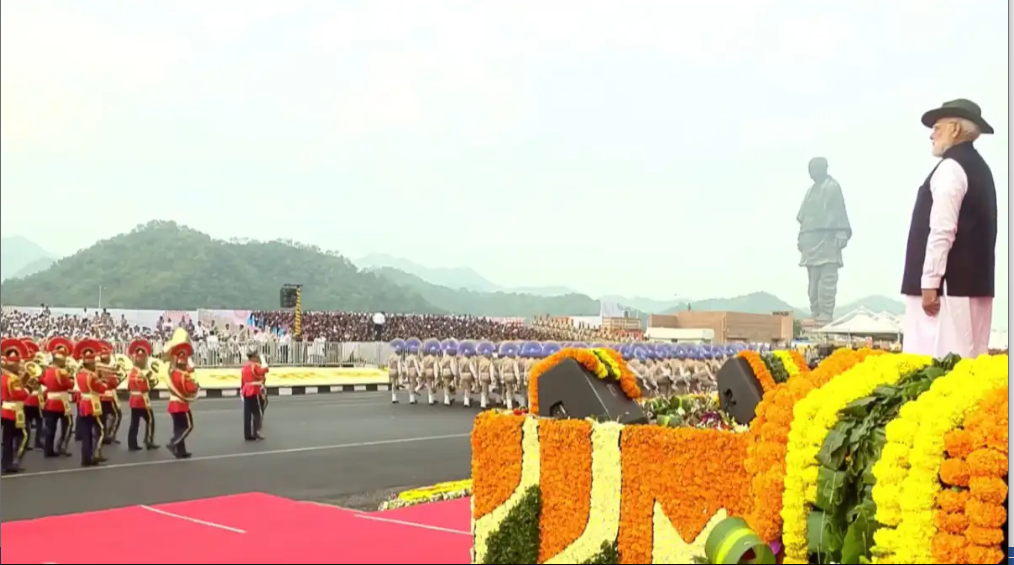
PM Modi arrived at Patel’s 182-metre-tall statue in Narmada district in the morning and paid his respects to the Iron Man of India by offering flower petals. The policies that Sardar Patel formulated, the decisions he took, created new history, the PM said.
“After Independence, the impossible task of uniting more than 550 princely states was made possible by Sardar Patel. The idea of One India, Excellent India, was paramount for him,” Mr Modi said. “Sardar Patel once remarked that his greatest joy came from serving the nation. I want to convey to the people of our country that there is no greater source of happiness than dedicating oneself to the service of the nation,” he said.
Before his address, Mr Modi reviewed the National Unity Day parade in which contingents from police and paramilitary forces took part. Women officers commanded all the contingents, including paramilitary forces like BSF, CISF, ITBP, CRPF and SSB, and police contingents from Jammu & Kashmir, Punjab, Assam, Tripura, Odisha, Chhattisgarh, Kerala, Andhra Pradesh, Maharashtra and Madhya Pradesh. A contingent of the National Cadet Corps (NCC) also participate in the parade.
One of the major attractions of this year’s celebrations was the ‘Republic Day-style’ parade of the armed forces along with decorative tableaux. The parade featured 10 floats from NSG (National Security Guard), NDRF (National Disaster Response Force), Gujarat, Jammu and Kashmir, Andaman and Nicobar Islands, Manipur, Maharashtra, Chhattisgarh, Uttarakhand and Puducherry, depicting the theme ‘Unity in Diversity.’
On the parade route, a cultural programme featuring 900 artists showcased India’s classical dances, representing the richness and diversity of Indian culture. In a display of women’s empowerment in the security forces, PM Modi received a ceremonial salute from contingents of police and paramilitary forces, all of them led by women officers.
Key attractions of this year’s parade included a BSF marching contingent, composed exclusively of Indian breed dogs such as Rampur Hounds, Gujarat Police’s horse contingent, Assam Police’s motorcycle daredevil show, and BSF’s camel contingent and camel-mounted band.
The parade also honoured five Shaurya Chakra awardees of the CRPF and 16 gallantry medal winners of the BSF who displayed exceptional courage in anti-Naxal operations in Jharkhand and counter-terror operations in Jammu and Kashmir. The Indian Air Force presented a fly-past under ‘Operation Surya Kiran.’
In New Delhi paying tributes to Sardar Patel, the Union Home Minister Amit Shah said Mr Modi fulfilled the Iron Man of India’s dream of a unified India by abrogating Article 370 in Jammu and Kashmir. Flagging off the ‘Run for Unity’ on the 150th birth anniversary of the country’s first Home Minister at the Major Dhyan Chand National Stadium, Mr Shah said after India’s independence, the British decided to leave the country divided into 562 princely States.
“At that time, the entire world thought that it would be impossible to unite these 562 princely states into one nation. However, within a short span of time, Sardar Patel accomplished the monumental task of integrating all 562 princely states and the map of modern India that we see today is the result of his vision and efforts,” he said.
The Home Minister said some provinces were reluctant to integrate but Sardar Patel addressed every issue with determination. But because of Article 370, Jammu and Kashmir was not fully integrated into India so Prime Minister Narendra Modi accomplished the work of Sardar Patel by abrogating the Article and now we have ‘Akhand Bharat’ with us, Mr Shah said.
He said Congress Governments did not give adequate regards to Sardar Patel who was the architect of unified India and added that even a great personality like Sardar Patel was awarded the Bharat Ratna after a delay of 41 years.
“Neither a memorial nor a monument was built anywhere in the country. It was only when Narendra Modi became the Chief Minister of Gujarat that he conceptualised the Statue of Unity and built a grand memorial in Sardar Patel’s honour. He pointed out that the foundation stone of the Statue of Unity was laid on the Sardar’s birth anniversary day in 2013.
The 182-metre-tall statue was completed in just 57 months using the iron from the farmers’ tools collected from across the country, he said. He said that these tools were gathered and melted down to produce nearly 25,000 tonnes of iron used in the statue’s construction. “Using 90,000 cubic metres of concrete and over 1,700 tonnes of bronze, this unforgettable monument was created, which has now become an iconic site for paying tribute to Sardar Patel,” he said.
With over 2.5 crore visitors from India and abroad, Mr Shah said the Statue of Unity has emerged as a true marvel of Indian engineering. Earlier, he offered floral tributes at the statue of Sardar Patel at Patel Chowk.
In an early morning message posted on social media platform ‘X’, Mr Shah paid homage to the ‘Iron Man’ Sardar Vallabhbhai Patel calling him a symbol of “national unity, integrity, and the empowerment of farmers.” “Sardar Sahab strengthened the unity and security of the country by integrating the princely states and advanced the nation toward self-employment and self-reliance by connecting farmers, backward classes, and the deprived with cooperatives,” he said in his message.
Mr Shah said his (Patel’s) firm belief was that the axis of the country’s development lies in the prosperity of farmers. “He remained dedicated throughout his life to the welfare of farmers and the protection of their rights. It is the duty of every patriot to safeguard the nation that Sardar Sahab built, bound by the principles of justice and unity,” he said.
The Modi government has been observing October 31 as ‘Rashtriya Ekta Diwas’ or National Unity Day since 2014 to foster and reinforce its commitment to preserving and strengthening the nation’s unity, integrity, and security.