


Manas Dasgupta
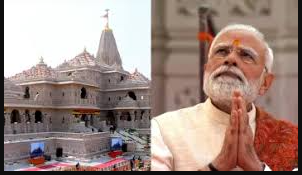
NEW DELHI, Nov 25: The Prime Minister Narendra Modi on Tuesday hoisted the right-angled triangular saffron flag “Dharma Dhwaj” made of parachute-grade cloth measuring ten feet in height and twenty feet in length, atop the 191-foot-high ‘shikhar’ of Ayodhya Ram Temple signifying the completion of the temple’s construction.
The Dharma Dhwaj bears the image of a radiant Sun representing Lord Ram’s Surya Vansh, with an ‘Om’ inscribed on it along with the image of the Kovidara tree, described as the state tree of Ram Rajya.
The Rashtriya Swayamsevak Sangh (RSS) Sarsanghchalak (chief) Mohan Bhagwat and Uttar Pradesh Governor Anandiben Patel and Chief Minister Yogi Adityanath were also present. The placing of the triangular flag marks the formal completion of the Ram Mandir after the consecration of Ram Lalla in the garbhagriha in January 2024.
Following the ceremony, Prime Minister Modi said, “This Dharma Dhwaj is not just a flag. It is the flag of the rejuvenation of Indian civilisation. The saffron colour, Suryavansh’s insignia, the ‘Om’ word, and the Kovidara tree impersonate Ram Rajya’s glory. This flag is a resolution, a success, a story of struggle to creation… For the coming thousands of centuries, this flag will proclaim Lord Ram’s values.”
“Today, the city of Ayodhya is witnessing another tipping point in India’s cultural consciousness. This moment of flag hoisting, celebrating the pinnacle of the Shri Ram Janmabhoomi Temple, is unique and ethereal. Siyawar Ramchandra ki Jai,” said Mr Modi, addressing the gathering.
Mr Modi said the “wounds and pain” of centuries were healing as a 500-year-old resolve was finally being fulfilled after the formal completion of the Ram temple. He also urged people that if India was to become a developed nation by 2047, “we must awaken” the Ram within ourselves.”
He also said India attained independence, but we could not free ourselves from the sense of inferiority. “India is the mother of democracy. Democracy is in our DNA,” he said. He also said the sacred flag would stand as a testament that “truth ultimately triumphs over falsehood,” and congratulated Ram ‘bhakts’ along with all those who contributed to the construction of the temple.
The flag was placed on a “shikhar” built in the traditional North Indian Nagara style, while the 800-metre Parkota that surrounds the temple follows designs from South India.
“The saffron flag hoisted at Shri Ram Mandir is also a symbol of religion, dignity, truth, justice and national religion. It is a symbol of the concept of a developed India. We are witnessing a New India, where there is a perfect synergy of development and heritage. This is giving it new heights,” Yogi Adityanath said.
Earlier in the day, the city of Ayodhya resonated with devotional fervour as thousands of devotees streamed into the temple town ahead of Mr Modi’s visit to ceremonially hoist the saffron flag atop the Ram temple. From the crack of dawn, chants of “Jai Shri Ram” echoed across the city as visiting seers and pilgrims termed the hoisting of the temple flag — a sacred ceremony called “Dhwaj Arohan” — one of historic fulfilment.
The city had been under a heavy security blanket, with extensive checking of incoming vehicles and questioning of passengers at all entry points. According to officials, 6,970 personnel, including ATS commandos, NSG snipers, cyber experts and specialised technical teams, were deployed in the temple town. Anti-drone systems and advanced surveillance technology were active in and around the temple complex.
Senior officers supervised crowd management, security screening, explosives detection and emergency response systems, while bomb squads, dog squads, VVIP protection units, fire personnel and rapid response teams are stationed at key points.
During his visit, the Prime Minister also offered prayers at the Ram Darbar Garbh Grah and the Ram Lalla Garbh Grah, and visited the Saptmandir, Sheshavtar Mandir and the Mata Annapurna temple. The temple complex features 87 carved stone episodes from the Valmiki Ramayana on the outer walls of the shrine and 79 bronze-cast depictions from Indian culture along the enclosure walls.
Mr Modi also held a roadshow in Ayodhya to reach the Ram temple complex as a large number of people, including women and youth, stood along the route to welcome him showering flower petals. Many held the tricolour while some had the BJP’s flag bearing the lotus symbol as the Prime Minister’s convoy moved past them amid heavy security deployment.
The “Dhwajarohan” ceremony was held on the auspicious Panchami of the Shukla Paksha in the month of Margashirsha, coinciding with the Abhijit Muhurat of Ram and Sita’s Vivah Panchami, a day signifying divine union, the prime minister’s office had said in a statement on Monday.
Unlike traditional flag-hoisting, where a rope is pulled downward to unfurl the flag, Tuesday’s ceremony featured a unique ritual. After priests performed Vedic rituals, Prime Minister Modi and Mohan Bhagwat walked to a podium designed with a hand in a ‘Namaskara’ pose placed beside the folded flag. By moving the symbolic hand towards the flag, the two leaders activated the mechanism that hoisted it atop the temple.
Construction of the Ram temple began after Prime Minister Modi performed the Bhumi Poojan in August 2020. Its foundation was made possible after the Supreme Court, in its landmark judgment on November 9, 2019, allocated the 2.77-acre disputed land for the temple’s construction.
Meanwhile, the local MP belonging to the Samajwadi Party Awadhesh Prasad alleged that he was not invited to the flag-hoisting ceremony because he “belongs to the Dalit community.” The BJP dismissed the accusation as “completely political.” Party spokesperson Harishchandra Srivastava said the allegations were “baseless and purely political. If the Ayodhya MP truly had devotion for Lord Ram, he would have joined the people of Ayodhya in the programme where the prime minister unfurled the religious flag,” he said.