


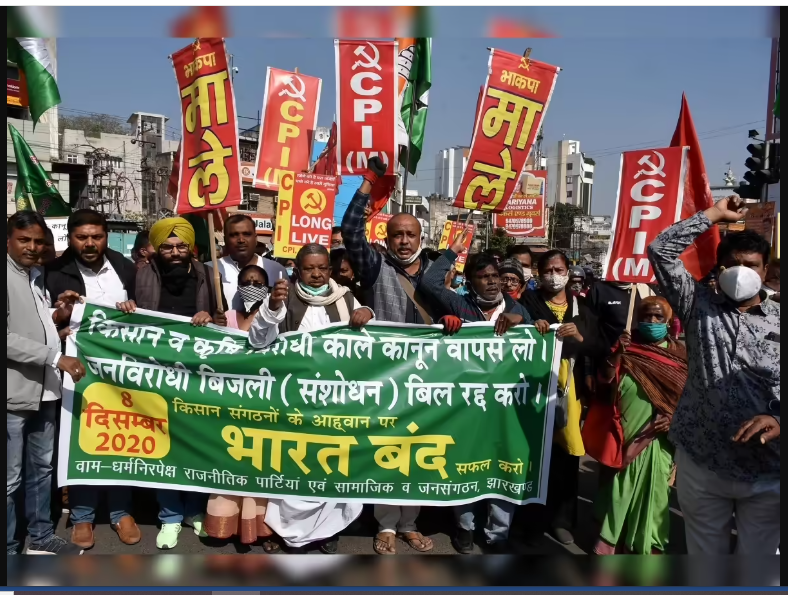
NEW DELHI, July 9: The nation-wide general strike “Bharat Bandh” called by the Joint Committee of Trade Unions (JCTU) on Wednesday received mixed response and had limited impact on normal life across the country except in the public transport sector.
Public transportation was disrupted in various parts of the country. The leaders had said the workers supported the 17-point charter of demands of the strike including labour rights and social security reforms, called against the Union government’s policies.
The CPM-ruled Kerala was perhaps the worst affected by the strike as the lockdown of services almost halted private and public stage carriage and long-distance services, inconveniencing hundreds of passengers. Reports of violence were received from various pockets of West Bengal after Left-wing activists clashed with police and ruling Trinamool Congress supporters in multiple districts, even as additional security forces were deployed to ensure normal life.
In Mysuru, leaders of various trade unions and scores of activists from AIUTUC, CITU, and AIKMS, marched along the main thoroughfares of the city raising slogans against the government in Karnataka and at the Centre.
The Union Labour Ministry on Tuesday had claimed that about 213 unions, including the RSS-backed Bharatiya Mazdoor Sangh (BMS), have informed the government that they would not join the “Bharat Bandh.” Markets across the national capital remained open on Wednesday ignoring the nationwide strike call. The Confederation of All India Traders (CAIT) said the bandh had no impact on Delhi’s commercial activity.
“All 700 markets and 56 industrial areas in Delhi are functioning as usual,” said CTI chairman Brijesh Goyal. Connaught Place, one of the busiest commercial hubs in Delhi, witnessed normal operations. “It is a regular working day for Connaught Place. There is no bandh impact here,” said Amit Gupta, Joint Secretary, New Delhi Traders Association (NDTA). Khan Market also remained unaffected.
Leaders and activists of various Trade Union staged a road-roko protest in front of Madurai Railway junction. Commercial vehicles remained off the roads in Assam as members of several unions including tea garden workers staged demonstrations across the State in support of the nationwide strike called by trade unions to oppose the Central government’s alleged “anti-labour” policies.
State units of almost all transport workers’ bodies have lent their support to the strike, bringing the sector to a halt in the State. Commercial vehicles, including buses and trucks, remained off the roads, though services of school buses and vehicles engaged in emergency services were not affected. In Guwahati, city buses as well as app-based taxis went off the roads, creating problems for commuters.
A sea of red flags swept through Hyderabad’s central streets as more than 1,000 members of the Centre of Indian Trade Unions (CITU), Trade Union Centre of India (TUCI), All India United Trade Union Centre (AIUTUC) and others held protest rally as part of the Bandh.
Bank employees in Mumbai joined the countrywide general strike. Randeep Singh Surjewala, AICC general secretary in charge of Karnataka and MP, said 80% of India’s workforce is in the unorganised sector while 60% of India’s workers don’t have a written contract. Supporting the call for Bharat Bandh, he claimed that ‘53% of the Indian workforce has no social security, which means no insurance and no pension’.
This Bandh was called to protest against the Government’s alleged pro-corporate policies by central trade unions who claimed that its crony capitalist measures have pushed millions of Indians to unemployment, income inequality, disparity in standard of living.
The participating organisations included Congress (INTUC), All India Trade Union Congress (AITUC), Hind Mazdoor Sabha (HMS), Centre of Indian Trade Unions (CITU), All India United Trade Union Centre (AIUTUC), Trade Union Coordination Centre (TUCC), Self-Employed Women’s Association (SEWA), All India Central Council of Trade Unions (AICCTU), Labour Progressive Federation (LPF), and the United Trade Union Congress (UTUC).
(Subham Singh)