


Manas Dasgupta
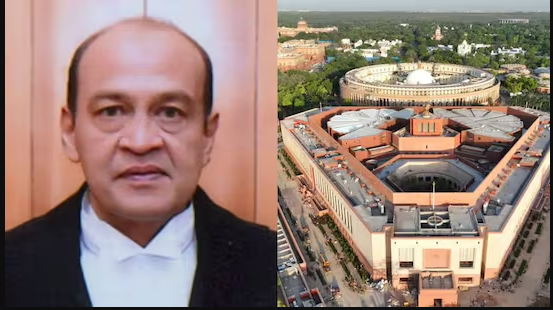
NEW DELHI, July 25: An opposition-sponsored motion for the impeachment of the Allahabad High Court Judge Yashwant Varma, which was initially considered to be the reason for the abrupt resignation of the Vice-President Jagdeep Dhankhar, who is also the chairman of the Rajya Sabha, was never admitted in the upper house, official sources said on Friday.
The impeachment move of Justice Varma, who was indicted by a Supreme Court-appointed probe panel after the discovery of a huge amount of half-burnt cash from his official residence in the national capital when he was a judge in the Delhi High Court, is expected to be initiated through a government-sponsored motion in the Lok Sabha during the current monsoon session.
Justice Varma is facing allegations of corruption after the cash discovery in March, when he was a judge at the Delhi High Court. However, he has claimed ignorance about the cash. After the controversy, Justice Varma was transferred to the Allahabad High Court, his parent High Court.
After the cash discovery incident, the Supreme Court had set up a three-member committee of Justice Sheel Nagu, Chief Justice of the High Court of Punjab and Haryana, Justice GS Sandhawalia, Chief Justice of the High Court of Himachal Pradesh and Justice Anu Sivaraman, Judge of the High Court of Karnataka, to look into the allegations against Justice Varma. The committee has submitted its report to the Supreme Court which forwarded it to the President.
Government sources revealed that the impeachment motion, referred to as a “removal motion,” has already garnered over 100 signatures from members of the ruling BJP and its allies. Opposition members are also expected to submit their signatures shortly.
Once the motion is formally submitted, the Speaker of the Lok Sabha will decide whether to admit it. If admitted, a three-member committee will be formed, comprising a sitting Supreme Court judge, a High Court judge, and a distinguished jurist. This committee will investigate the charges against Justice Varma and submit a report to Parliament.
The decision to form a committee will be taken by the Lok Sabha Speaker, with Rajya Sabha concurrence. The action on the impeachment motion will be taken up only after the discussion on Operation Sindoor, sources said.
Ahead of the commencement of the monsoon session of Parliament, union minister Kiren Rijiju had said that potential impeachment of Justice Yashwant Varma was a collective initiative of the MPs of all political parties, and not just the government.
“I have spoken to all the senior leaders of different political parties. I will also get in touch with some of the single-MP parties because I do not want to leave out any member. So it becomes a unified stand of the Parliament of India,” Rijiju had said. He further said corruption in judiciary was an extremely sensitive and serious matter and that’s why members of Parliament cutting across party lines were in favour of moving a motion to remove Justice Varma.
While the preliminary report of the Delhi High Court Chief Justice and the response of Justice Varma, along with the photos and videos taken by the Delhi Police, were publicised by uploading them on the Supreme Court’s website, the final inquiry report, submitted to the Chief Justice of India on May 4, has not been officially disclosed yet.
Then Chief Justice of India Sanjiv Khanna had written to the president and the prime minister to remove Justice Varma, mired in the cash discovery row. The then CJI had prodded Varma to resign but he had refused, sources had earlier said.
The opposition-backed motion accepted by Mr Dhankhar as the then Rajya Sabha chairman would be junked since it was never formally tabled in the House, sources said. Sources said the BJP wanted to be seen as taking the lead in this matter to underline its stance on corruption in the judiciary and make a statement ahead of critical Assembly elections – in Bihar this year, and Bengal and Tamil Nadu the next.
The ruling party had prepared its impeachment motion ahead of the Parliament’s monsoon session that began Monday, July 21. The BJP even reached out to opposition parties to ensure cross-party consensus and a handful of opposition MPs signed the government’s motion.
Since the opposition-sponsored impeachment motion has turned out to be non-starter, new theories were being floated for the shocking resignation of Mr Dhankhar. According to some top government sources, “a coup-like situation” in which Mr Dhankhar attempted to go beyond his mandate and powers to appoint an officer as the Secretary and In-charge of Sansad TV in April could have spoiled his relations with the Modi government. Such high-level appointments only the Appointments Committee of the Cabinet (ACC) can carry out.
Sources said Mr Dhankhar wanted a junior officer to take charge as the Secretary and In-charge of Sansad TV after then Secretary Rajit Puhnani was made the Skill Development Secretary in April. These are ACC posts and the Rajya Sabha can’t appoint officers. The Rajya Sabha, Lok Sabha, VP and President can’t make appointments. The officers have to be picked from the offer list of the central government. Allotment of officers is the job of the ACC and those appointments are only considered valid Dhankhar was to issue orders,” alleged sources.
“The PM was abroad and top officials intervened to stop that. Even the officer was told not to join. He was told that appointment would be illegal and would create a legal crisis. Multiple calls were made between cadre controlling authorities, the PMO and Rajya Sabha Secretariat to avoid it. The officer was even suggested to proceed on leave if pressure comes to join and the Rajya Sabha Secretariat issues orders,” alleged sources.
The Appointments Committee of the Cabinet (ACC) is a key decision-making body in the Government of India responsible for approving appointments to top-level posts in the civil services, public sector undertakings (PSUs), and statutory bodies. It is composed of the Prime Minister, who serves as the Chairperson, and the Union Home Minister.
The ACC approves the appointments of secretaries, additional secretaries, joint secretaries, and other senior bureaucrats in ministries and departments, as well as the heads of various regulatory bodies such as the Election Commission, UPSC, and CBI (in consultation with other committees). It also clears appointments of chairpersons and managing directors of Central Public Sector Enterprises.
The committee functions under the Transaction of Business Rules, 1961, framed under Article 77(3) of the Constitution, and its decisions play a vital role in shaping the leadership of India’s administrative and institutional framework.