


Manas Dasgupta
NEW DELHI, Dec 8: Chanting of slogans from the treasury benches as the Prime Minister Narendra Modi entered the Lok Sabha on Monday to initiated the debate on “Vande Mataram” to mark its 150th anniversary year, immediately made it amply clear about the intention behind the ruling BJP’s new-found love for the national song.
“Bihar ki jeet hamari hai, ab Bengal ki baari hai” — this slogan accompanied chants of “Vande Mataram” by BJP-led NDA members as Mr Modi entered the Lok Sabha to initiate a discussion on the national song. “We have won Bihar, it’s now the turn of Bengal,” the slogan meant, pointing towards the West Bengal state assembly election due early next year.
That was, of course, not a stated reason why Bengal — the wider region encompassing Bangladesh — remained central to the Vande Mataram discussion. The members of the NDA led by the BJP also did not try to hide the fact, more than paying tributes to the national song, they led by Mr Modi used the occasion only to attack the Congress and the present West Bengal ruling party Trinamool Congress for their alleged “Muslim appeasement” policies.
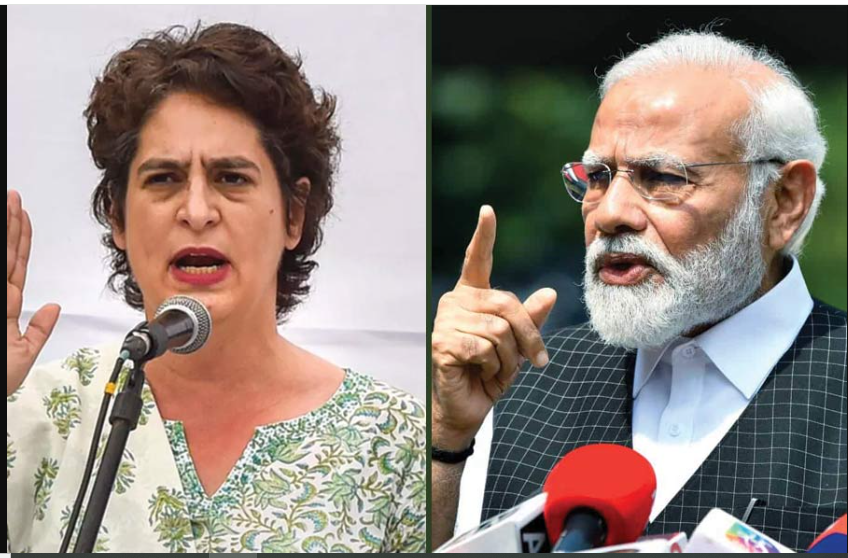
It elicited a prompt response from the Congress leader Priyanka Gandhi Vadra. Pointing out that there was nothing to debate on “Vande Mataram” since the song is “alive in every part of the country” and no one has any objections against it, she asserted the government “wanted debate on Vande Mataram because the Bengal polls are coming soon… The government wants us to keep delving in past because it does not want to look at present and future.”
Ms Gandhi said the chanting of slogan from the NDA benches make it clear that the government’s insistence on allocating time for debate on the national song was that it was “only eyeing Bengal elections” and accused the BJP-led NDA government of politicising the national song and evading the real issues. Ms Gandhi also accused the Prime Minister of “selectively” quoting Jawaharlal Nehru, and suggested that the BJP list out the insults for Nehru, set aside a time to debate it, and close the chapter. “Let us use the precious time of this Parliament for the job people have elected us for,” she said.
The BJP has alleged that Vande Mataram was truncated and its crucial lines excised in the version adapted as national song by Jawaharlal Nehru under pressure from the Muslim League.
Initiating the debate, Mr Modi launched a sharp attack on the Congress accusing former prime minister Jawaharlal Nehru of echoing Muhammad Ali Jinnah’s opposition to the national song and “pandering to communal concerns.” PM Modi said Nehru had once written to Netaji Subhas Chandra Bose that Vande Mataram might “provoke and irritate Muslims”, and suggested examining its usage. “This, despite Vande Mataram being born in Bankim Chandra’s Bengal,” he said.
The Prime Minister also linked the national song to the Emergency imposed by Indira Gandhi in 1975, asserting that when Vande Mataram completed 100 years, “the Constitution was throttled and those who lived for patriotism were put behind bars.” “The Emergency was a dark chapter in our history. Now we have the opportunity to restore the greatness of Vande Mataram. That opportunity should not be allowed to pass,” Modi told the House.
PM Modi described Vande Mataram as the mantra that “energised and inspired India’s freedom movement”, noting that even when the British banned its printing and propagation, the song “stood like a rock” against oppression. “After the 1857 uprising, the British pushed ‘God Save the Queen’ into every household. Bankim Chandra Chattopadhyay responded with Vande Mataram, and despite the partition of Bengal in 1905, it unified the country,” he said.
Mr Modi said the Congress “surrendered before the Muslim League and partitioned Vande Mataram.” PM Modi said Nehru had followed Jinnah’s stand in 1937, claiming the hymn could “irritate Muslims,” and thereby compromised its legacy. “Instead of condemning the slogans of the Muslim League and expressing loyalty towards Vande Mataram, he wrote to Netaji Subhas Bose, agreeing with Jinnah. He wrote that the context of Anandamath can irritate Muslims,” PM Modi said.
“Nationalists across the country took out prabhat pheris against it when the Congress Working Committee decided to inspect Vande Mataram,” but the Congress decision prevailed. Calling it a part of the Grand Old Party’s “appeasement politics”, he said this was the mentality that led to the Partition.
Priyanka Gandhi Vadra contended that PM Modi was misrepresenting the matter. Nehru — her great-grandfather and India’s first Prime Minister – had called the row over Vande Mataram “manufactured by communalists,” she said. In support of her argument, she read out the relevant passages from the letters by Nehru and Bose and the later correspondence between Nehru and Rabindranath Tagore, saying it was important to “understand the chronology” of the events that led to the choice of Vande Mataram as the National song.
“Let me share an excerpt from the letter in which Gurudev (Rabindranath Tagore) says that the two stanzas that were always sung were so significant that he had no difficulty in separating them from the rest of the poem and the passages in the book… He said the same two stanzas were always sung during the freedom struggle and to honour the hundreds of martyrs who sacrificed their lives. While singing them, it would be appropriate to sing them as they were. He also said that the stanzas added later could be interpreted as communal and their use would be inappropriate in the atmosphere of that time. Subsequently, on 28 October 1937, the Congress Working Committee, in its resolution, declared Vande Mataram as the national anthem,” she said.
Others in the Congress and some allies also alleged that the BJP was distorting Nehru’s views. DMK’s A Raja also agreed that Nehru had observed in his letter to Subhas Bose that the public outcry against Vande Mataram was “manufactured by communalists.” But Nehru had also accepted that there was “some substance” in the grievances expressed by sections of people, he said.
The 150th anniversary of India’s National Song, Vande Mataram, which translates to “Mother, I Bow to Thee”, was observed on November 7. Composed by Bankim Chandra Chattopadhyay. ‘Vande Mataram’ was first published in the literary journal Bangadarshan on November 7, 1875. Later, Bankim Chandra incorporated the hymn into his immortal novel ‘Anandamath’, published in 1882. Set to music by Rabindranath Tagore, the words became a battle cry of nationalists during the freedom movement and later became an integral part of the nation’s cultural consciousness.
Ms Gandhi also compared Mr Modi’s time as the Prime Minister and Nehru spending in jails for participating in the freedom movement. The time Jawaharlal Nehru, the country’s first Prime Minister, spent in jail during the freedom struggle is close to the period Prime Minister Narendra Modi has been in the country’s top post, Ms Gandhi said.
“Mr Modi has spent 12 years as Prime Minister. Jawaharlal Nehru spent nearly the same period in jail for this country’s independence. He then served as Prime Minister for 17 years. You criticise him a lot, but if he had not started ISRO (Indian Space Research Organisation), you wouldn’t have Mangalyaan. If he had not started DRDO, there would be no Tejas; if he had not started IITs and IIMs, we would not be ahead in IT; if he had not started AIIMS, how would we face a challenge like Corona?” she asked. “Pandit Jawaharlal Nehru lived for the country and died serving the country,” the Wayanad MP said.
Nehru went to prison nine times during the independence movement, spending over 3,200 days in jail — nearly nine years.
Priyanka Gandhi advised the Prime Minister to make a list of insults for Jawaharlal Nehru. “Whether it is 999 or 9,999, make a list, and then we can decide on a time, just like we are debating for 10 hours on Vande Mataram. We are ready to debate about it for as long as you want. But let us use the precious time of this Parliament for the job people have elected us for. Once and for all, let’s close the chapter,” she said, drawing loud cheers from the Opposition benches.
“The country will hear the complaints, what Indira ji, what Rajiv ji did, what is dynasty politics, what are Nehru’s mistakes, let’s speak about them and end it there. Then we can talk about unemployment and price rise,” Priyanka Gandhi said.
Prime Minister Modi, opening the discussion, recalled the British colonial regime’s divide-and-rule politics and said, “When they divided Bengal in 1905, Vande Mataram stood like a rock.”
“They (British regime) used Bengal as their laboratory. Even they knew that Bengal’s intellectual capability gave direction, strength, and inspiration to the country. They knew Bengal’s capabilities were the focal point of the country. This is why they divided Bengal,” he said. “They believed that if Bengal was divided, the country would be divided too,” he said. In his tribute to the song, Modi also recalled some slogans in Bengali raised after Vande Mataram was banned by the British regime between 1905 and 1908.
There was hiccup, and a quick recovery, when PM Modi’s reference to Bankim Chandra as “Bankim da” — was objected to by a Trinamool Congress MP from West Bengal. “Da” is short for ‘dada’, meaning brother in everyday Bangla. MP Saugata Roy asked the PM to use the suffix “babu”, instead. It’s a word closer to the more respectful “sir.” Modi responded immediately, “I will say ‘Bankim Babu’. Thank you, I respect your sentiments.”
Speaking after Mr Modi, the Congress deputy leader in the Lok Sabha Gaurav Gogoi also referred to Bengal’s role in the national struggle. Gogoi said his party ensured that it was not just seen as a political slogan but given the status of national song. It was in the 1896 Calcutta Session of the Congress that Rabindranath Tagore first sang Vande Mataram, Gogoi noted. “He (Tagore) wrote to Nehru that ‘the privilege of originally setting the first stanza of Vande Mataram to the tune was mine when the author was still alive’,” the Congress MP from Assam said.
Reacting on X, Congress MP Jairam Ramesh said the PM had “insulted” Rabindranath Tagore, the Bengali literary giant, who is also reported to have agreed that the first two stanzas were more inclusive. Ramesh accused the Hindu Mahasabha and RSS of being pro-partition at the time.