


Manas Dasgupta
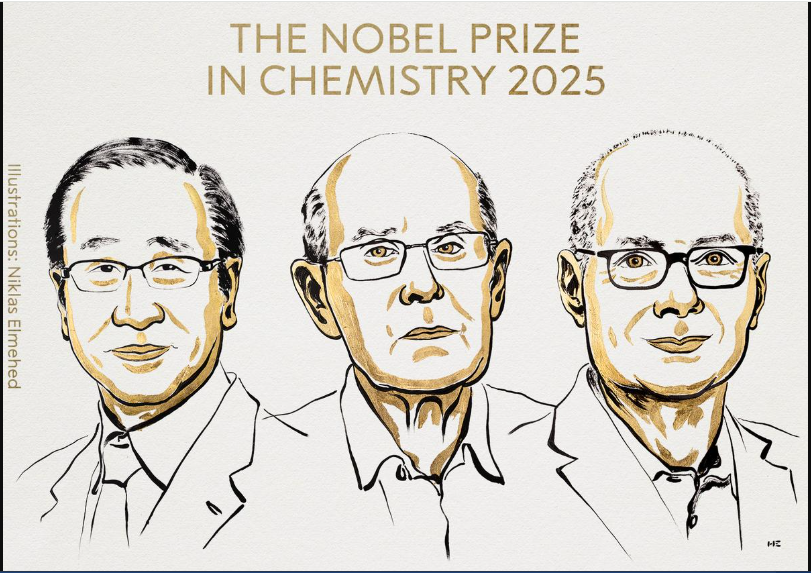
NEW DELHI, Oct 8: The Nobel Prize in Chemistry has been awarded to Susumu Kitagawa, Richard Robson and Omar M. Yaghi “for the development of metal–organic frameworks,” the Royal Swedish Academy of Sciences announced on Wednesday.
The Royal Swedish Academy of Sciences in a release said the three laureates developed a new type of molecular architecture. “The constructions they created – metal-organic frameworks – contain large cavities in which molecules can flow in and out. These constructions, metal-organic frameworks, can be used to harvest water from desert air, capture carbon dioxide, store toxic gases or catalyse chemical reactions.
“Researchers have used them to harvest water from desert air, extract pollutants from water, capture carbon dioxide and store hydrogen,” the release said.
In 1989, Richard Robson tested utilising the inherent properties of atoms in a new way by combining positively charged copper ions with a four-armed molecule; this had a chemical group that was attracted to copper ions at the end of each arm. Though the molecular construction had potential, it was unstable and collapsed easily.
However, Susumu Kitagawa and Omar Yaghi provided this building method with a firm foundation. Kitagawa showed that gases can flow in and out of the constructions and predicted that MOFs could be made flexible. Yaghi created a very stable MOF and showed that it can be modified using rational design, giving it new and desirable properties.
The release said through their development of metal-organic frameworks, the laureates have provided chemists with new opportunities to solve some of the challenges they face.
Susumu Kitagawa of Japan’s Kyoto University, Richard Robson of the University of Melbourne, and Omar M. Yaghi of the University of California will all receive 1/3rd share of the Nobel Prize.
The 2024 Nobel Prize in chemistry was shared by David Baker “for computational protein design” along with Demis Hassabis and John Jumper “for protein structure prediction.” One of the award was given to David Baker, and the other half jointly went to Demis Hassabis and John M Jumper, for their ground-breaking contributions in protein science.
Nobel Prize announcements kicked off on Monday with the Prize for Medicine. Three scientists – Mary E. Brunkow, Fred Ramsdell, and Shimon Sakaguchi shared the Medicine Nobel for identifying the immune system’s security guards, regulatory T cells. Physics Nobel, announced on Tuesday was awarded to John Clarke, Michel Devoret, and John Martini for building device showing ‘quantum tunnelling’.
The winners of the Literature, Peace and Economic Sciences Prize will be declared on October 9, October 10, and October 13 respectively. The prizes carry a cash award of 11 million Swedish kronor (approximately ₹1.03 crore) and will be awarded on December 10.