


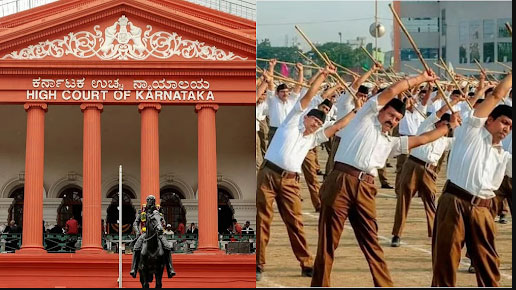
Manas Dasgupta
NEW DELHI, Oct 28: The Karnataka High Court on Tuesday stayed a state government order which was alleged to be aimed at curbing the activities of the Rashtriya Swayamsevak Sangh (RSS) on the ground of it being violative of fundamental rights guaranteed under the constitution.
While staying the Karnataka government’s October 18 order which restricted the use of public properties, including roads, parks, playgrounds, etc., without prior permission for a gathering of 10 or more persons, the High Court said that the restriction “on the face of it is violative of Article 13(2) of the Constitution of India.”
“Prima facie the Government Order [GO] of October 18, 2025, has taken away the right conferred upon a citizen or citizens under Chapter-III [fundamental rights] of the Constitution of India, that is Article 19(1) (a) and (b), which gives freedom of speech and expression and right for congregation and free movement,” it said.
Justice M. Nagaprasanna passed the interim order on a petition filed before the Dharward Bench of the High Court by various Hubballi and Dharwad based non-government organisations and individuals like, Punashchetana Seva Samsthe, We Care Foundation, Rajeev Malhar Patil Kulkarni and Uma Satyajit Chavan.
The Karnataka government had on October 18 issued an order for regulating the activities of private organisations/societies/trusts/clubs or any other entity registered/unregistered using the State government properties and premises, playgrounds, parks, roads and water-bodies or any other immovable property.
Earlier in the week, the State Cabinet had decided on taking measures to prevent trespassing of public properties by private organisations. It came days after IT-BT Minister Priyank Kharge’s letter to Chief Minister Siddaramaiah seeking a ban on activities of organisations such as the RSS on public properties like government schools, colleges, etc. The government order is aimed at “the preservation, protection and proper utilisation of government properties and premises, playgrounds, and public assets.”
The Court also stayed all consequential orders, notifications or circular, if any, issued by the Government. “If this GO is left to be operational during the pendency of the petition, it would in effect be violative of Article 13(2) of Constitution of India, which indicates that law conferred under fundamental rights can be abridged only by a law,” the Court observed.
As the GO states that a gathering of 10 or more persons in any public place either on street/road, park, playgrounds, water bodies, etc., without prior permission would be treated as an “unlawful assembly,” the Court pointed out that this GO has sprung when the regulation of assembly of people is governed under the provisions of the Karnataka Police (KP) Act, which regulates the conduct, behaviour and action of persons constituting assembly and processions in public place, etc.
When the subject of regulation of assembly of people is governed under the KP Act, the October 18 GO can have any semblance of effect of taking away the fundamental rights conferred upon a citizen or citizens under the Constitution, the Court said. Earlier, senior advocate Ashok Haranahalli, appearing for the petitioners, pointed out that the GO is violative of the provisions of the KP Act and amounts to curbing the fundamental rights through a GO.
Going by the nature and restriction imposed in the GO, Mr Haranahalli contended that it would mean even having a laughter club session or walking in a group in a park would become an “unlawful assembly’” if no prior permission was taken.
Though activities of any specific organisation on public properties were not referred to in the GO, it was interpreted that the restrictions were imposed to curb the activities of the RSS as the Cabinet approved issuance of the GO a few days after Karnataka’s IT-BT Minister Priyank Kharge’s letter to the chief minister. The GO had said the police should register cases, whether on receipt of complaint or by suo motu for gathering in public properties in violation of this GO, under the provisions of the Bharatiya Nyaya Sanhita.
On October 4, Mr Priyank Kharge wrote to Chief Minister Siddaramaiah seeking a ban on the activities of the Sangh on the premises of government-run institutions as they are “contrary to India’s unity and the spirit of the Constitution.” The government order on October 18 did not directly mention the RSS. It sought to put riders on a broad spectrum of “private organisations/societies/trusts/clubs or any other entity registered/unregistered” using public spaces. In essence, it reiterated and consolidated existing rules.
Mr Siddaramaiah had been at pains to explain that the order did not singularly targeted the RSS and that similar rules had been put in place during the BJP regime in 2013. However, the timing and sequence of events have made it difficult to delink the order from the Sangh which celebrated its centenary year on October 11 taking out massive rallies through the public roads.
Soon after the order was issued by the government, the Kalaburagi district administration denied permission for an RSS patha sanchalana the next day at Chittapur, the constituency of Mr Kharge, citing law and order issues. The Bhim Army and the Bharatiya Dalit Panthers too had sought permission for marches along the same route the same day. Over the previous two days, Dalit groups had held protests in support of Mr Kharge, who had been receiving abusive calls and threats from the self-proclaimed “sanatanis” over his letter to the Chief Minister. The RSS has now rescheduled its march to November 2 and approached the High Court.
Condemning the denial of permission for the RSS route march in Chittapur, BJP State president B.Y. Vijayendra had accused the Congress government of functioning in an “authoritarian” manner reminiscent of the Emergency. In a post on X, Mr Vijayendra had alleged that constitutional rights were being “snatched away by those who claim to uphold the Constitution.”
Mr Siddaramaiah had also issued instruction to the Karnataka Chief Secretary to study the measures taken by the Tamil Nadu government to restrict the RSS’s activities. It was, however, found that there were no specific “rules” in place in Tamil Nadu to curb RSS activities; rather, the Dravidian, anti-Brahmin movement has historically made it hard for the RSS to penetrate that region. This, in turn, has made it easier for the government to impose restrictions, despite a constant push back.
On the other hand, Karnataka has been fertile ground for the RSS ideology for a long time. In independent India, the Bharatiya Jana Sangh got vote shares of 2-5% in the elections as early as the 1950s, unlike Tamil Nadu, Andhra Pradesh, or Kerala, where Dravidian and communist currents held greater sway over society.