


Manas Dasgupta
NEW DELHI, Apr 21: The criticism of the Supreme Court and the judiciary by some BJP leaders seems to have boomeranged on the ruling party with the apex court on Monday refusing to entertain a plea by a pro-Hindu advocate for ordering the centre to deploy additional central forces in Murshidabad in West Bengal hit by riots in the wake of the anti-Waqf Act protests last week.
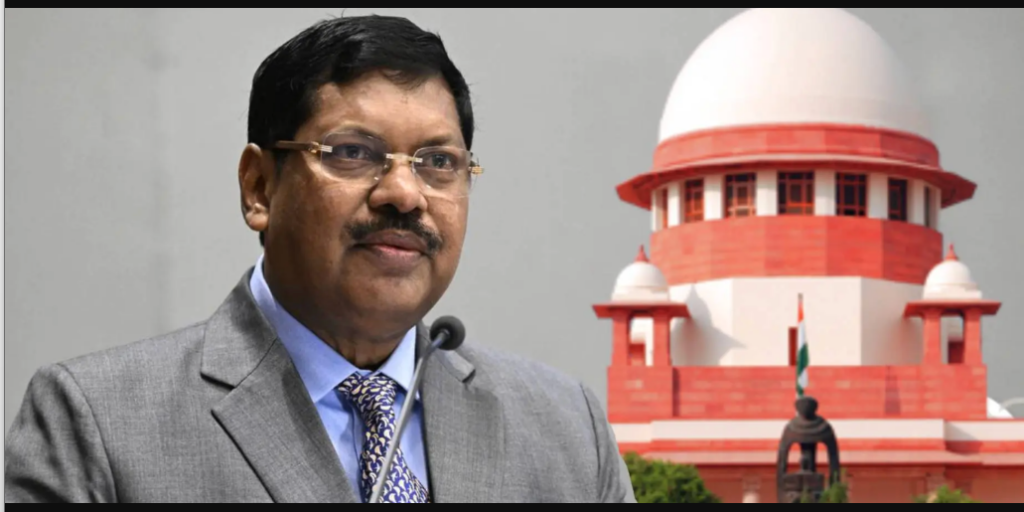
“You want us to issue a writ of mandamus to the President to impose this? As it is, we are facing allegations of encroaching into executive (domain). Please,” Justice BR Gavai commented as advocate Vishnu Shankar Jain sought directions to the Centre to deploy paramilitary forces and set up a panel of three retired judges to investigate the violence in Murshidabad. He also sought a report on the displacement of Hindus following the incidents of violence in West Bengal under the Trinamool Congress government headed by Mamata Banerjee.
It was the Supreme Court’s first reaction to the recent allegations of judicial overreach and controversial remarks by some BJP leaders following its landmark judgment that effectively set a deadline for the President and Governors to clear Bills passed by the legislature for the second time. Justice BR Gavai, the next Chief Justice, said the court is “facing allegations of encroaching into executive” domain after a lawyer sought a direction to the Centre regarding recent incidents of violence in West Bengal which would have been to the liking of the BJP
The court’s response came after Mr Jain mentioned his pending plea linked to West Bengal. The advocate said there was a need for paramilitary forces to remain on the ground to ensure peace. He said his pending plea, filed after post-poll violence in Bengal in 2022, was listed for tomorrow. The remarks by Justice Gavai, who will take over as Chief Justice next month, suggests that the Supreme Court has been closely following the remarks by a section of ruling party leaders against the judiciary.
A section of BJP leaders have criticised the Supreme Court in the weeks following its judgment in the Tamil Nadu case in which it ruled that the Governor’s decision to withhold Bills indefinitely was “arbitrary” and set aside the Governor’s actions using its special powers under Article 142 of the Constitution. The order by the bench of Justice JB Pardiwala and Justice R Mahadevan also said only courts have the prerogative to provide recommendations regarding the constitutionality of a Bill and the Executive is supposed to exercise restraint in such matters. It underlined that it would be prudent for the President to refer Bills with constitutional questions to the Supreme Court.
Reacting to the judgment, BJP MP Nishikant Dubey said Parliament must be shut down if the Supreme Court makes all decisions. “The Supreme Court is crossing its limits. If one has to go to the Supreme Court for everything, then Parliament and State Assembly should be shut,” he had said. “When the Ram Mandir, Krishna Janmabhoomi, or Gyanvapi issue arises, you (Supreme Court) say, ‘Show us the paper’. But for mosques built after the Mughals came, you are saying how will you show papers? The Supreme Court is responsible for inciting religious wars in this country,” the BJP MP had said.
Mr Dubey asked how the Supreme Court can set a deadline for President and Governors to clear Bills. “How can you give direction to the appointing authority? The President appoints the Chief Justice of India. Parliament makes the law of this country. You will dictate Parliament?” After the apex court flagged certain aspects of the new Waqf legislation, Mr Dubey had even blamed the Chief Justice of India Sanjiv Khanna for “all civil wars in the country.”
Another BJP MP Dinesh Sharma said no one can “challenge” the President, as the President was “supreme.” He was equally critical of the Supreme Court for admitting petitions challenging the Waqf Act. “According to the Constitution of India, no one can direct the Lok Sabha and Rajya Sabha which have passed the law and the President has already given her assent to it. No one can challenge the President, as the President is supreme.”
First to attack the judiciary following the SC order on the governors was the Vice-President Jagdeep Dhankhar, who has often been criticised for behaving like a BJP leader even after taking over as the governor of West Bengal and later as the vice-president, the two constitutional posts regarded to be above party politics. “We cannot have a situation where you direct the President of India and on what basis?…Article 142 has become a nuclear missile against Democratic forces, available to judiciary 24 x 7”, he said.
As the Opposition parties accused the ruling dispensation of targeting the judiciary, BJP disowned its MPs’ remarks and said they were personal statements. Amid the controversy over the remarks, Mr Nadda said the BJP has “nothing to do” with the statements made by the BJP MPs. “These are their personal statements, but the BJP neither agrees with nor supports such statements. The BJP completely rejects these statements,” BJP chief JP Nadda said in a post on X. The party, however, has not taken any action against the MPs making offensive comments against the apex court, the chief justice of India and the judiciary.
Even as the Supreme Court refused to entertain a petition for a court-monitored probe into the Murshidabad violence, the BJP launched a sharp attack on the chief minister Mamata Banerjee, accusing her of deliberately ignoring the victims of Murshidabad violence because of “her hatred for Hindus.”
Addressing a press conference at the party headquarters in New Delhi, BJP MP and national spokesperson Sambit Patra said, “She hates Hindus.” The BJP leader was answering a question about Banerjee not visiting Murshidabad, where violence broke out during protests against the Waqf (Amendment) Act. “Had such atrocities been carried out against Muslim brothers, Banerjee would have been agitating and camping there,” Patra charged.
Union Minister and West Bengal BJP President Sukanta Majumdar on Monday visited the violence-affected areas and met the victims affected by the Waqf Act protests. After meeting the victims, Majumdar stated that if the Kolkata High Court permitted the National Investigation Agency to conduct an investigation, the government would need to follow the court’s orders. He also took a jibe at CM Mamata Banerjee for pressurising authorities to send the victims back, questioning where they would go when their homes had been destroyed.