


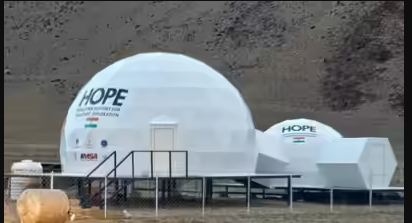
NEW DELHI, Aug 2: Marking a significant leap in India’s space exploration efforts, the Indian Space Research Organisation (ISRO) has set up the Himalayan Outpost for Planetary Exploration (HOPE) in Ladakh’s Tso Kar Valley. It is a high-altitude, Mars-like environment selected to test life-support systems and technologies for future lunar and Martian missions.
The HOPE station, inaugurated by ISRO chairman Dr V Narayanan, will be used to test systems for future space missions. The project is led by ISRO’s Human Space Flight Centre, along with support from an industry partner and top research institutions.
The analogue mission is part of a growing international movement to study how humans might survive and thrive in extra-terrestrial environments by replicating the harsh conditions of other planets on Earth. The Tso Kar Valley was chosen for its environmental similarities to Mars, which include high UV radiation, low atmospheric pressure, extreme cold and saline permafrost.
The HOPE facility has two connected units. One is an eight-metre wide living space for the crew, while the other is a five-metre utility module housing equipment and support systems. A 10-day trial mission is being held from August 1 to 10, where two crew members will stay inside and take part in various physical, mental and task-based tests.
Scientists from institutions like IIT Bombay, IIT Hyderabad, IIST Trivandrum, RGCB Trivandrum and the Institute of Aerospace Medicine in Bengaluru are leading several experiments. They are studying how isolation affects the body and mind, testing health-monitoring tools, and trying out methods for working on planetary surfaces and collecting microbes. The results will help shape safety plans, equipment and systems for future space missions.
Calling the HOPE mission “a rehearsal for the future,” Dr Narayanan said the initiative aligns with Prime Minister Narendra Modi’s vision of expanding private sector participation in India’s space programme. Coinciding with the HOPE mission, new research from Ladakh’s high-altitude Puga Valley has uncovered clues about the origins of life on Earth. Indian scientists have found that the valley’s geothermal springs may mimic early Earth conditions and can preserve organic molecules associated with life’s beginnings.
A study by the Birbal Sahni Institute of Palaeosciences (BSIP) has found traces of amino acid compounds, fatty acids, formamide and sulphur in calcium carbonate deposits (travertine) from the area. According to lead researcher Dr Amritpal Singh Chaddha, “The high UV exposure and extreme conditions of the Puga Valley mimic those of early Earth and potentially, ancient Mars.”
(Manas Dasgupta)