


Manas Dasgupta
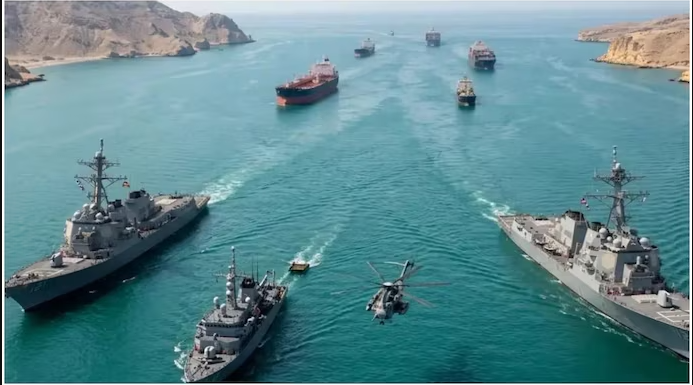
NEW DELHI, Apr 17: In a major relief to all nations across the world, Iran, on Friday, finally opened the Strait of Hormuz for the passage of all commercial vessels after a ceasefire was agreed between Israel and Lebanon on Thursday, but the US President Donald Trump said the naval blockade of the Strait for Iranian ships would remain in place till its “transactions” with Iran was completed.
Iran’s Foreign Minister Araghchi said on X that the passage for all commercial vessels through Strait of Hormuz was declared completely open for the remaining period of ceasefire. He also explained that the passage of vessels through the strait would be on the coordinated route as already announced by the Ports and Maritime Organisation of Iran.
In a statement on X, he said: “In line with the ceasefire in Lebanon, the passage for all commercial vessels through [the] Strait of Hormuz is declared completely open for the remaining period of ceasefire, on the coordinated route as already announced by Ports and Maritime Organisation of the Islamic Rep. of Iran.”
In the meantime, Mr Trump also confirmed that the Strait of Hormuz was “fully open.” “Iran has just announced that the strait of Iran is fully open and ready for full passage. Thank you!” Trump wrote on Truth Social.
“Iran has agreed to never close the Strait of Hormuz again. It will no longer be used as a weapon against the World,” Mr Trump said on his Truth Social network, after Iran earlier said the crucial sea passage would remain open during the ceasefire.
The announcement from Iran came after Trump declared that Israel and Lebanon have agreed to a 10-day ceasefire. However, there was no reference in Trump’s statement to Hezbollah, the Iran-backed militant group based in Lebanon, which has been engaged in cross-border exchanges of fire with Israel over the past weeks. Later in a post on Truth Social, Trump urged the group to respect the truce, saying, “I hope Hezbollah acts nicely and well during this important period of time.”
The cessation of hostilities is considered a central component of broader American initiatives to secure an agreement to end the conflict with Iran. Tehran had reportedly maintained that a Lebanese truce was a prerequisite for any such deal.
According to the US leader, the arrangement to pause combat followed “excellent” telephonic discussions with Israeli Prime Minister Benjamin Netanyahu and Lebanese President Joseph Aoun. “These two Leaders have agreed that in order to achieve peace between their Countries, they will formally begin a 10 day ceasefire at 5 P.M. EST,” Trump stated. He further mentioned expectations for both Netanyahu and Aoun to convene at the White House “over the next four or five days” to build upon the temporary truce.
After welcoming Iran’s announcement of the Strait of Hormuz being “fully open,” Mr Trump clarified that the naval blockade of the strait would remain intact until their “transaction” with Iran was complete. However, he claimed that the process would be concluded “very quickly” as the sticking points have already been negotiated.
“The Strait of Hormuz is completely open and ready for business and full passage, but the naval blockade will remain in full force and effect as it pertains to Iran, only, until such time as our transaction with Iran is 100% complete,” Trump wrote. He added, “This process should go very quickly in that most of the points are already negotiated.” In any case, the Trump administration sees the US blockade as a way of putting pressure on Iran to sign the deal.
Crude prices have tumbled 10 per cent after the announcement of the opening of the Hormuz Strait, media reports said. On Thursday, Trump said there was a “very good chance” that the US and Iran could be making a deal. He said the two countries were going through a “very successful negotiation” and that if the deal happens, there will be free oil, an open Strait of Hormuz and “everything will be nice.”
Before that, Trump claimed that Iran was ready to hand over its “nuclear dust” to the United States. “Nuclear dust” has been Trump’s phrase for Iran’s highly enriched uranium that the International Atomic Energy Agency (IAEA) believed is buried deep underneath the ground following US strikes on three key Iranian nuclear facilities in June last year. “There will be no enrichment of Uranium,” Trump said, adding that the United States would work with Iran to “dig up and remove all of the deeply buried (B-2 Bombers) nuclear ‘dust.'”
The fighting has killed at least 3,000 people in Iran, more than 2,100 in Lebanon, 23 in Israel and more than a dozen in Gulf Arab states. Thirteen US service members have also been killed.