


Manas Dasgupta
NEW DELHI, Oct 3: The Indian military chiefs on Friday issued fiery warning to Pakistan to stop supporting terrorism or be prepared to meet its doomsday.
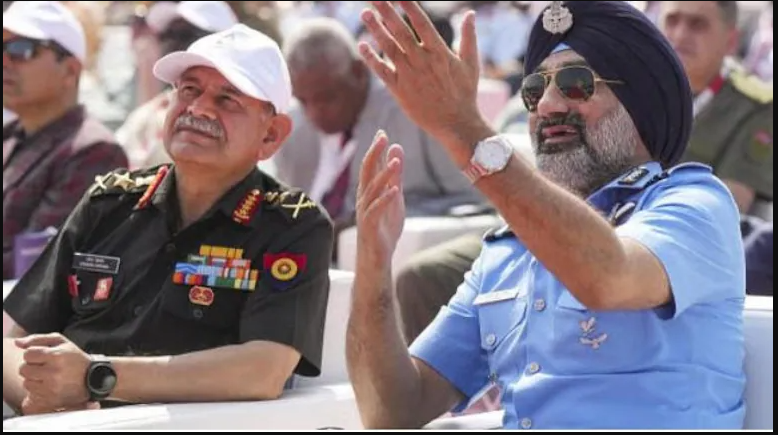
Speaking at different occasions, India’s chief of the army staff General Upendra Dwivedi warned Pakistan that India would no longer show any restraint as it did during Operation Sindoor if it was forced into another battle, while the air force chief reminding Pakistan about the losses it suffered during Operation Sindoor and warned that damages next time would be far greater if the western neighbour continued to fight proxy war with India.
General Dwivedi was addressing the soldiers at an outpost Anupgarh in Rajasthan while the Air Chief Marshal Amar Preet Singh was responding to a question at a press conference at the 93rd Air Force Day celebrations in Delhi when he said, “We struck a large number of their airfield and we struck a large number of installations.”
“India, as a country, is fully prepared this time. And this time, it will not show the restraint that it showed during Operation Sindoor 1.0. This time we will take a step forward and act in a manner that will make Pakistan think whether it wants to remain on the world map or not,” the army chief warned.
Dwivedi also urged Indian soldiers to remain ready for action. “Keep yourselves fully prepared now, if god wants, the opportunity will come soon,” he said, noting the importance of vigilance amid continuing threats.
He also said the focus of the strikes during Operation Sindoor were terrorist camps and bases in Pakistan and Pakistan-occupied Kashmir. Targeting these presented evidence to the world Islamabad does, in fact, harbour terrorism on its soil. Had India not acted, Pak would have hidden the truth, he said.
The army chief also claimed that India had exposed terrorist hideouts in Pakistan during its military confrontation, asserting that without India’s intervention, these would have remained concealed from the world’s view. General Dwivedi said India targeted nine terror sites inside Pakistan, seven by the Army and two by the Air Force.
“We had identified the targets because we only wanted to harm the terrorists. We had aimed to strike their bases. We have no complaints against ordinary Pakistani citizens, so long as their country does not sponsor terrorists. Because terrorists were being sponsored, those terrorist targets were hit,” he said.
The army chief was referring to the May 7 strikes codenamed Operation Sindoor, launched in response to the April 22 Pahalgam attack, which killed 26 civilians. The strikes reportedly eliminated over 100 terrorists before Pakistan requested a ceasefire on May 10.
Air Chief Marshal AP Singh said India shot down at least one Pak AEW&C (an airborne early warning platform) aircraft and four to five fighter jets, including US-made F-16s. He also mocked Islamabad for claiming it had downed Indian jets, calling them “manohar kahaniyan (fascinating tales).” He added, “If they think they downed our 15 jets, I hope they are convinced about it and they will cater for 15 less aircraft in my inventory when they come to fight again.”
He rejected Pakistan’s claims about Operation Sindoor and provided a detailed account of the damage inflicted on Islamabad during the May strikes. He went on to outline the extensive losses suffered by Pakistan. The Indian strikes hit “radars at least four places, command and control centres at two places, runways of course damaged at two places, then three of their hangars in three different stations have been damaged.”
“We have signs of one C-130 class of aircraft…and at least 4 to 5 fighter aircraft, most likely F-16 because that place happened to be F-16 with whatever was under maintenance at that time,” he added.
The list did not end there. He said, “Along with that, one SAM system has been destroyed…We have clear evidence of one long-range strike, which I talked about more than 300 km, which happened to be either an AEW&C or a SIGINT aircraft. Along with that, five high-tech fighters between F-16 and JF-17 class—this is what our system tells us.”
The remarks come days after Pakistani Prime Minister Shehbaz Sharif claimed at the UN General Assembly that his forces had downed seven Indian jets. “Our falcons took flight and etched their answer across the skies, resulting in seven of the Indian jets turning to scrap and dust,” he had said, without presenting any evidence to support his claims.
India countered these assertions the following day through Petal Gahlot, First Secretary in India’s Permanent Mission to the UN. “If destroyed runways and burnt-out hangars look like victory, as the prime minister claimed, Pakistan is welcome to enjoy it,” Gahlot said in a sharp rebuttal.
The tag-team takedown of Pak echoed strong remarks by Prime Minister Narendra Modi in May, two days after the Op Sindoor ceasefire. Pakistan, he said then, must know that India’s military has only suspended strikes on promises to act against terrorist groups operating from its soil. “In the coming days, we will measure every step of Pakistan on one criterion… what sort of attitude will they adopt (in dealing with terrorist groups embedded in its territories).” If Pakistan backtracks or misleads… then let me repeat that we have only suspended our action.”
India has repeatedly warned Pakistan that Op Sindoor – which began as retaliation for the April 22 Pahalgam terror attack – was only paused after the May 10 ceasefire, which Air Chief Marshal Singh underlined this afternoon had been asked for by Pakistan, and not a third party. The comment underlines India’s repeated assertion – the ceasefire was only because Pakistan asked for peace – made as United States President Donald Trump claimed credit.
The Indian military leaders’ comments also came after Defence Minister Rajnath Singh warned Pakistan over another long-standing border dispute, this one over Sir Creek in Gujarat. Reminding Pakistan the Indian armed forces hit its targets, disabling terrorist infrastructure and crippling Pak air defences, the Defence Minister said Op Sindoor had “exposed” the latter and put the enemy on alert. He also called out unsuccessful attempts to penetrate Indian defences.
Pak should keep this in mind when considering aggression in the disputed Sir Creek area, he said. “Any aggression by Pakistan in the Sir Creek area will be met with a resounding response that will change both history and geography,” the Defence Minister declared.
The Army chief also honoured three officers for their exceptional work during Operation Sindoor. At the event, BSF 140th Battalion Commandant Prabhakar Singh, Rajputana Rifles Major Ritesh Kumar, and Havildar Mohit Gaira received special recognition.