


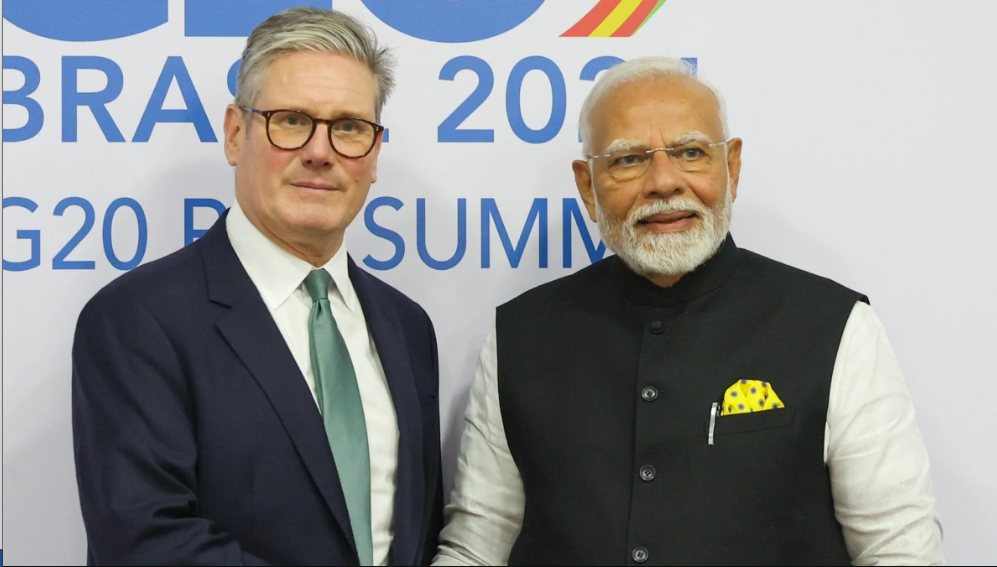
NEW DELHI, Oct 9: Prime Minister Narendra Modi has signed a new £350 million defence deal with his visiting United Kingdom counterpart Keir Starmer to buy missiles for the Indian army, the U.K. government said on Thursday.
The two leaders have also agreed to take forward their collaboration on electric-powered engines for naval ships, worth an initial £250 million. In a separate release, the U.K. government also said that 64 Indian companies have so far committed to invest £1.3 billion (₹15,430 crore) in the U.K., a sign of the growing business confidence boosted by the India-U.K. trade deal.
The Indian government has not shared similar data on investment commitments by U.K. companies in India. However, the U.K. government also said the University of Lancaster and the University of Surrey have been given approval to open new campuses in India to help meet booming demand from Indian students.
The missile deal paves the way for a “broader complex weapons partnership” between the U.K. and India, which is currently under negotiation between the two governments, the UK government said in its statement.
“The contract is set to deliver UK-manufactured Lightweight Multirole Missiles (LMM) built in Belfast to the Indian Army, delivering on the Government’s Plan for Change in another significant boost for the UK defence industry,” it said.
“A new milestone has also been reached in the UK and India’s cooperation on electric-powered engines for naval ships as both countries signed the Implementing Arrangement to advance collaboration to the next stage, worth an initial £250 million,” it added.
“Nearly 7,000 brand new jobs will be created in the United Kingdom thanks to a raft of major new deals secured by the Prime Minister during his visit to India this week,” the U.K. government said. “As a result, Indian investment will flow into a range of U.K. sectors including engineering, technology and the creative industries, driving growth and creating jobs across every region of the country – from Basingstoke to Birmingham,” it added.
Among the major investment announcements are TVS Motor’s plan to invest £250 million in Solihull to expand its Norton Motorcycles operations and develop next-generation electric vehicles. “Engineering company Cyient is investing £100 million to boost innovation in semiconductors, geospatial tech, mobility, clean energy, and digital domains – creating 300 UK jobs and strengthening its long-standing presence in the country,” the release said.
Muthoot Finance UK Limited, a part of the Muthoot Group, plans to invest £100 million to expand its branch network to 20 locations in the UK. Hero Motors plans to invest £100 million in the U.K. over the next five years in its e-mobility, e-bicycles and aerospace divisions.
On the first day of Mr Starmer’s visit to India on Wednesday, Rolls-Royce CEO Tufan Erginbilgic said his company has “deep ambitions to develop India as a home for Rolls-Royce.” He did not, however, mention any specific investment details.
The Imperial College, London, has partnered with Science Gallery Bengaluru (SGB) to co-develop open research facilities, boost U.K.-India and global talent exchange through a joint fellowship, Imperial President Hugh Brady announced on Thursday.
According to Mr Brady, the partnership also aims to explore public engagement along with research and education. The announcement was made as Imperial’s president joins a U.K. delegation led by Mr Starmer. “Through this new partnership, the two organisations plan to co-develop open research facilities on-site at SGB, boost U.K.-India and global talent exchange through a joint fellowship, and collaborate on exploring public engagement, research and education,” Mr Brady said.
He said by joining forces, the two organisations will train the innovators of the future and cultivate the next generation of talent. The partnership aims to co-develop new facilities, establish a joint fellowship program, and a major program for public engagement, he said. It will also help in further developing research and innovation links with Indian academia and industry, which is already accelerated following the launch of Imperial’s hub in May, he added.
Mr Brady explained that the new partnership sees a commitment to grow the international impact of the SGB’s Public Lab Complex and co-develop a new portfolio of initiatives spanning innovation and discovery challenges, science and technology fellowships, and public engagement.
“This exciting partnership is a launchpad for U.K.-India innovation and scientific collaboration. Imperial’s innovation and incubation expertise will create a unique lab and convening space with Science Gallery Bengaluru, where cutting-edge solutions to global issues will be discovered, designed and delivered,” he said.
“Our participation in the prime minister’s first India visit signals the role Imperial plays in strengthening U.K.-India partnerships, following the launch of our Imperial Global India hub earlier this year,” the institution said in a statement. It further said that by joining forces across continents, it is deepening research and innovation collaboration between the two countries, and building bridges that will empower the next generation of scientists, thinkers, leaders and change-makers.
Imperial College had set up its Indian hub in Bengaluru, the fourth in a series of its series of global network hubs following Singapore, San Francisco in the U.S., and Accra in Ghana. The hub called “Imperial Global India” has been established as a liaison office and will focus on strengthening and co-creating new research partnerships between Imperial and leading institutes in India.
Founding Director at Science Gallery Bengaluru, Jahnavi Phalkey, said, “We are delighted to be partnering with Imperial College London to co-develop our public lab complex. This is an important step in creating shared spaces where inquiry, creativity, and learning thrive across borders.” “We are excited about what we can build together,” she added.
(Manas Dasgupta)