


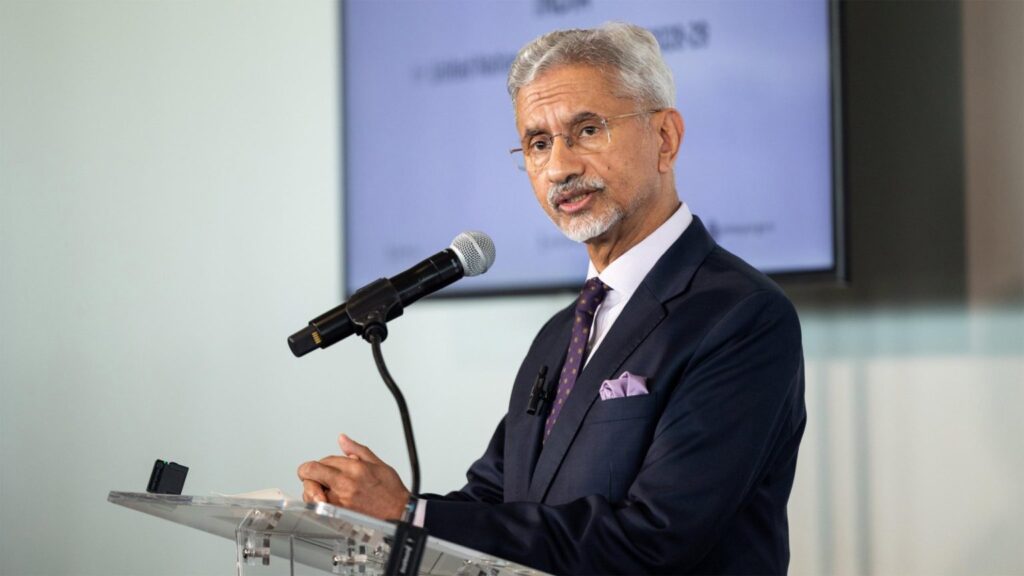
New Delhi: External Affairs Minister S. Jaishankar on Monday launched India’s campaign for a non-permanent seat on the United Nations Security Council (UNSC) for the 2028–29 term, outlining New Delhi’s vision for a more representative, effective and future-ready global order while identifying countering terror financing, strengthening maritime security and promoting responsible governance of Artificial Intelligence (AI) as key priorities.
Addressing member states at the UN Headquarters, EAM Jaishankar said the world is witnessing unprecedented levels of conflict, violence and instability, making stronger leadership from the United Nations and the Security Council more important than ever.
“We are witnessing levels of conflict, violence and instability that threaten even those who may be far away. To address this complexity, the UN must take the lead and the Security Council must show the way,” he said.
Presenting India’s campaign theme, SHANTI – Securing Holistic Advancement through Norms, Trust and Integrity – EAM Jaishankar said India’s approach would be guided by dialogue, cooperation and efforts to bridge differences while advancing the interests of the Global South.
He said India would work for “a secure, peaceful and equitable world” where the voice of the Global South is heard equally, multilateral institutions reflect contemporary realities, and peacekeeping operations are equipped to address present and future challenges.
One of India’s foremost priorities at the Security Council, if elected, will be intensifying efforts to curb terrorism by targeting its financial networks.
Describing terrorism as one of the world’s most persistent security challenges, EAM Jaishankar said global efforts have often focused on addressing its symptoms rather than its root causes.
“Our commitment is to concentrate on countering terror financing and encourage objective and evidence-based proposals for the listing of terrorist groups,” he said, adding that a transparent sanctions regime is essential for effectively combating terrorism.
Highlighting maritime security as another key priority, EAM Jaishankar said safeguarding global maritime trade has become increasingly important in an interconnected world where supply chains drive economic growth.
He said India would promote a free, open and rules-based maritime order in accordance with international law, particularly the United Nations Convention on the Law of the Sea (UNCLOS). Ensuring the safe and uninterrupted flow of maritime commerce, combating piracy, protecting seafarers and supporting humanitarian assistance and disaster relief (HADR) operations would remain central to India’s agenda.
EAM Jaishankar noted that India has consistently contributed to maritime security through search and rescue operations, humanitarian missions, capacity building and the sharing of best practices. He also highlighted the role of India’s International Fusion Centre in fostering maritime cooperation across the Indian Ocean region.
On emerging technologies, the External Affairs Minister said Artificial Intelligence presents enormous opportunities but also significant risks that require a human-centric approach to governance.
He said India has proposed the MANAV framework for AI, representing Moral and Ethical Systems, Accountable Governance, National Sovereignty, Accessible and Inclusive, and Valid and Legitimate Systems.
Referring to India’s efforts to bridge the global digital divide, EAM Jaishankar said the country remains committed to ensuring inclusive access to AI technologies while preventing their misuse.
“As a nation that has contributed to bridging the global digital divide, we stand equally committed in respect of AI. That is why the recent AI Impact Summit in India was based on a vision of ‘AI for All’. Equally important, we are determined to counter the misuse of AI and the threats it may pose to international peace and security,” he said.
EAM Jaishankar also outlined India’s vision for a future-ready UN peacekeeping framework, calling for missions that are better equipped, technologically enabled, realistically mandated and focused on core objectives. He reaffirmed India’s commitment to the Women, Peace and Security agenda and pledged continued support for a greater role for women peacekeepers.
The External Affairs Minister also reiterated India’s longstanding demand for reforms in global governance, saying multilateral institutions must become more democratic, representative and effective to address contemporary challenges.
Following the launch, EAM Jaishankar said in a post on X that India’s campaign would focus on strengthening the voice of the Global South, advancing reformed multilateralism, promoting future-ready peacekeeping, ensuring responsible AI governance, safeguarding maritime security and intensifying efforts against terror financing.
“A reformed, representative and results-driven Security Council needs a voice of the Global South at the table,” he said.
During his visit to New York, EAM Jaishankar also met United Nations Secretary-General António Guterres. The two leaders discussed major global developments, including the situations in West Asia, Ukraine and Sudan, while recognising the strength of India-UN cooperation.
(DD News)