


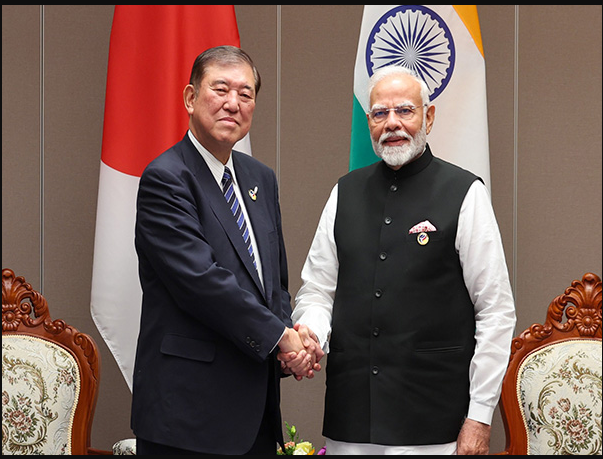
NEW DELHI, Aug 29: India and Japan on Friday signed a wide-ranging set of agreements spanning technology, space exploration, clean energy, critical minerals and cultural ties, underlining the ambition to scale up their “special strategic and global partnership” over the next ten years, after the Prime Minister Narendra Modi met his Japanese counterpart Shigeru Ishiba in Tokyo marking what both leaders described as a turning point in bilateral relations.
“Cooperation between India and Japan is crucial for global peace and stability. Today, we have laid a strong foundation for a new and golden chapter in India-Japan special strategic and global partnership. We have created a roadmap for cooperation for the next decade,” PM Modi said after the meeting.
The Indian Space Research Organisation (ISRO) and the Japan Aerospace Exploration Agency (JAXA) signed an implementing arrangement for cooperation on the Joint Lunar Polar Exploration Mission (Chandrayaan-5). The agreement defines the terms for joint exploration of the Moon’s South Pole, strengthening India-Japan collaboration in advanced space technology.
A new India-Japan Digital Partnership 2.0 was announced to deepen collaboration in emerging technologies such as artificial intelligence, semiconductors, IoT and digital public infrastructure. The two sides also pledged to expand joint research and development and the creation of digital talent pools.
To reduce supply chain vulnerabilities, both nations signed a Memorandum of Cooperation on Mineral Resources, focusing on critical minerals exploration, processing technologies, joint investments and stockpiling. The agreement is seen as vital for securing inputs essential for clean energy and advanced manufacturing.
Alongside these landmark initiatives, the two nations also signed a Joint Vision for the Next Decade, identifying eight priority areas ranging from economic security to ecological sustainability, as well as a Joint Declaration on Security Cooperation, creating a fresh framework for defence and strategic collaboration.
An Action Plan on Human Resource Exchange was adopted to enable the movement of 500,000 people, including 50,000 Indian skilled workers to Japan within five years. Additional MoUs focused on clean hydrogen and ammonia cooperation, climate change and biodiversity protection, cultural preservation and decentralized wastewater management. Agreements were also signed between diplomatic academies and research institutions to strengthen exchanges of diplomats, academics and scientists, along with enhanced cooperation in science and technology.
(Manas Dasgupta)