


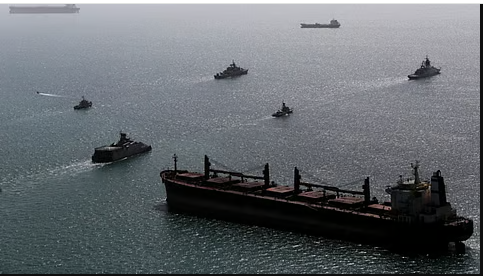
NEW DELHI, Mar 5: The Indian Navy launched search and rescue operations following a distress signal from the sinking Iranian frigate IRIS Dena after being struck by a torpedo from a United States submarine off the Sri Lankan coast in the Indian Ocean.
A distress call from IRIS Dena reached the Maritime Rescue Coordination Centre (MRCC) in Colombo during the early hours of March 4, according to a statement from the Navy. The frigate was positioned 20 nautical miles west of Galle, within the search and rescue region under Sri Lankan responsibility. Upon receiving the information, the Indian Navy initiated its efforts without delay.
According to the Navy, a long-range maritime patrol aircraft deployed at 1000 hours on March 4 to support the search operations that were already underway under Sri Lankan leadership. A second aircraft, equipped with air-droppable life rafts, remained on standby for rapid deployment if required.
INS Tarangini, a sailing training ship operating in the vicinity, received orders to assist and reached the search area by 1600 hours that day. By that point, the Sri Lankan Navy and other agencies had already begun search and rescue activities. INS Ikshak, a survey vessel, sailed from Kochi to reinforce the operation. It remains in the area conducting searches for missing personnel as a humanitarian effort on behalf of the shipwrecked crew. Coordination between the Indian Navy and Sri Lankan authorities has continued.
The frigate had been returning to Iran after participating in a military exercise at Visakhapatnam. Iran’s Foreign Minister Abbas Araghchi described the incident as an “atrocity at sea” in a post on X, stating that the ship, carrying almost 130 sailors, had been struck without warning in international waters, 2,000 miles from Iran’s shores. He called IRIS Dena a “guest of India’s Navy” and warned that the United States would “bitterly regret” setting such a precedent.
US Defence Secretary Pete Hegseth confirmed the action at the Pentagon, describing it as a “quiet death” achieved with a torpedo. He said it marked a significant extension of operations in the ongoing conflict sparked by a joint US-Israel attack on Iran, which has spread beyond the Middle East.
(Manas Dasgupta)