


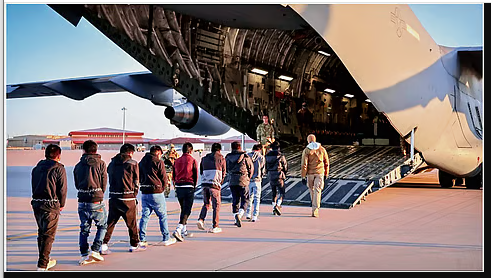
NEW DELHI, Dec 4: As many as 3,258 Indian nationals have been deported by the United States since January, this year, the highest for any year since 2009, External Affairs Minister S. Jaishankar told the Rajya Sabha on Thursday.
A total of 18,822 Indian nationals have been deported since 2009. Mr Jaishankar was replying to a question raised by Samajwadi Party MP Ramjilal Suman.
Mr Suman also asked “whether it is a fact that women have also been deported in handcuffs by the US Government.” Mr Jaishankar clarified that 73-year-old Harjit Kaur, whose deportation was widely reported in Indian media, was not handcuffed during her return to India. However, he confirmed that she was maltreated by Immigration and Customs Enforcement (ICE) officials during her detention in the U.S.
“While Harjit Kaur (deportee) was not handcuffed, she was maltreated in detention before she was put on the flight. We raised the matter of her maltreatment strongly with the American Embassy and asked the American authorities to look into it,” he added.
Ms Kaur was deported in September after spending three decades in the U.S. She spent 60 to 70 hours in detention without a bed and was forced to sleep on the floor despite double knee replacements. She was reportedly given ice to take medication and denied food she could eat, with guards blaming her for her inability to eat the provided sandwich.
In his written reply, he also noted that of the 3,258 deportees, 2,032 individuals (62.3%) travelled on regular commercial flights, while 1,226 (37.6%) were transported on ICE, the U.S. Customs and Border Protection (CBP) charter flights. He emphasized that while issuing visas is a sovereign right, India has raised concerns about the ill-treatment of Indian deportees, especially women and children, with U.S. authorities.
“The issuance of visas is a sovereign right of a government. In the case of the United States, the US government has taken a view, the latest announcement was yesterday, that every visa adjudication is a national security decision. So, they reserve the right to take a decision on a visa, which is based on their assessment of the national security implications of a particular individual’s position,” Mr Jaishankar said.
The U.S., he added, has asked applicants, particularly student visa seekers, to switch their social media settings from private to public so that authorities can scrutinize their online activity.
Responding to supplementaries on the issue, the Minister said the problem began in April 2025, when a new policy was announced by the Secretary of State in the U.S. “As a result of that, even for relatively minor offences, we saw the cancellation of visas of students. In many cases, there was also pressure on them to self-deport,” Mr Jaishankar said.
Asked whether the Indian authorities have taken up the issue with U.S. authorities, the Minister said, “Yes, in each of these cases, wherever it came to our attention, and when students directly contacted our consulates or embassies, the consulates and embassies intervened where possible.” “We have tried to get the American system to understand that minor offences should not be a reason for such action,” he said.
The U.S. government has expanded screening and vetting measures for H-1B visa applicants and their H-4 dependents, directing them to keep the privacy settings on all their social media profiles set to public. In a new order issued Wednesday, the State Department said beginning December 15, a review of the online presence for all H-1B applicants and their dependents would be conducted. Students and exchange visitors were already subject to such scrutiny, which has now been extended to include those applying for H-1B and H-4 visas.
(Manas Dasgupta)