


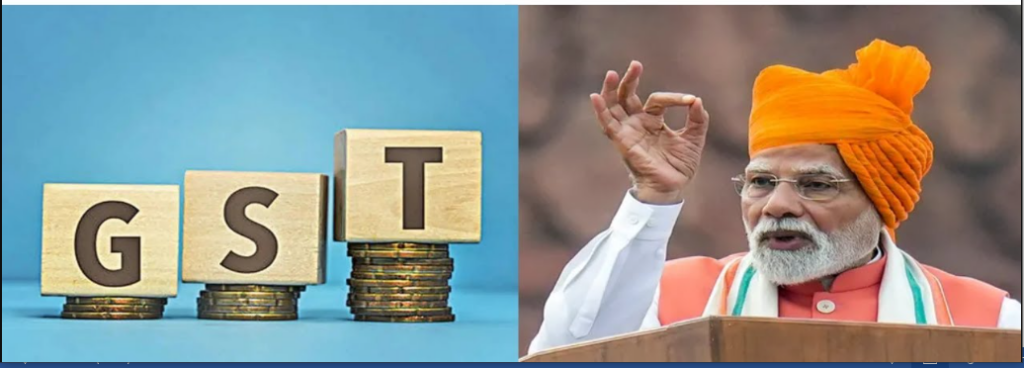
NEW DELHI, Aug 21: The Group of Ministers (GoM) on Rate Rationalisation, formed by the Goods and Services Tax (GST) Council, has accepted the Centre’s two-rate GST structure proposal.
The GoM will be recommending the GST Council to adopt the two-rate formula, the chairperson of the GoM, Samrat Choudhary, who is also the Bihar deputy chief minister, said on Thursday. This was the first of the two steps the proposals would need to clear before being implemented. The second step would be for the GST Council to accept the changes.
“It was the Centre’s proposal to end two slabs of GST, the 12% and 28% slabs,” Mr Choudhary told reporters. “We discussed that proposal and have supported it. We have recommended it, and now the GST Council will decide on this.” The Centre has not, however, announced the date for the next GST Council meeting, although it is expected in early September.
The move for the “next-generation GST reforms” to reduce the tax rates was announced by the Prime Minster Narendra Modi in his Independence Day speech from the ramparts of the Red Fort. Mr Modi had announced it as a “Deepavali gift” from the Centre to the people.
The Centre’s proposal involves retaining just the 5% and 18% slabs in the current GST structure and doing away with the 12% and 28% slabs. This would entail 99% of the items in the 12% slab moving to 5%, and 90% of the items in the 28% slab moving to 18%.
The remaining items in the 28% — comprising ‘sin’ goods and services such as tobacco, cigarettes, and online real-money gaming — would be moved to a higher 40% slab. However, the compensation cess currently being levied on the items in the 28% slab would no longer apply.
The new GST regime would be consumer-centric, with particular emphasis on the poor, the MSMEs, the middle class and the farmers, senior government sources said on Sunday (August 17, 2025). The new two-tier Goods and Services Tax (GST) structure of 18% and 5% rates will have the twin objective of making rates and processes simpler and more rational, as it was originally intended to be, the sources said.
The proposed shift of most items from 12% slab to 5% and from 28% slab to 18% promises tangible relief for households and MSMEs while aligning with the government’s broader agenda of growth and financial inclusion,” experts said but added that it needed “careful calibration” to preserve revenue neutrality and avoid inflationary pressures.
According to them, the Centre’s proposals were an acknowledgement of the importance of consumption to the Indian economy. “This is a clear signal of confidence in India’s domestic consumer base as the primary engine of growth, especially amid global trade uncertainties,” they said. “By easing costs for households and enhancing affordability, this framework is poised to strengthen our consumption-driven economy.”
“This has been in the making for a while. Our learning from the last eight years is going into this, and this will be a fundamental change in the template of taxation,” one senior functionary said. “The new GST regime will make our taxation more equitable, and will see reduced taxes on what these four categories consume. The template will be more from the consumers’ point of view, and it will be put to and explained to the States from the consumers’ point of view.”
The Centre expects any reduction in revenues that this may cause to be soon offset by a new buoyancy in the economy expected from rate rationalisation and process simplification. “Reduced rates will not lead to reduced revenues, and we expect compliance and collection going higher,” an official said, adding that the forthcoming tax regime will be “fiscally sustainable.”
“Revenues may fall in the very short run but we expect change in consumption and ease of compliance to make up for it. Thus, it will be a fairly fiscally sustainable exercise,” said a source. The Centre expects the States to be on board with the proposals in time for the Deepavali — October 20 — deadline it has set for itself to set them in motion. In a press release following the PM’s speech, the Ministry of Finance said the Centre would be engaging with the State governments in the subsequent weeks, in the run-up to the next GST Council meeting.
(Manas Dasgupta)