


Manas Dasgupta
NEW DELHI, Jan 16: Family legacies, splits and reunions after years, appear to be in a shambles in Maharashtra with results of the civic elections show that the voters were not impressed with divergent branches coming together after long gaps.
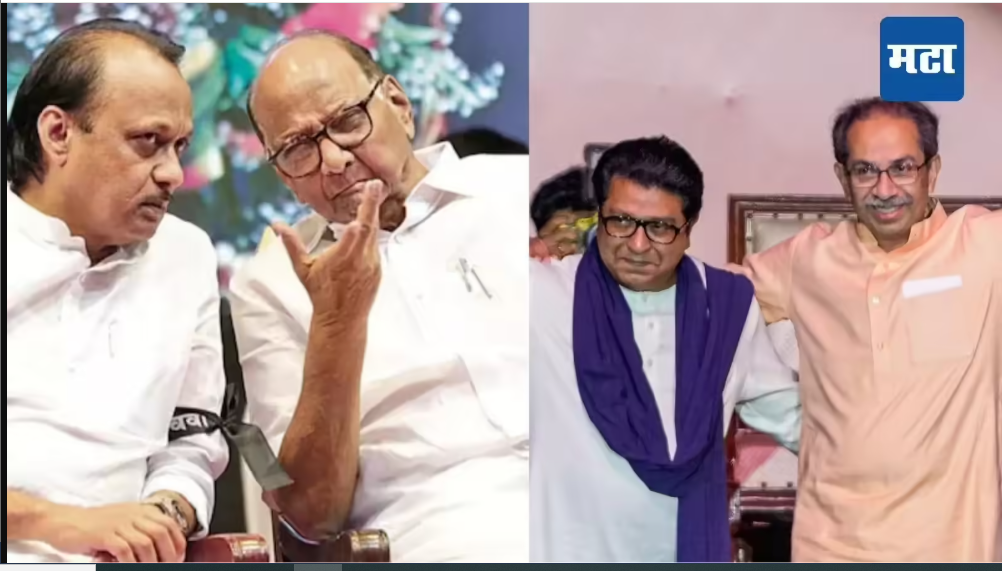
Maharashtra’s complicated political space took a turn ahead of the Brihanmumbai Municipal Corporation elections when estranged cousins Uddhav and Raj Thackeray joined forces after 20 years. The much-publicised reunion was meant to consolidate the Marathi vote and reclaim the legacy of Bal Thackeray – Uddhav’s father and Raj’s uncle – from his aide Eknath Shinde, who is now in control of both the Shiv Sena name and symbol.
For Uddhav Thackeray, who had gambled once by cutting off ties with long-time ally BJP and forming an alliance with the Congress and Sharad Pawar’s Nationalist Congress Party (NCP), the latest move was seen as a desperate roll of the dice after the Maha Vikas Aghadi (MVA) coalition suffered an embarrassing defeat in the 2024 Maharashtra Assembly elections.
The 2022–23 splits of the Thackerays’ Shiv Sena and Pawars’ NCP in Maharashtra landed their breakaway groups in a BJP-led government in the state; but the implosions appear to have taken full effect now.
At the centre of this election is Mumbai, where Uddhav Thackeray’s making up with cousin Raj after two decades does not seem to have meant much in the end.
The rule of the undivided Shiv Sena founded by Uddhav’s late father Bal Thackeray lasted 25 years here — with and without the BJP — until 2022, since when elections were pending.
Eknath Shinde has long claimed Bal Thackeray’s aggressive legacy of Hindutva, terming the relatively moderate Uddhav as having diverged by aligning for power with the Congress and the NCP. That was his stated logic for breaking away in 2022 with BJP’s support, and replacing Uddhav as CM. Shinde is now deputy to CM Devendra Fadnavis since the 2024 assembly election.
In the fight for a legacy of street aggression, Raj Thackeray and his Maharashtra Navnirman Sena (MNS), formed after Bal Thackeray favoured son Uddhav as his successor, brought back some of the original Thackeray flavour. He deployed anti-migrant sentiment, laid a claim to the ‘Marathi manoos’ vote bank, and recycled Bal Thackeray’s original slogans from the 1960s, when the anti-‘outsider’ sentiment was directed more against South Indians, unlike those from North Indian states like UP and Bihar now.
“Hatao lungi, bajao pungi,” he harked back, attacking BJP’s Tamil Nadu leader K Annamalai by making fun of the loincloth traditionally worn by many South Indians. But the boat appears to have sailed, as even Bal Thackeray had long shifted to a BJP-adjacent Hindutva line in his politics with the anti-migrant stance as plus-one. Uddhav and Raj may call BJP’s Hindutva fake, but lack of numbers would now mean they have a central question to answer for themselves: What’s their Senas’ core ideology?
The Sharad Pawar-Ajit Pawar uncle-nephew split of 2023 was more straightforward in one sense — there was no family outsider like Shinde involved in their feud. Their making up also happened more quickly thus, for the municipal elections in Pune and Pimpri-Chinchwad, even when Ajit remains the second deputy CM in the BJP-led state government. But in both Pune and Pimpri-Chinchwad municipal corporations, their strongholds, the Pawar alliance is far from power as per result trends showed.
The BJP was leading in Pune, set for majority. The NCP of Ajit Pawar, which has the original name and symbol, was in single digits, as was the NCP(SP) led by Sharad Pawar’s daughter Supriya Sule. The Congress and the Thackerays’ parties did not look like they would open their account. Eknath Shinde’s Sena is on its own here — not with the BJP — and looked set to end up with zero.
The Pimpri-Chinchwad corporation, considered one of the richest after Mumbai’s, was held by Sharad Pawar’s undivided NCP since 2017 until the end of the last term in 2022. Here the BJP had taken a wide lead with Ajit Pawar’s NCP a respectable second but Sharad Pawar’s party hardly on the scoreboard.
This puts a spanner again in talk that the Pawar may even come back together at the state and central levels. There was chatter of a plum post for Supriya Sule, but all that is eclipsed by ground realities and lost strength for now, until or unless Maharashtra sees another big churn within families and alliances.
The BMC elections were also crucial because the corporation is one of Asia’s richest and the Shiv Sena had been in power there for 25 years. For Uddhav Thackeray’s Shiv Sena (UBT), then, this election was about defending its last bastion. Friday’s results have made it clear, however, that the coming together of the Thackerays did not work, and that may have largely been down to one cousin.
What’s worse, Raj Thackeray’s strident stand on non-Maharashtrians and a violent championing of Marathi pride, including his workers beating up people for not speaking the language, is also being seen as having cost the Shiv Sena (UBT) seats, especially in wards with a large non-Marathi population. The speculation, thus, is that, despite a transfer of votes from the MNS to his party, Uddhav Thackeray would probably have been better off contesting on his own or with the Congress, which has won 11 wards but enjoys more support among non-Maharashtrians.
Sharad Pawar’s NCP, which was in an alliance with the Shiv Sena (UBT) and the MNS, failed to open its account. Things may have been different, however, if the Maha Vikas Aghadi – Congress-Shiv Sena (UBT)-NCP(SP) – coalition, which has been in existence since 2019 and won more seats than the ruling alliance in the 2024 Lok Sabha polls, had fought together.
Uddhav Thackeray may have lost control of the BMC amid a massive challenge from the BJP, but his position as a leader of consequence has remained intact with the Shiv Sena (UBT) winning 74 seats so far and outsmarting Eknath Shinde. While Shinde made inroads into Mumbai, it could not dent the Thackerays’ position as the face of the Marathi Manoos in the financial and entertainment capital. Uddhav Thackeray’s MVA ally, the Congress party, decided to go it alone leaving the Thackeray cousins to consolidate their base to put up a fight. The Marathi Manoos in Sena strongholds have shown faith in Uddhav Thackeray and the Shiv Sena (UBT) has managed to show a decent performance.
The loss of control of the BMC is a big blow to the Shiv Sena (UBT) as the BMC has been the main power centre for the Shiv Sena since its inception. The Sena always maintained that its control over the BMC was the main point of agreement between its allies. Eknath Shinde may have walked away with a majority of corporators, but in this election Uddhav Thackeray has reaffirmed that when it comes to Mumbai, he controls the legacy of the Shiv Sena which was founded by his father, Bal Thackeray.
Uddhav Thackeray has also claimed the Opposition space as Eknath Shinde’s Shiv Sena failed to win more than the Shiv Sena (UBT). With the Congress decimated, Uddhav Thackeray becomes the de-facto Opposition now.
The results of the Pune and Pimpri-Chinchwad Municipal Corporation elections have delivered a clear political message: the Pawar brand, once considered decisive in these urban power centres, no longer guarantees victory on its own. Despite tactical coordination between the two Nationalist Congress Party (NCP) factions led by Sharad Pawar and Ajit Pawar, the electorate did not respond with the kind of consolidation the leadership had hoped for.
In Pune Municipal Corporation, the BJP has emerged with a clear upper hand. The party has either won or taken strong leads in a large number of wards, positioning itself to dominate the civic body. The NCP factions, even when fighting on broadly aligned lines, failed to convert their traditional pockets of influence into a citywide momentum. Pune’s voter profile has changed significantly over the past decade, with middle-class, first-time voters and apartment-centric societies responding more to governance, infrastructure, and national-level political narratives than to legacy local leadership.
The Pawars’ campaign struggled to counter this shift with a compelling, unified urban vision. Pimpri-Chinchwad was expected to be different. Historically, PCMC has been considered a Pawar stronghold, especially under Ajit Pawar’s influence. However, the results here too have disappointed the NCP camp. The BJP has made deep inroads and is leading or winning enough seats to challenge, if not outright deny, NCP dominance.
This outcome is particularly significant because Pimpri-Chinchwad was seen as the testing ground for whether Ajit Pawar’s personal clout could still decisively shape urban verdicts. The verdict suggests that charisma alone is no longer sufficient without strong organisational unity and a clear political narrative.
One of the key reasons behind the setback is the incomplete nature of the Pawars’ coming together. While there was seat coordination and an attempt at joint campaigning, this was never projected as a full political reunion. On the ground, workers remained divided, loyalties were confused, and voters were unsure whether this was a genuine reconciliation or merely a temporary adjustment to stop the BJP. That ambiguity diluted the impact of the alliance.
At the same time, the BJP entered both elections with superior booth-level management, a clearer message, and a sustained urban presence built over years. In contrast, the NCP’s effort appeared reactive, stitched together close to the polls, and overly dependent on legacy goodwill rather than future-oriented promises. Internal competition between local leaders loyal to different Pawar camps also weakened campaign coherence in several wards.
The losses now raise a larger question about the future of Pawar unity. Will these results push Sharad Pawar and Ajit Pawar to reassess their separation more seriously, or will the setback instead harden positions and revive internal rivalries? So far, both sides have maintained that cooperation was limited to civic elections and that no formal merger has been decided. After these results, the incentive to immediately expand that cooperation appears uncertain.