


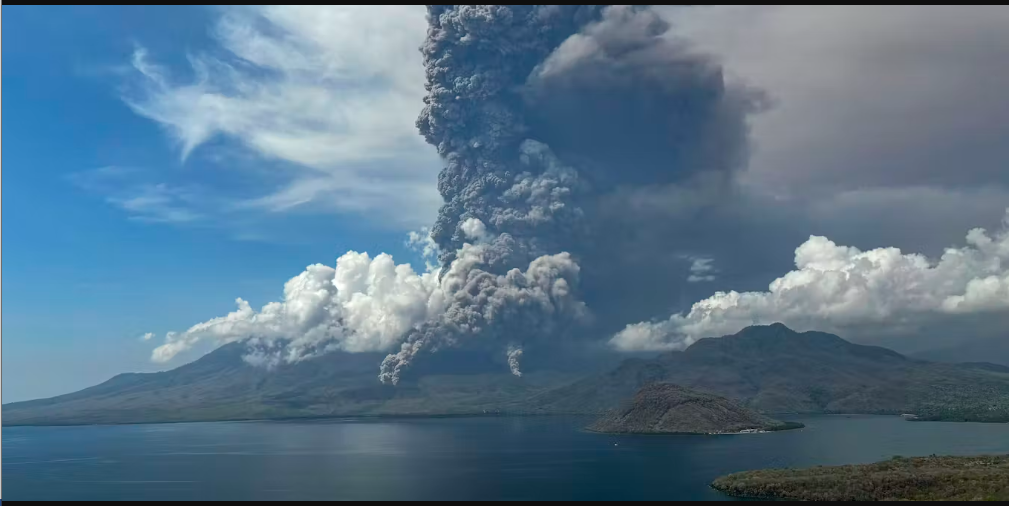
NEW DELHI, Nov 24: A thick cloud of ash due to a volcanic eruption for the first time in thousands of years at Ethiopia’s Hayli Gubbi volcano, is likely to impact northwest India on Monday night, with the ash plumes expected to enter Gujarat and move towards Rajasthan, Delhi-NCR and Punjab in the next few hours, meteorological experts said.
Aircraft operations in and around Indian airspace are also beginning to be impacted as the ash moves towards the region, with further disruptions likely in the next few hours, officials said.
The plumes – consisting of volcanic ash, sulphur dioxide and even small particles of rock – are at heights of around 10-15 kms above the surface, the India Meteorological Department (IMD) has said, stating it will primarily impact flights.
Airlines had already begun to cancel flights post noon, following the movement of the ash across the Red sea, drifting towards Middle East and Central Asia. IndiGo was forced to cancel six flights due to the issue. While one of these flights originated from Mumbai, the others cancelled were originating from down South,” sources said.
A Mumbai airport official said flights were re-routing via Pakistan airspace. “The Pakistan airspace is shut for Indian airlines, hence the Indian airlines are expected to be impacted. We have started keeping a record of this and are monitoring the situation,” an official said.
“Flights either have to be re-routed or cancelled. While the impact on flight operations are minimal today, the situation is expected to be worse on Tuesday,” another official said. “The ministry officials as well as the DGCA are keeping a close eye on the matter. If the ashes settle over Delhi and Jaipur by Tuesday, Indian aviation is expected to be impacted severely,” he added.
The IMD also said its impact in the region is likely in the coming hours. “This will begin to impact Gujarat and other parts of Delhi-NCR in the next few hours. It is already nearing Gujarat and we will see its impact over Delhi-NCR and neighbouring northern India in the next few hours,” IMD director general M Mohapatra said.
“It is in the upper-levels so we will not see significant impact near the surface. It will appear as a hazy, cloudy sky with its impact expected for a few hours, as it continues to move further eastwards,” he said.
“The impact over cities will mainly be a marginal rise in the temperature. Similar to clouds, the minimum will rise. It is unclear whether it will impact air quality, but any significant impact is unlikely as it is at higher levels,” Mohapatra added.
Meteorological experts said the plume was moving rapidly across Central Asia and into India. “The ash plume is moving at a speed of around 100-120km/h, towards north India. This is between 15-25,000 feet and upto 45,000 feet up in the sky and contains mostly volcanic ash, sulphur dioxide and some small particles of glass or rock which will make the sky appear darker and impact air traffic,” said Ashwary Tiwari, an amateur weatherman, who runs the handle IndiaMetSky on X.
“It has already begun to impact Jodhpur, with NCR and other areas likely to be impacted soon,” he added. This is expected to possibly spike the already high pollution levels in the region too. Already, air quality in NCR was on the brink of ‘severe’ at most locations. Delhi’s air quality index (AQI) stood at 382 at 4 pm on Monday. It was 396 (very poor) at Ghaziabad at the same time; 397 in Noida; 382 at Greater Noida and 232 (poor) in Faridabad. An AQI over 400 is classified as ‘severe’ with the AQI maxing out at 500.
(Manas Dasgupta)