


Manas Dasgupta
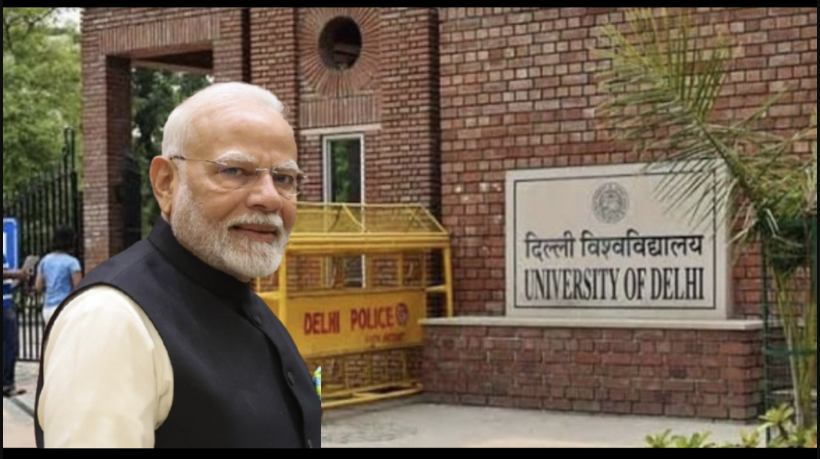
NEW DELHI, Aug 25: Ending the row over the Prime Minister Narendra Modi’s educational qualifications, the Delhi High Court on Monday quashed the Central Information Commission’s (CIC) 2016 order permitting an RTI activist to inspect Delhi University’s 1978 BA records, the year Mr Modi is claimed to have graduated from the institution.
The Court’s order came on an appeal filed by DU against the CIC’s December 21, 2016, order allowing an RTI application questioning Mr Modi’s graduation degree. The court had stayed the CIC’s order on the very first date of hearing, January 24, 2017.
On the RTI plea of one activist Neeraj, the CIC had ordered DU to allow inspection of its register containing details of all students who passed the BA examination in 1978 — including their roll numbers, names, fathers’ names and marks — and to provide certified extracts of the relevant pages.
In its plea, the DU had contended that it cannot reveal details personal information of all students, who had appeared in Bachelor of Arts in the Year 1978, the year PM Modi cleared the degree. DU had argued that the information of students is held in “fiduciary capacity, the same is exempt from disclosure” under the RTI Act. DU had said the CIC order had “far-reaching adverse consequences” for all universities in the country that held degrees of crores of students.
Previously, Solicitor General Tushar Mehta, representing DU, had argued that the purpose of RTI was not to satiate a third party’s curiosity. “Section 6 provides a mandate that information will have to be given, that is the purpose. But the RTI act is not for the purpose of satisfying someone’s curiosity,” Mr Mehta had argued.
The CIC, in its order, told DU to allow inspection and rejected the argument of its public information officer that it was a third party personal information, observing there was “neither merit, nor legality” in it.
Challenging the CIC’s directives, the DU had argued that mere “interest to public” was not the same as matters of “public interest”, which warrant a disclosure under the Right to Information (RTI). “Mere curiosity that ‘I want to know about it, what is your objection’ cannot be an argument. The public may get interested in something but it may not be in public interest. Is there any public interest in this matter? The answer in the facts of this case is: no,” Solicitor-General Tushar Mehta, representing DU, he said.
Noting that there lies a “special relationship of trust and confidence” between a student and a university which is fiduciary in nature, the court held that information pertaining to an individual’s educational qualifications — including degrees and marks — falls within the ambit of “personal information” under provisions of the RTI Act.
Claiming that DU held the information in a fiduciary capacity, the Solicitor-General had said “mere curiosity” in the absence of public interest did not entitle anyone to seek private information under the RTI law. Senior advocate Sanjay Hegde, appearing for the RTI applicant who sought the information before the CIC, submitted that the marks obtained by a student were not held in a fiduciary capacity by an educational institution.
Mr Hegde had argued that the RTI Act provided for disclosure of such information in the greater public good. “The fact that it relates to an old degree does not immunise the information from being republished. Marks, whether pass or fail, are not external or pre-existing information given by a student in fiduciary capacity. It is generated by the university in the process,” he had submitted.
The court underlined that “disclosure of academic details sans any overriding public interest, would amount to an intrusion into the personal sphere”, which was otherwise protected under right to privacy. Justice Sachin Datta, recording that the framework of the university’s statutes “does not permit the disclosure of marks/grades to any third party,” said “there is a legitimate expectation on the part of the students that confidentiality shall be maintained” with regard to their information.
The court also relied on a Gujarat HC order of 2023 where it had similarly quashed and set aside an order of the CIC that had directed the varsity to “search for information” regarding PM Modi’s degrees at Gujarat University in 1983. “It is unambiguously clear that the ‘marks obtained’, grades, and answer sheets etc., are in the nature of personal information and protected under Section 8(1)(j) of the RTI Act, subject to an assessment of overriding public interest… This court cannot be oblivious to the reality that what may superficially appear to be an innocuous or isolated disclosure could open the floodgates of indiscriminate demands, motivated by idle curiosity or sensationalism, rather than any objective ‘public interest’ consideration,” Justice Datta said in the 175-page order.
The order further stated, “Disregarding the mandate of Section 8(1)(j) in such a context would inexorably lead to demands for personal information concerning official functionaries spanning the entire gamut of public services, without any real ‘public interest’ being involved. The RTI Act was enacted to promote transparency in government functioning and not to provide fodder for sensationalism.”
The verdict comes nearly six months after the court had completed the hearing on February 27 and reserved the case for orders. In its ruling on Monday, the HC also noted that the “entire approach of the CIC” in its order directing for disclosure “was thoroughly misconceived.” It expressed “its dismay” that the CIC’s order “is based on a subjective critique rather than on the interpretation and application of the statutory provisions as they exist.”
Among the petitions filed by DU was also one which challenged a CIC direction in the 2016 order. The Commission had directed the university to recover Rs 25,000 from the salary payable to the Central Public Information Officer (CPIO), in five equal monthly instalments, for rejecting an RTI application as the fee was not paid.
The court set this aside as well, recording that imposition of such a penalty and its recovery from the personal salary of the CPIO “requires clear, cogent and specific finding of deliberate wrongdoing or misconduct” — which the CIC failed to record in its order. Justice Datta further recorded that “any perceived shortcomings in the procedure cannot be construed as “obstructionist” or “malafide.”
“The CIC ought not to have lost sight that the CPIO could not be faulted for seeking to adhere to the requirements under… RTI Rules, 2012. At the very highest, the conduct of the CPIO could be characterised as a procedural irregularity rather than a malafide or obstructionist denial of information,” Justice Datta recorded.
Taking note of the “staggering number of RTI applications” DU receives each year — between 2,100-2,400 per year from 2014-17 — the court observed that it “is demonstrative of the burden imposed on the CPIO” and, thus, recovery of penalty from the CPIO’s personal salary is “clearly disproportionate.”
The court also dealt with a petition filed by the Central Board of Secondary Education (CBSE) against one Mohd Nashadudin and others — who had sought copies of the admit card and marksheet of former BJP MP Smriti Irani in an RTI application moved in 2015.
The Board challenged a January 2017 order of the CIC to facilitate inspection of records and provide certified copies of the documents selected free of cost, except personal details in admit card and mark-sheets. Setting aside this order on similar lines, the HC held that the information sought in the RTI application “falls squarely within the exemption” contemplated under Section 8(1)(j) of the RTI Act.