


Manas Dasgupta
NEW DELHI, Sept 19: With many Arab nations feeling a rising threat from Israel, the Saudi-Pakistan defence pact announced this week brings Pakistan and its nuclear umbrella into the region’s security equation.
The “Strategic Mutual Defence Agreement” signed between Pakistan and Saudi Arabia on Wednesday effectively marries Riyadh’s money with Pakistan’s giant nuclear-armed military. Few details of the pact have been disclosed, and Pakistan’s stated nuclear doctrine says that its weapons are solely aimed against India.
But Pakistan’s Defence Minister said on Thursday night that the country’s nuclear programme “will be made available” to Saudi Arabia, if needed, under the new pact between Pakistan and Saudi Arabia, which have had military ties for decades. It was the first specific acknowledgment that Islamabad had put the Saudi kingdom under its nuclear umbrella and underlined the importance of the pact.
The move is seen by analysts as a signal to Israel, long believed to be the Middle East’s only nuclear-armed nation. It comes after Israel’s attack targeting Hamas leaders in Qatar last week killed six people and sparked new concerns among Gulf Arab nations about their safety.
“Let me make one point clear about Pakistan’s nuclear capability: that capability was established long ago when we conducted tests. Since then, we have forces trained for the battlefield,” Mr Asif said. “What we have, and the capabilities we possess, will be made available to (Saudi Arabia) according to this agreement,” he added.
The two countries signed a defence deal Wednesday declaring that an attack on one nation would be an attack on both. Neither country has responded to questions about the pact and what it meant in regards to possibly accessing Pakistan’s nuclear arsenal.
Hours after the announcement of the Pakistan – Saudi Arabia agreement, India has said it was aware of the development and reiterated its commitment to “comprehensive national security.” “The Government was aware that this development, which formalizes a long-standing arrangement between the two countries, had been under consideration. We will study the implications of this development for our national security as well as for regional and global stability. The Government remains committed to protecting India’s national interests and ensuring comprehensive national security in all domains,” said the Ministry of External Affairs in response to the Saudi-Pakistan mutual defence agreement.
Saudi Arabia has long been linked to Pakistan’s nuclear programme. Retired Pakistani Brigadier General Feroz Hassan Khan has said Saudi Arabia provided “generous financial support to Pakistan that enabled the nuclear programme to continue, especially when the country was under sanctions.” Pakistan faced U.S. sanctions for years over its pursuit of the bomb, and saw new ones imposed over its ballistic missile work at the end of the Biden administration.
Pakistan developed its nuclear weapons programme to counter India’s atomic bombs. India is believed to have an estimated 172 nuclear warheads, while Pakistan has 170, according to the U.S.-published Bulletin of Atomic Scientists.
Gulf Arab states said Israel, which has never confirmed or denied possessing nuclear weapons, had shown itself to be a direct threat following its unprecedented strikes on Qatar last week. Saudi Arabia has also said if rival Iran acquired nuclear weapons, it would follow.
Asked whether Pakistan would now be obliged to provide Saudi Arabia with a nuclear umbrella, a senior Saudi official said, “This is a comprehensive defensive agreement that encompasses all military means.” Analysts said the agreement also reflected shrinking confidence in the security provided by the United States to the region. A statement from Saudi Arabia said the pact “aims to develop aspects of defence cooperation between the two countries and strengthen joint deterrence.”
Pakistan, the only nuclear-armed Muslim nation, is one of the poorer countries in Asia, but it has an army of more than 600,000. Pakistan has fought three major wars with India, along with numerous clashes, including a four-day conflict in May that was their heaviest fighting in decades.
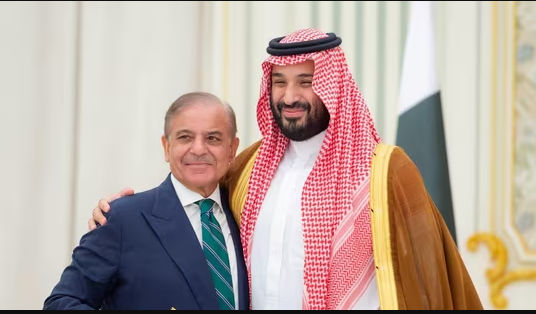
Wednesday’s announcement made no mention of nuclear weapons or any payment to Pakistan. “The agreement states that any aggression against either country shall be considered an aggression against both,” Pakistan said. Pakistan’s Prime Minister Shehbaz Sharif thanked the Saudi crown prince, Mohammed bin Salman, for “his keen interest in expanding Saudi investments, trade and business ties.”
India and Pakistan went nuclear in the late 1990s, with Pakistan developing missiles that can hit deep into India. But if pointed the other direction, Pakistan’s longest-range missiles could – in theory – strike Israel.
Pakistan for long had a small military contingent in Saudi Arabia, but this week’s agreement points to far greater involvement. “For Pakistan, the power projection into the Middle East is huge, even though it has inserted itself into a volatile region,” said Maleeha Lodhi, Pakistan’s former ambassador to the United States.
Mushahid Hussain, a former chairman of the defence committee of Pakistan’s Senate, said Pakistan’s outlook had been pan-Islamist since it was founded. “Pakistan has the military capability and, in turn, what we get is economic strengthening,” said Hussain. “Pakistan is the new strategic option for these Gulf nations.”
Pakistan struggles to compete with an Indian defence budget that is at least seven times as big, meaning any new Saudi injection of funds could even the balance somewhat. Saudi Arabia has helped Islamabad financially for decades, most recently with a $3 billion loan.
Saudi Arabia also has close ties with India. It is one of the top energy suppliers to India is also a major employer of Indian blue and white collar expat workers in the Gulf and in recent years had gradually built military relation with India. The inaugural Saudi-India military exercise SADA-TANSEEQ was held from January 29 to February 10 2024 in Rajasthan where a Saudi contingent had participated in the exercise with the Indian Army.
However, in comparison, the Saudi relation with Pakistan has been marked prominently by the generous support that Riyadh extended to Pakistan especially after the humiliating defeat in the 1971 India-Pakistan war. Saudi Arabia first came to Pakistan’s rescue with a $300 million assistance that King Faisal extended after meeting Prime Minister Zulfiqar Ali Bhutto’s foreign minister Aziz Ahmed in Riyadh in 1974.
Over the years, Pakistan has intensified defence cooperation with Saudi Arabia and as a recognition of that Saudi Arabia conferred then Pakistani Army Chief Qamar Javed Bajwa with the prestigious King Abdulaziz Medal of Excellent Class in 2022.