


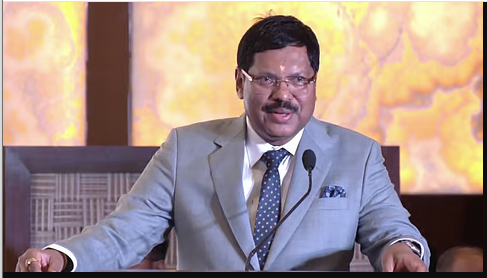
NEW DELHI, Set 18: After 48 hours of incessant social media outrage over his oral remarks made in a hearing on a damaged Lord Vishnu idol, Chief Justice of India B.R. Gavai broke his silence on Thursday to clarify in open court that he believed in all religions, visits sites of worship of every faith, and firmly trusts in “true secularism.”
“Someone told me the other day that the comments I made are being portrayed in social media. I believe in all religions. I respect all…” Chief Justice Gavai said to the assembled courtroom when the Bench re-assembled after the lunch break.
The remarks in question were made on Tuesday, while dismissing a plea seeking directions to reconstruct and reinstall a seven-foot idol of Lord Vishnu at the Javari Temple, part of the UNESCO World Heritage Khajuraho temple complex in Madhya Pradesh.
A bench headed by Chief Justice Gavai had refused to entertain the plea filed by a person named Rakesh Dalal, who sought the replacement and consecration of the damaged idol at the Javari Temple in Chhatarpur district. Declining the plea, the CJI, speaking for the Bench also comprising Justice Vinod Chandran, had orally remarked that this was a purely “publicity interest litigation. Go and ask the deity himself to do something. If you are saying you are a strong devotee of Lord Vishnu, then you pray and do some meditation,” the CJI said.
The top court rejected the plea, observing that the issue squarely fell under the Archaeological Survey of India’s jurisdiction. “It’s an archaeological find, whether ASI would permit such a thing to be done or not. There are various issues,” CJI said.
On Thursday, the CJI explained that his remarks were intended to convey that the court could not possibly intervene as the area was a protected monument. He noted that the comments had been taken out of context. “We said it is within the monuments controlled by the Archaeological Survey of India (ASI), and how can we pass orders,” the CJI explained.
The Chief Justice said the petition had come up when the waqf case was still fresh in his mind. He referred to an ASI report which had led to an insertion of a provision in the Waqf (Amendment) Act of 2025.
Solicitor General Tushar Mehta, who was present, said he had known the Chief Justice for over a decade and knew of his visits to “temples and religious places of all religions.” Chief Justice Gavai added to Mr Mehta’s response by saying that he had visited dargahs and gurdwaras too. “I believe in true secularism, in all religions,” the CJI reiterated.
“Really unfortunate the way it was shown on social media… Earlier we used to learn Newton’s law which said that for every action there is an equal reaction. Now, the new law is every action has a wrong and disproportionate reaction,” Mr Mehta said.
“Therefore, I never watch social media. At least till November 24 [the date of the CJI’s retirement],” Chief Justice Gavai responded. Senior advocate Kapil Sibal, also present in the courtroom, compared social media to an “unruly horse.” “We cannot tame it,” he said.
Chief Justice Gavai referred to the happenings in neighbouring Nepal. Protests and violence, leading to the fall of the ruling government in that country, was reportedly sparked by a social media ban. “It [social media] is designed that way, to multiply. That is their revenue model,” Mr Mehta commented.
Justice Chandran mentioned his September 8 recusal from a public interest litigation involving the Vedanta group. “People called me to ask if I had shares in Vedanta,” Justice Chandran remarked light-heartedly.
In September 2024, a Constitution Bench judgment had cautioned judges from making “casual observations” in court. The judgment was based on a suo motu case regarding video clips circulated online of oral remarks made by a Karnataka High Court judge, Justice V. Srishananda, during a hearing.
The judiciary’s run-ins with social media have a relatively long history. Justice N.V. Ramana, former Chief Justice of India, in a speech in 2018, had commented on how judges had become “soft targets for juicy gossip and slanderous social media posts” due to their inability to speak out in their own defence.
Justice Arun Mishra (now retired), in 2019, had hit back at social media posts criticising him for heading a Supreme Court Constitution Bench constituted to re-examine his own judgment rather than opting to recuse from the case. Justice Mishra had retorted that maligning an apex court judge was the same as maligning the institution of the court.
Former CJI D.Y. Chandrachud, on his last working day, took a more stoic view of the situation. “When you expose your own life to public knowledge, you expose yourself to criticism, particularly in today’s age of social media. So be it. What makes judges tick is the impact their decisions have on the lives of ordinary citizens,” he had said.
(Manas Dasgupta)