


Manas Dasgupta
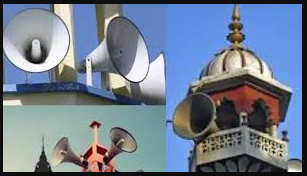
NEW DELHI, Dec 5: The Calcutta High Court on Friday refused to intervene in the claimed construction of a mosque to be modelled after the demolished Babri Masjid in Ayodhya, the Nagpur bench of the Bombay High Court refused to grant relief to a mosque seeking permission to use loudspeakers noting it was not entitled to use the device to practise religion as a matter of right.
The court, while relying on Supreme Court judgments, said no religion mandates prayers to be offered through voice amplifiers or beating drums. A Bench of Justices Anil Pansare and Raj Wakode said the issue of noise pollution was recurring and took suo motu cognisance of the same and asked the Maharashtra government to come up with an effective solution. The court also orally commented against the “bhajans” being performed using loudspeakers in complete violation of the noise pollution rules and wanted the state government to take necessary steps in this direction.
Refusing to intervene in the construction of the “Babri Masjid” modelled mosque, a division bench of acting Chief Justice of the Calcutta High Court and Sujoy Paul, directed the West Bengal government to take necessary steps to maintain the law and order if construction of the proposed mosque threatened peace and communal harmony.
The court’s observation comes ahead of the scheduled foundation-laying ceremony for the proposed ‘Babri Masjid’ on Saturday marking the 34th anniversary of the demolition of the original mosque in Ayodhya by the kar sevaks of the Vishwa Hindu Parishad.
The division bench after hearing a Public Interest Litigation (PIL) seeking a stay on the foundation stone laying ceremony for the proposed mosque, directed that the responsibility of maintenance of law and order would rest with the West Bengal Government. The PIL, which was filed on Thursday, sought a stay on the grounds that the ceremony at Beldanga in Murshidabad district announced by the suspended Trinamool Congress MLA Humayun Kabir could disrupt communal harmony in the region. The petitioner prayed that the court should take immediate action against Mr Kabir’s provocative remarks that have allegedly disrupted communal harmony.
“The writ petition pertains to stop foundation stone laying of Babri Masjid in Beldanga Block 1, Murshidabad to maintain Law and order… The MLA has been using filthy and derogatory statements and hate speech against a community, which causes breach of public tranquillity. Such kind of statements and hate speech over social media and YouTube news portal, being a Member of Legislative Assembly, may break the communal harmony of our state as well as our country,” the petition stated.
Mr Kabir, who has hogged the limelight in the past with controversial statements on matters, including the party’s internal affairs, was suspended by the Trinamool Congress on Thursday for indulging in what it termed “communal politics.” The suspended leader subsequently announced his decision to resign as MLA and launch his own party later this month.
Mr Kabir’s claim of laying the foundation stone of a “Babri Masjid” has stirred politics in the election-bound State, with the BJP claiming that this was an attempt to turn “West Bengal into West Bangladesh.” The claims of construction of “Babri Masjid” have given a handle to the BJP, with State BJP president Samik Bhattacharya saying that such remarks were an attempt to turn “West Bengal into West Bangladesh.”
Mr Kabir, who is an MLA from the Bharatpur Assembly constituency, has over the past several days stated that he will start construction of “Babri Masjid” on December 6, the day the Babri Masjid was demolished in Ayodhya in 1992. While the place where the mosque will be set up has not yet been confirmed, posters in support of “Babri Masjid” have come up in the Beldanga area of the district.
Mr Kabir has said even the Supreme Court had directed that a mosque should be constructed in Ayodhya, but any mosque “constructed by non-Muslims is not considered holy.” “It is my constitutional right to construct a mosque,” the MLA said. Mr Kabir has even appeared to throw a challenge to the State government and said, “If the State government can give honorarium to Durga Puja clubs, hold a carnival and all of it is constitutional, then how can construction of a mosque be unconstitutional.” The Bharatpur MLA has, over the past several months, often targeted his party and even threatened to quit and contest Assembly elections as an independent candidate.
Interestingly, Mr Kabir who has often been accused by the BJP of making communally charged remarks, was a member of the BJP a few years ago and even contested the 2019 Lok Sabha election from Murshidabad on a BJP ticket. Murshidabad district has been one of the most volatile districts of the State, witnessing several incidents of political and communal violence over the past few years.
Meanwhile, the order of the Nagpur bench dismissing a petition filed by Masjid Gousiya in Gondia district seeking permission to use loudspeakers to offer prayers, comes in the wake of a move initiated by the Uttar Pradesh police to remove loudspeakers from mosques in several parts of the state to control noise pollution.
“The petitioner, therefore, is not entitled to seek relief for the installation of a loudspeaker, as of right. The petition is accordingly dismissed,” the court said. Relying on judgments passed by the apex court, the bench said no religion prescribes that prayers should be performed by disturbing the peace of others, nor does it preach that they should be through voice amplifiers or the beating of drums.
The Supreme Court also highlighted the importance of other citizens entitled to enjoy reasonable quietness, particularly those who are of tender age and those who are aged, sick, and people afflicted with psychic disturbances, it said. “Noise pollution is a serious threat to public health and welfare. It causes ‘fight or flight’ syndrome, releasing cortisol and other harmful chemicals into the bloodstream,” the court said.
Over time, these chemicals build up in the body, leading to a host of health problems, including cardiovascular disease, aggression, chronic fatigue, headaches, high blood pressure, mental illness and anxiety, it added. The court said that noise pollution can cause hearing damage, and if it exceeds 120 decibels, it can cause eardrum rupture.
The Bench also highlighted functions and other festivities celebrated in the event halls at Civil Lines in Nagpur during which the noise pollution rules are violated. “In our view, while permitting various celebrations, these venues should take responsibility for ensuring adherence to the rules,” it said.
The court also pointed out several religious places where ‘bhajans’ are performed on loudspeakers in complete violation of the rules. “We hope the State government will be sensitive to the issue involved, which affects public health, and will come up with an effective solution,” it said.