


Manas Dasgupta
NEW DELHI, Oct 18: Even as the nominations for the first phase of the two-phased elections to the 243-member Bihar state Assembly already completed, the opposition INDIA Bloc has remained a divided house and all set to contest among themselves in multiple seats threatening to undermine the very foundation of the coalition.
The INDIA bloc – an alliance that once promised a united front against the ruling NDA – has transformed into a farcical spectacle of misalignment and muddle. The scene in Bihar is set not for a robust battle against the NDA but rather for a series of “friendly fights” that threaten to undermine the very foundation of this coalition. If there is any certainty in this political labyrinth, it is that the NDA stands to benefit from the disarray that has gripped the INDIA bloc.
There was yet no official announcement on seat-sharing arrangements in the INDIA bloc. Only the Congress released its first list of 48 candidates on Thursday night while no other party in the alliance has released its candidate list but many, including INDIA bloc coordination committee head and Rashtriya Janata Dal (RJD) leader Tejashwi Yadav, have filed their nominations.
There have been a series of meetings and dialogues from Delhi to Patna but no leader was able to make an official declaration over seat-sharing or candidate list. While INDIA bloc leaders call these friendly fights, the ruling parties project it as confrontation within the alliance.
There are at least 10 seats where the INDIA bloc in set for “friendly contest” while the Jharkhand Mukti Morcha, a key alliance of the INDIA Block in neighbouring Jharkhand, on Saturday announced that it would contest the Bihar elections independently and field candidates in six seats. “The party has decided to contest the Bihar polls on its own. It will contest six assembly seats – Chakai, Dhamdaha, Katoria (ST), Manihari (ST), Jamui and Pirpainti,” JMM general secretary and spokesperson Supriyo Bhattacharya said. All these seats will go to polls in the second phase on November 11.
The ruling NDA, however, also received a setback on Saturday when the nomination papers of its nominee for the Madhaura seat, Seema Singh of the Lok Janshakti Party (Ram Vilas), one of the key candidates from Chirag Paswan’s party, were rejected in scrutiny.
Seema Singh is a renowned Bhojpuri film actress who joined LJP (RV) and entered the fray. During her nomination, she submitted detailed information about her educational qualifications and assets, which has attracted attention. The returning officer cancelled her nomination due to discrepancies in her documents. It was also confirmed that a total of four nominations, including Seema Singh’s, were rejected due to technical errors found during scrutiny.
Along with Singh, the papers of independent candidates Altaf Alam Raju and Vishal Kumar, as well as BSP’s Aditya Kumar, were also dismissed, the publication further stated. The development is likely to send ripples through the Madhaura constituency as Seema Singh was considered a strong contender for NDA.
The stage is further complicated by the confusion and delay surrounding candidate announcements. While the Congress has managed to release its list of 48 candidates, the other parties within the bloc have faltered in their preparations. This lack of cohesion speaks volumes about the fragile nature of this alliance, which had initially appeared to be a formidable opposition.
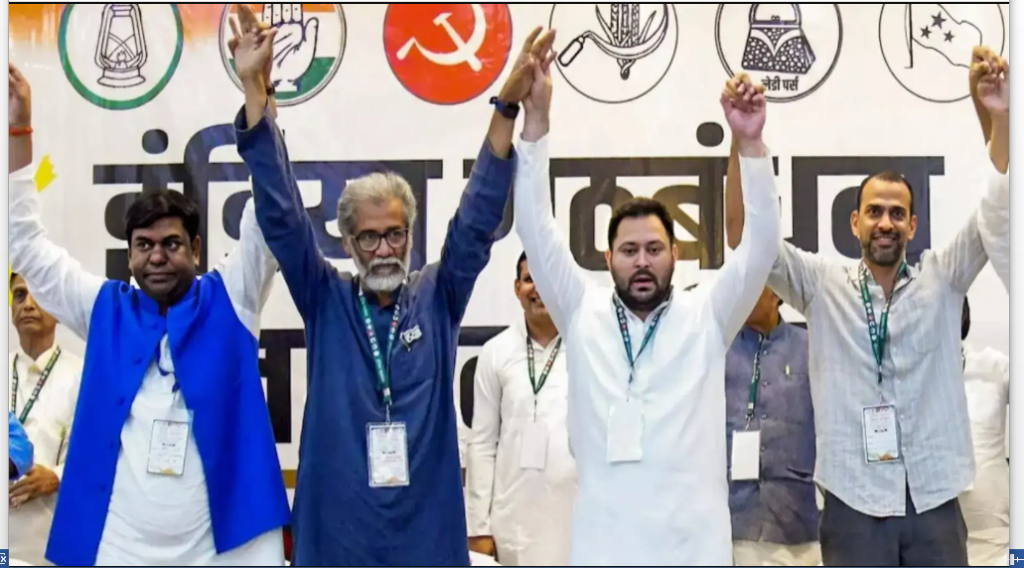
The RJD’s Tejashwi Yadav, along with other leaders, has been engaged in endless dialogues, yet the outcome remains nebulous. The absence of a clear seat-sharing arrangement is a glaring testament to their disarray.
Mukesh Sahani, the VIP chief, announced his withdrawal from the elections just as the dust was beginning to settle, declaring his intentions to support his party’s candidates instead. The cruel truth is Mukesh Sahani has never won a single election in his entire political career, even when he has contested from Mallah-Sahani-Nishad-dominated constituencies.
At a time when leaders like Rahul Gandhi and Tejashwi Yadav have campaigned on foot or on motorcycles across Bihar, during the 16-day Voter Adhikar Rally and the five -day Bihar Adhikar Rally, Mukesh Sahani only does aerial campaigns like traditional VVIPs via choppers and organises press conferences in five-star hotels.
Prashant Kishor walks the entire length and breadth of Bihar, while leaders like Mukesh Sahani cut deals but do no ground campaign, trying to establish mass contacts with voters. Mukesh Sahani had earlier decided to quit the Mahagathbandhan alliance since the RJD leadership was inflexible with his outrageous demands. CPI-ML’s Deepankar Bhattacharya had to call Rahul Gandhi late at night to intervene and pacify Mukesh Sahani.
Sahani’s last-minute accommodation after tantrums reflects a deeper instability within the Mahagathbandhan alliance. His announcement is a microcosm of the larger malaise that afflicts the INDIA bloc – a lack of clarity and direction. Sahani’s aspirations to ascend to the role of Deputy Chief Minister, without even contesting, illustrate the competing ambitions lurking beneath the surface, adding to the utter chaos.
The irony is striking; what was intended as a collaborative effort has devolved into a series of self-inflicted wounds. The ruling NDA, with its cohesive narrative and defined strategy, has become the unlikely beneficiary of the INDIA bloc’s missteps. Each time an RJD candidate stands against a Congress or VIP rival, the NDA’s chances of winning those constituencies only increase. The narrative crafted by the NDA is that of a divided opposition, and the INDIA bloc’s attempts to project unity ring hollow in the face of their internal conflicts.
The efforts of the leaders to present a united face while commendable, are overshadowed by the disarray on the ground. Candidates scrambling to file nominations at the last minute only add to the sense of urgency and confusion that permeates this electoral contest. What was envisaged as a coalition capable of challenging the NDA has instead become a canvas of contradictions – each brushstroke revealing the chaos and contention that lie beneath the surface. The friendly fights, rather than showcasing solidarity, underline the disunity that threatens to derail their ambitions.
In a political landscape where clarity and conviction are paramount, the muddle within the INDIA bloc serves as a cautionary tale. As elections draw near, the question remains: can this alliance overcome its internal discord and present a united front? Or will the NDA, ever watchful, seize the opportunity to solidify its hold on power while the INDIA bloc remains ensnared in its own web of confusion? The infighting within the INDIA bloc may end as an advantage for the NDA.
Another point of continuing rancour in the INDIA bloc is Congress party’s refusal to give assent to Tejashwi Yadav being the Opposition’s Chief Ministerial candidate. Assuring that a Grand Alliance government will be formed in Bihar, senior Congress leader Pawan Khera made it clear that friendly fires could be the norm this time rather than an exception.
“In constituencies where more than one Grand Alliance candidate has filed nomination, one nomination will be withdrawn within one to two days,” Khera said. “The Chief Ministerial face will be announced at an appropriate time,” he added.
The Congress had been demanding over 70 seats, a chunk of which, they said, should give them a sure shot at winning. To ensure that the demand is met, the party has deliberately been withholding agreement to confirm Tejashwi Yadav as the Chief Ministerial face of the alliance. In fact, it had pointedly maintained silence despite Yadav Junior’s open statements on the matter.