


Manas Dasgupta
NEW DELHI, Oct 6: The Election Commission of India (ECI) on Monday announced two-phase polling for the 243-member Bihar State Assembly on November 6 and 11 with the votes to be counted on November 14.
Announcing the poll schedule, the Chief Election Commissioner Gyanesh Kumar said while 121 seats would go to the polls in the first phase on November 6, the remaining 122 constituencies would go to the polls in the second phase on November 11.
For the first phase polling, the date of issue of notification is October 10, last date of nomination is October 17, and the last date of withdrawal of candidature is October 20. For the second phase, the date of issue of notification is October 13, last date of nomination is October 20, and the last date of withdrawal of candidature is October 23. For the counting of votes, it is mandatory to complete counting of postal ballots before last two rounds of counting of votes, Mr Kumar said.
The dates have been fixed apparently in keeping with the demands of most of the political parties who wanted the polling to be held soon after the Chhath and Diwali celebrations to ensure maximum voter participation. The two major festivals of Bihar are to take place between October 18 and 28 this year. The political parties believe that since most of the people of Bihar who work outside the state come to Bihar to attend Chhath and Diwali, would also be available to cast their votes if the polling are held within the close vicinity of the Diwali vacation.
Over 7.4 crore people are eligible to vote in the Bihar Assembly elections, including 14 lakh first-time voters, Mr Kumar said. The CEC asserted that the Bihar elections will be conducted in a transparent and peaceful manner. The term of the 243-member State assembly ends on November 22. The 2020 assembly polls in the State were held in three phases under the shadow of the COVID-19 pandemic.
The EC also announced dates for eight Assembly by-elections to be held along with Bihar polls. Two of these will be held in Jammu and Kashmir, including Budgam – won and vacated by Chief Minister Omar Abdullah after he also won the Ganderbal seat in last year’s election – and one each in Rajasthan, Jharkhand, Telangana, Punjab, Mizoram, and Odisha.
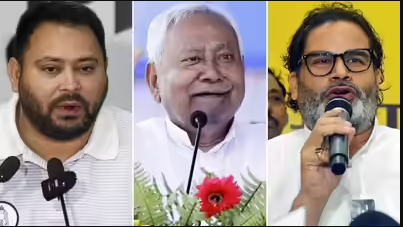
In Bihar, the election will be a fight between the ruling BJP and Janata Dal United-led alliance and the Mahagathbandhan led by the Congress and Rashtriya Janata Dal. Prashant Kishor – who orchestrated superb wins for Nitish Kumar and his Bengal counterpart Mamata Banerjee as a poll strategist – will himself make his electoral debut this time with his own party, the Jan Suraaj that he claimed would contest all 243 seats in the state. Campaigning and voting will take place in the shadow of a furious political and legal controversy – the Election Commission’s ‘special intensive revision’ of the state’s voter list.
On the issue of alleged criticism of the just-concluded “Special Intensive Revision” (SIR) exercise of Bihar electoral rolls, Mr Kumar without naming anyone accused critics of running an ‘online campaign against the exercise’, and said verified voters had already been issued new cards.
New protocols have been put in place, the poll panel also said, to issue new voter cards within 15 days of receipt of an application, to ensure that every eligible voter can cast their ballot.
The opposition – already attacking the EC and ruling BJP over ‘voter fraud’ across elections last year – had cried foul over the SIR alleging the timing was meant to disenfranchise lakhs of men and women from marginalised groups who might vote for them.
The EC, however, maintained the revision was meant to ensure only eligible individuals, i.e., Indian citizens, can vote, and pointed to the discovery of Nepali and Bangladeshi nationals on Bihar’s voter lists. The Bihar SIR reduced registered voters in Bihar to less than 7.24 crore from 7.9 crore before the exercise.
The SIR saw fierce arguments and challenges in the Supreme Court, culminating in the court this week saying the process could be scrapped, at any time, if illegality is established. CEC Gyanesh Kumar said people can still get added their names to voter lists till 10 days before the filing of nomination papers by candidates.
The 2020 election saw a narrow win for the BJP-led alliance, which won 125 seats (BJP 74, JDU 43, others eight) against 110 by Mahagathbandhan. (RJD 75, Congress 19, others 16). Nitish Kumar began his seventh term as a BJP ally but, halfway through it, acted on his ‘paltu’ Kumar nickname and walked out, allying with the Mahagathbandhan.
However, two years into that switch (and having helped found the INDIA bloc to rally parties not aligned with the BJP, Nitish Kumar switched again, returning to the saffron party’s side.
The 2025 Bihar election will kickstart a run of high-profile Assembly polls over the next two years – with Assam, Bengal, and Tamil Nadu in 2026, and Punjab and Uttar Pradesh, among others, in 2027, signalling the long build-up to the 2029 Lok Sabha election.