


Manas Dasgupta
NEW DELHI, July 11: The National Security Advisor Ajit Doval on Friday slammed foreign media for their anti-India bias during reportage of Operation Sindoor and challenged them to give proof of damage to Indian infrastructure by Pakistani airstrikes.
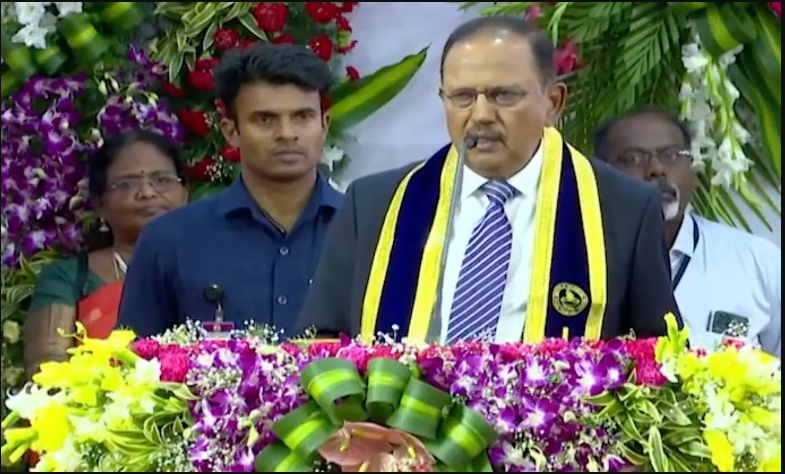
Addressing the 62nd convocation of IIT Madras, Ajit Doval talked about Operation Sindoor, where he highlighted the ‘bias’ of foreign media when it comes to covering India’s interests. He said that foreign media reported that “Pakistan did this and that” but they failed to show any damage to any Indian structure while images from 13 air bases that were damaged in Indian precision strikes in Pakistan surfaced.
Media outlets such as The Guardian, The Times, reported the Pakistan narrative that civilians were targeted in the May 7 attack inside Pakistan and Pakistan-occupied Kashmir. However, the Indian authorities made it abundantly clear that the strikes were precise and only targeted at terror camps and headquarters of LeT and Jaish.
Foreign Media outlets, such as New York Times and The Washington Post, acknowledged India’s military might and admitted that India had a “clear edge” in targeting Pakistan’s military facilities and airfields. “At Bholari air base, located less than 100 miles from the Pakistani port city of Karachi, India’s defence officials said they had struck an aircraft hangar with a precision attack. The visuals showed clear damage to what looks like a hangar,” an article from the NYT said.
“The Nur Khan air base, within a roughly 15-mile range of both the Pakistani Army’s headquarters and the office of the country’s prime minister and a short distance from the unit that oversees and protects Pakistan’s nuclear arsenal, was perhaps the most sensitive military target that India struck,” excerpt from the same article read.
A large chunk of the Western media had refused to recognise the April 22 massacre at Baisaran meadows as a “terrorist attack” and termed the terrorists as “gunmen” and “militants.”
Notably, only in an article published on May 14, The New York Times had acknowledged that Pakistan’s military sites suffered damage in Indian missile strikes. “High-resolution satellite imagery, from before and after the strikes, shows clear damage to Pakistan’s facilities by Indian attacks, if limited and precise in nature,” an excerpt from the article read.
Hailing India’s precision in hitting its targets in the criss-cross of Pakistan on May 7, Doval said armed forces “hit nowhere else except the targets.” “Foreign press said Pakistan did that and this. You tell me one photograph, one image, which shows any damage to any Indian (structure), even a glass pane having been broken. They wrote these things. The images only showed 13 air bases in Pakistan before and after 10th May, whether it was in Sargodha, Rahim Yar Khan, Chaklala.” NSA Doval said.
“I am only telling you what the foreign media put out on the basis of images. We are capable of doing it (damage to Pakistani air bases),” he added. On the intervening night of May 9th and 10th, the Indian Air Force with active support of other forces struck Pakistani Air Bases spanning the length and breadth of the country and in the process also, crippled their Chinese supported Air Defence systems.
Around 15 BrahMos missiles were fired by the Indian Air Force to target the Pakistan Air Force base with an aim of disrupting their ability to launch aircraft and other operations, sources in the Defence establishment had said.
Further speaking about the Operation Sindoor, Mr Doval highlighted how Indian indigenous defence capabilities played a defining role during the conflict, urging the need to develop more indigenous technology. “We have to develop our indigenous technology. Mention of Sindoor was made here. We are really proud of how much of indigenous content was there. We are proud of that some of the best systems were there, whether it was BrahMos missiles, whether it was our integrated air control and command system, whether it was our radars. We decided to have 9 terrorist targets in the criss-cross of Pakistan, it was not in the border areas. We hit nowhere else except that. It was precise to the point where we knew who was where. Entire operation took 23 minutes,” Mr Doval said.
NSA Doval also emphasised that Artificial Intelligence is a “game changer” and India needs to make it a “focal point” in order to lead and develop. “AI is one of the great game changers. AI will change the world at a rate of every year. It will become unrecognisable from everything we do today, and its application will be diverse, not only required for research and development, but also for machine learning, LLMs, defence, robotics, medicine, finance, and everything. If India is going to lead and develop, make it a focal point. This is the one area that we have to develop,” he said.
India struck terrorist camps deep inside the enemy territory, as the armed forces avenged the Pahalgam terror attack that killed 26 civilians in Kashmir on April 22. In India’s retaliatory strikes, over 100 terrorists were killed, officials have said.
Along with BrahMos missiles, the indigenously developed Akash surface-to-air missile air defence system has played a key role in thwarting Pakistani drone attacks targeting Indian assets. Operation Sindoor was launched after Pahalgam terror attack to give a “befitting reply” to Pakistan for their terror-related activities. Indian Armed Forces destroyed nine terror infrastructure sites in Pakistan and Pakistan-occupied Kashmir in air strikes on May 7.