


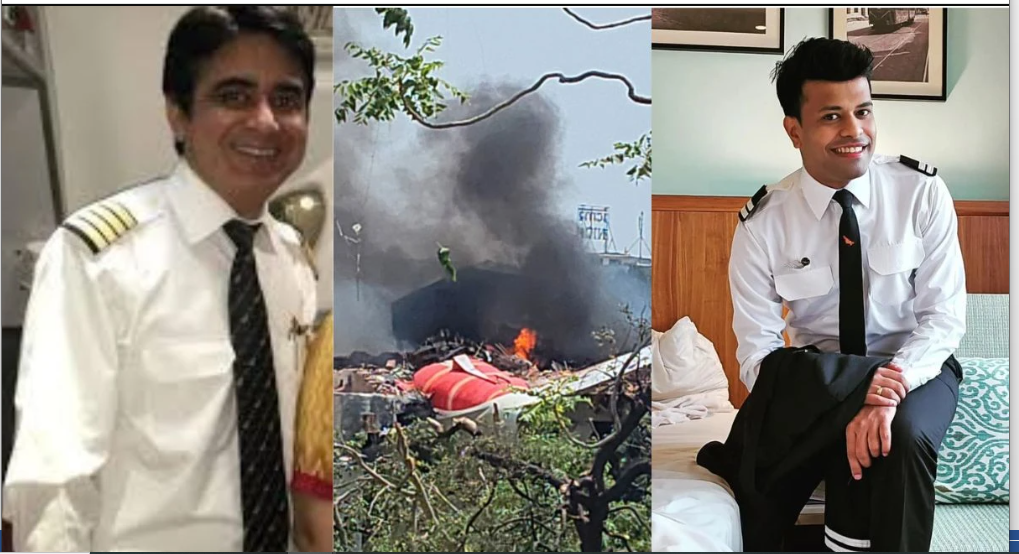
Manas Dasgupta
NEW DELHI, Nov 7: Providing great relief to the nonagenarian father of the pilot of the ill-fated London-bound Air India flight which crashed soon after taking off from Ahmedabad airport on June 12 killing over 260 people, the Supreme Court on Friday orally observed that since no official report had held the cockpit crew responsible for the tragedy, it would be wrong to blame the pilot Sumeet Sabharwal for the tragedy.
A Bench of Justices Surya Kant and Joymalya Bagchi said it was even willing to record this position formally, as it took up for hearing a petition filed by 91-year old Pushkar Raj Sabharwal, father of the late Captain Sumeet Sabharwal, seeking a judicially monitored probe into the crash.
The Supreme Court’s comments which gave comfort to the old father has brought the focus back on theories of electrical malfunction and other probable causes. “No one can blame the pilot of the Dreamliner for the crash,” the bench told the pilot’s father and sent notices to the Centre, the civil aviation regulator (DGCA), and the Aircraft Accident Investigation Bureau (AAIB).
The order came on a petition by Sabharwal senior who was seeking an independent judicial probe into the crash. Justice Surya Kant, who heard the petition, told the father, “This crash was extremely unfortunate, but you should not carry this burden that your son is being blamed. We can always clarify that nobody, and especially the pilot, can be blamed for the tragedy.”
The AAIB in its preliminary report released in July had said fuel supply to both engines was “cut off” shortly after take-off leading to the unfair conclusion that the pilot could have deliberately made the move. The two fuel control switches were moved to the “cutoff” position in quick succession; although the switches were turned back on about 10 seconds later, the engines had already flamed out, leading to the crash, the report said.
Appearing for the petitioner, senior advocate Gopal Sankaranarayanan contended that the preliminary findings of the AAIB were “biased and incomplete” and appeared to attribute the cause of the crash to pilot error while overlooking possible technical and systemic failures that warranted an independent probe.
Citing Rule 12 of the Aircraft (Investigation of Accidents and Incidents) Rules, 2017, Mr Sankaranarayanan argued that the Centre was mandated to institute a formal investigation into the crash. “That has not been done. What we have instead is a preliminary investigation under Rule 9,” he submitted.
The Bench noted that the preliminary report drew no adverse inference against the pilot. “We have gone through the report. There is no insinuation against the pilot at all… It just records a cockpit recorder which says one pilot enquires of the other: ‘Have you switched off the fuel switch?’, and he says ‘No’. So, there’s no question of the report apportioning blame,” Justice Bagchi remarked.
Emphasising that the objective of the probe was preventive and not punitive, Justice Bagchi remarked further, “In fact, the Rules and the AIB investigation are not to apportion blame. It’s to propose better performance and the avoidance of such accidents in the future. Where is the cause of action in this writ petition?”
According to the AAIB report, the fuel control switches of the aircraft “transitioned” to the “CUTOFF” position three seconds after it became airborne, cutting off fuel supply and causing both engines to shut down. The report had noted that the cockpit voice recording captured one pilot asking the other, “Why did he cut off?” to which the colleague responded that he had not done so. It did not clarify whether the switch movement was inadvertent or deliberate, but identified the fuel cut-off as the immediate cause of the disaster.
The court’s observations came at a time when there are credible theories from experienced aviation experts pointing to the possibility of a massive electrical short circuit caused by water ingestion in one of the bays of the Boeing 787.
This, the theories suggest, resulted in a cascading set of failures causing the logic in the aircraft’s systems to shut down fuel flow to the engines of the Dreamliner as a safety feature, albeit one that eventually resulted in the crash of the aircraft – since there was no time, altitude or airspeed for the engines to spool up to maximum thrust once the engines restarted, which they did.
Now, in the absence of a detailed crash report or any further statements from the AAIB, more theories have emerged.
- Air India flight AI-171 was brought down by the deliberate action of one of the pilots, one theory says. This is based on the sentence fragment revealed in the preliminary report – “the aircraft achieved the maximum recorded airspeed of 180 knots IAS at about 08:08:42 UTC and immediately thereafter, the Engine 1 and Engine 2 fuel cutoff switches transitioned from RUN to CUTOFF position one after another with a time gap of 01 sec.” The cockpit voice recorder audio captures one pilot asking the other, “Why did you cut-off?” and the reply, “I did not do so.”
- The US Federal Aviation Administration’s (FAA) Bryan Bedford told Reuters, “We can say with a high level of confidence it doesn’t appear to be a mechanical issue with the Boeing fuel control unit. We feel very comfortable that this isn’t an issue with inadvertent manipulation of fuel control.”
- No international regulator has called for Boeing 787 Dreamliners to be grounded because of electrical or mechanical issues.
- Multiple independent accounts back this report – including a report in the leading Italian daily Corriere Della Sera which alleged the ‘pilot flying’ (the co-pilot in the case of AI-171) repeatedly asked Captain Sabharwal (the non-flying pilot-in-command) why he switched off the engines. According to the report, the pilot flying the aircraft “was unconvinced and asked the same question several more times, for another six seconds.”
- This is more information than the AAIB’s preliminary crash report states and indicates that the entire recording, transcript or technical data of the entire duration of the flight exists with multiple international agencies. This was expected since there were several international stakeholders who have been a part of the investigation.
- An independent report by aviation expert Richard Godfrey stated, “The dual engine shutdown to below idle was caused by water ingress to the Aft E/E Bay.” His report goes on to mention: “The engines automatically reduce to idle when a temporary fault occurs in the digital link between the aircraft’s central computer (CCR) and the engine electronic control (EEC) systems. This link carries the thrust lever position information, known as the thrust resolver angle (TRA), which tells each engine how much power the pilots are demanding. When that information is lost, the engine control systems automatically set both engines to idle as a protective measure. Once the connection is restored and valid data is received again, the systems automatically attempt to restart the engines.