


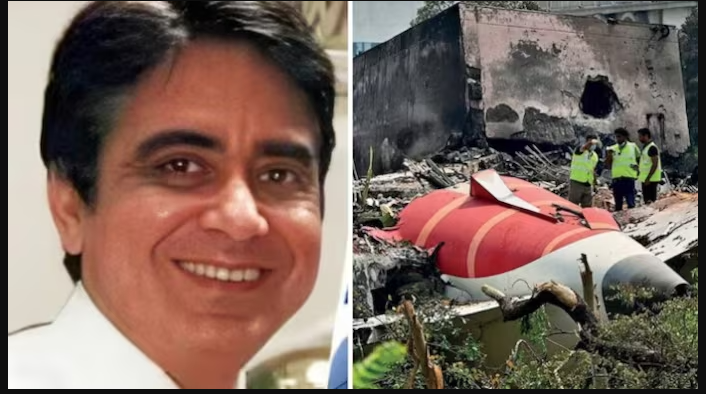
Manas Dasgupta
NEW DELHI, Oct 16: Four months after the London-bound AI-171 plane crash soon after take-off from Ahmedabad airport in which over 260 people were killed, Pushkaraj Sabharwal, father of deceased Captain Sumeet Sabharwal, and the Federation of Indian Pilots have moved the Supreme Court seeking a court-monitored inquiry headed by a former Supreme Court judge into the crash.
While 91-year-old Pushkar Raj Sabharwal is the first petitioner in the matter, the Federation of Indian Pilots is the second. The petitioners contend that the preliminary investigation into the crash on June 12 was “profoundly flawed.” The probe team, they say, was predominantly focusing on the pilots, who can no longer defend themselves.
On September 22, the Supreme Court had said certain aspects of the Aircraft Accident Investigation Bureau (AAIB) preliminary report on the crash indicated lapses on the part of pilots, and had issued notices to the Centre and the Director General of Civil Aviation (DGCA) on another plea seeking an independent, fair and expeditious probe.
Pushkaraj Sabharwal has sought a “fair, transparent and technically robust” investigation into the tragic incident. “An incomplete and prejudiced inquiry, without identification of the exact cause of the accident, endangers the lives of future passengers and undermines aviation safety at large, causing a violation of Article 21 of the Constitution,” the plea said.
This comes after a preliminary report by the Aircraft Accidents Investigation Board suggested that human error had led to the tragedy. “The current approach of the investigation has resulted in a failure to adequately examine, or rule out, other more plausible technical and procedural factors” that led to the tragedy, the petition says. “The petitioners emphasise that factual misdirection through selective disclosure, especially against crew who cannot defend themselves, impedes root cause discovery and threatens future flight safety-calling for a neutral judicial lens,” it adds.
The petition questions the composition of the five-member investigation team, saying it violated the fundamental principle of natural justice that mandates that no person should be a judge in their own cause. “The team is dominated by officers from DGCA, the State aviation authorities whose procedures, oversight, and possible lapses are directly implicated in the investigation. Moreover, the officers are placed under the control of the DG, AAIB, thereby creating a situation where the very entities responsible for regulating and overseeing civil aviation are effectively investigating themselves.”
“Only a judicially monitored, expert-driven investigation, independent of the regulatory authorities, can ensure a thorough, transparent, and credible determination of the true causes of this tragedy, uphold accountability, and prevent a repeat of such catastrophic failures,” the petition says.
It adds that Captain Sabharwal had an “unblemished career spanning over 30 years, with 15,638 hours of incident-free flying, including 8,596 hours on Boeing 787-8 aircraft, without a single reported lapse or incident causing fatalities or otherwise.” While Captain Sabharwal was the pilot-in-command of the flight, Clive Kundar was the First Officer.
The petition demands a probe by a judicially monitored committee headed by a retired Supreme Court judge and comprising independent experts from the aviation sector.
Air India flight 171, travelling from Ahmedabad to London Gatwick, crashed seconds after take-off on the afternoon of June 12. All 12 crew members and 229 of the 230 passengers died. The aircraft crashed into the hostel of a medical college in Ahmedabad, killing 19 people on the ground including some medical students. Only one flier miraculously survived the crash.
A month later, the Aircraft Accident Investigation Bureau published a preliminary report on what led to the tragedy. The report mentioned a conversation between Captain Sumeet Sabharwal and First Officer Clive Kundar. The report said the cockpit audio has confirmed that one pilot asked, “Why did you cut off?” And the other replied, “I didn’t.” This led to speculation that a pilot error was behind the shocking tragedy. Pilot associations have criticised the probe team’s report. Earlier, while hearing a similar petition filed by an aviation safety NGO, the Supreme Court had described the ‘pilot error’ narrative as “unfortunate.”
The petition, filed through AP&J Chambers on October 10, made the Union Ministry of Civil Aviation, the DGCA , and the Director General of the AAIB as respondents, and is likely to come up for hearing after Deepavali vacation.
The plea seeks directions for the constitution of an independent committee, comprising aviation and technical experts also, to probe the crash.
The petition said the official investigation conducted by the AAIB and the DGCA was “defective, biased, and technically unsound.” The preliminary report, issued on July 12, 2025, is alleged to have wrongly attributed the cause of the crash to pilot error, while ignoring multiple systemic and technical failures that could have played a decisive role.
According to the petition, “the inquiry team, rather than undertaking a comprehensive technical investigation, appears to have disproportionately focused on the deceased pilots, who can no longer defend themselves and overlooked plausible evidence of electrical, software, or design-level failures”.
The plea said such an approach not only tarnishes the reputation of the deceased crew but also undermines aviation safety, violating the right to life and dignity under Article 21 of the Constitution. “Issue an appropriate writ, order, or direction under Article 32 of the Constitution of India and constitute a Judicially Monitored Committee or Court of Inquiry, headed by a retired Judge of this Hon’ble Court, with independent aviation and technical experts as its members, to conduct a fair, transparent, and technically robust investigation into the crash…,” the plea said.
It also sought a direction that all prior investigations conducted so far into the crash, “including the preliminary report dated July 12, be treated as closed and all relevant materials, data, and records be transferred to the Judicially Monitored Committee or Court of Inquiry.”
Airline Pilots’ Association (ALPA)-India president Captain Sam Thomas met Director General of Air Accident Investigation Bureau (AAIB) G.V.G. Yugandhar and Director General of Civil Aviation chief Faiz Kidwai pressing for an observer status in the probe. During the meeting, ALPA was conveyed that the Act under which the AAIB was formed did not allow any non-government body to be part of accident investigations. “Nothing about AI 171 was discussed as this is a subject of an ongoing inquiry. But we have been assured that there will be quarterly meetings with us,” Captain Sam Thomas had said after the meeting.
ALPA had rejected the “tone and tenor” of the interim probe report on the Air India Boeing 787 crash for suggesting a “bias” towards pilot error after the report seemed to focus on the shifting of fuel switches to ‘cut off’ position. It claimed that the investigation was “shrouded in secrecy, undermining credibility and public trust,” and has demanded an observer status in the investigation to ensure transparency and accountability.
Last week, Pushkar Raj Sabharwal had strongly criticised the preliminary crash inquiry report for “insinuating” that his son deliberately turned off the plane’s fuel control switches shortly after take-off, leading to the crash. He condemned this suggestion as based on selective and speculative interpretations of cockpit voice recorder data and demanded that an additional investigation be opened.
Last month, in response to a PIL petition by aviation safety expert and founder of NGO Safety Matters Captain Amit Singh, the Supreme Court sought a response from the Centre and the Director General of Civil Aviation (DGCA) for “ensuring a fair, impartial and expeditious investigation by an expert body”, but refused to direct disclosure of the entire investigation record and emphasised that confidentiality must be maintained until the probe is concluded.
Mr Sabharwal earlier had also written a letter to the civil aviation secretary and AAIB Director General pointing out that selective leaks about the accident have led to speculation that Sumeet (56) was under tremendous psychological pressure and therefore was contemplating death.
“These innuendos have very adversely affected my health and mental setup and the reputation of Captain Sumeet Sabharwal. They tarnish Captain Sabharwal’s reputation, which is a fundamental right guaranteed to a citizen of India under Article 21 of the Constitution of India,” the letter, dated August 29, said. He had demanded that the central government order a formal enquiry into the accident under Rule 12 of the Aircraft (Investigation of Accidents and Incidents) Rules, 2017.
Under Rule 12, the central government can institute a formal investigation into circumstances of any accident of an Indian registered aircraft if it appears that it is expedient to hold such a probe. There were no immediate comments from the Civil Aviation Ministry and the Aircraft Accident Investigation Bureau (AAIB) on the letter.