


Manas Dasgupta
NEW DELHI, Sept 19: Within days of a Jaish-e-Mohammad (JeM) commander admitting heavy losses in the Indian attack during “Operation Sindoor,” some top Lashkar-e-Taiba (LeT) terrorists are now debunking Pakistan’s claims of “No Damage” in the operations by the Indian armed forces in May in response to the April 22 Pahalgam terror attack in which 26 tourists were killed.
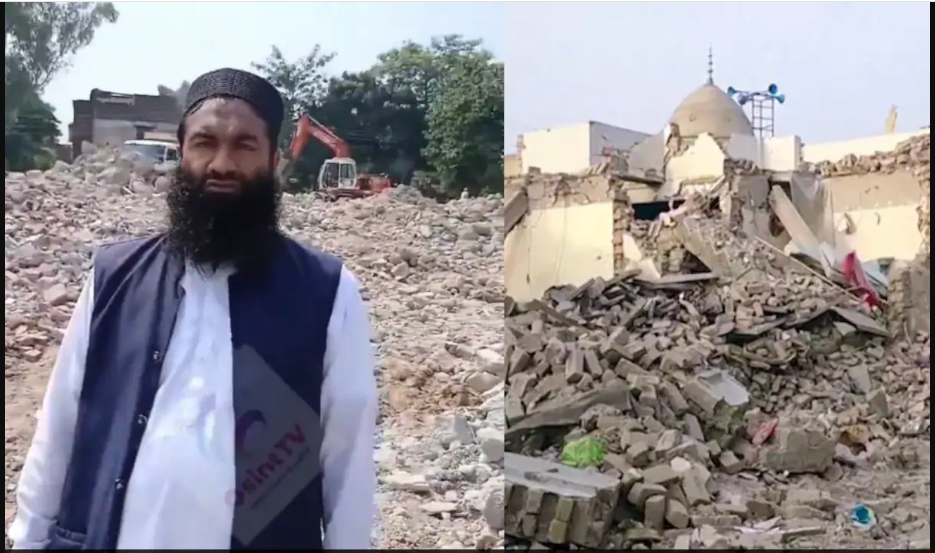
A commander of the LeT terror group, in a video that has gone viral, has made revelations about its headquarters in Pakistan that was hit by India in May. In the widely circulated video on social media, LeT commander Qaasim admitted that the Muridke terror camp, which was destroyed in the May 7 Operations, was being rebuilt ‘bigger than before’. Muridke is a city in the Sheikhupura district in Pakistan’s Punjab province.
“I am standing on the ruins of Markaz Taiba in Muridke, which was destroyed in the (Indian) attack. The process of rebuilding it is underway. With god’s grace, this mosque will be built bigger than before,” Qaasim, who was seen standing in front of an under-construction location, said in the video.
This has come within a couple of days of the JeM commander Masood Illyus Kashmiri exposing Pakistan’s claim on the terror group’s chief Masood Azhar’s connection with the Bahawalpur camp and admitting that about dozen of Masood Azhar’s family members were killed in Indian airstrikes.
In another viral video, Saifullah Kasuri, the deputy chief of Lashkar-e-Taiba (LeT), was heard making bold claims about Pakistan’s support for the terrorist organisation. In the clip, Kasuri was heard saying that the Pakistan government and army have provided funds to rebuild the terrorist group’s headquarters in Muridke.
Kasuri, in the video, also vowed revenge on India for Operation Sindoor. He also threatened Prime Minister Narendra Modi over Kashmir. Kasuri said the resolve of his group “remains strong” and, soon, “the rivers and dams of Jammu and Kashmir will belong to us.” Kasuri said they were “ready to sacrifice their lives” to capture Indian dams, rivers, and territory in Jammu and Kashmir. “It’s a tough time but we will avenge the blood of our brothers,” Kasuri added.
Qaasim admitted that many terrorists [mujahideens and talaba (students)] received training at the destroyed Markaz Taiba mosque, and achieved “victory (Faiz).” Pakistan had claimed that the destroyed building was no longer used by the terror group. In another video, the LeT operative urged Pakistani youths to join Daura-e-Suffa at Markaz Taiba in Muridke. Daura-e-Suffa is a terror training program that includes basic training with religious indoctrination as part of the “jihadi training program.”
India had carried out Operation Sindoor in May in which it hit nearly a dozen terror locations across Pakistan and Pakistan-occupied Kashmir. This included terror camps of the LeT, JeM and Hizbul Mujahideen. Lashkar’s Muridke camp was one of the nine terror locations destroyed by Indian forces in coordinated overnight strikes inside Pakistan and Pakistan-occupied Kashmir (PoK) on May 7. Army, under Operation Sindoor, also targeted key bases of Jaish-e-Mohammed in Bahawalpur and Hizbul Mujahideen in Sialkot, along with additional LeT facilities in Barnala and Muzaffarabad.
A dossier prepared by India’s intelligence agencies confirmed reports of Lashkar quietly rebuilding its demolished headquarters. The group now eyes February 5, 2026 – Kashmir Solidarity Day – as the symbolic deadline to inaugurate the reconstructed complex, timed with its annual convention. The LeT holds its annual convention on that day. New Delhi has intelligence inputs which indicate that the headquarters will once again be used to train terrorists and plan attacks against India.
Muridke, home to around 250 thousand people, is about 30 kilometres from Lahore. The compound itself, known as the Government Health and Educational Complex, was founded in 1988 by LeT chief Hafiz Saeed. India has been pushing the Financial Action Task Force (FATF) to return Pakistan to the “grey list” for failing to curb terror financing. Pakistan was earlier on the grey list three times – in 2008–2009, from 2012–2015, and between 2018–2022.