


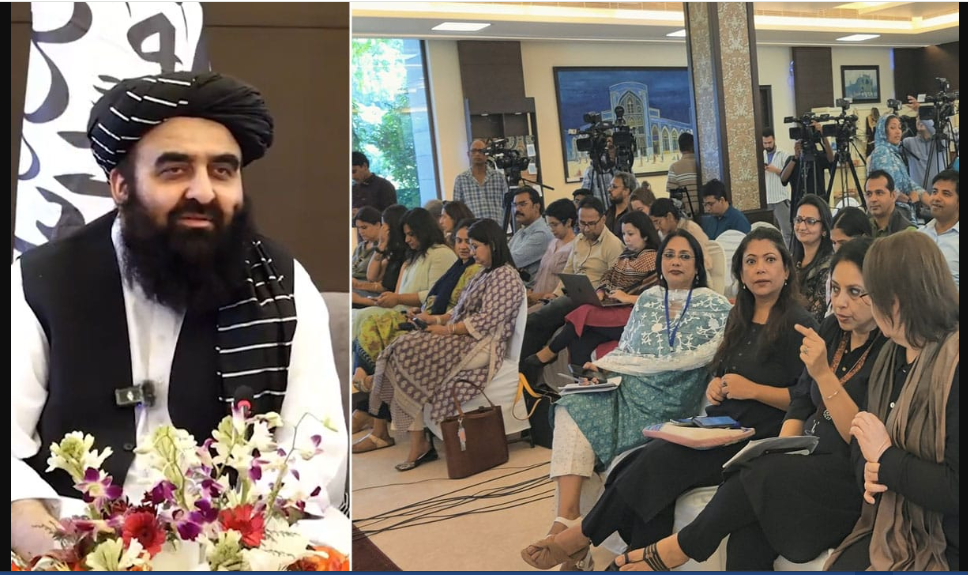
NEW DELHI, Oct 12: Afghanistan Foreign Minister Amir Khan Muttaqi on Sunday claimed that the absence of female journalists from his earlier press conference as a mere “technical issue” days after the incident sparked a major controversy for “insulting women.”
“Regarding the press conference, it was organised on a short notice. (There was) a short list of journalists that were invited. It was more of a technical issue but there was no other problem. Our colleagues had decided to send the invitation to a specific list of journalists. There were no other intentions other than that,” the visiting Afghan minister said, as he held his second press conference two days after the first presser at the Afghanistan Embassy triggered the row.
“We have 10 million students in schools and institutes, including over 2.8 million women and girls. In madrasas, education continues up to graduation. Some limits exist, but we’ve never declared women’s education religiously ‘haram,’ it’s only postponed until further order,” he added.
On Friday, Muttaqi’s presser triggered a major controversy after it was reported that no female journalist were invited for the event with the Opposition terming it as “unacceptable” and an “insult to women.” The interaction was held hours after Muttaqi held wide-ranging talks with External Affairs Minister S Jaishankar. The
Congress MP Rahul Gandhi launched a scathing attack on Prime Minister Narendra Modi over the absence of female journalists from the presser, saying by allowing “exclusion” of women scribes from a public forum, the latter is telling every woman in India that he is “too weak to stand up for them.”
Former Union Minister P Chidambaram said on X: “I am shocked that women journalists were excluded from the press conference addressed by Mr Amir Khan Muttaqi of Afghanistan.” “In my personal view, the men journalists should have walked out when they found that their women colleagues were excluded (or not invited).”
The Editors Guild of India and the Indian Women Press Corps (IWPC) also termed the act as highly discriminatory, which cannot be justified on grounds of diplomatic privilege under the Vienna Convention.
Amid the criticisms, sources in the Ministry of External Affairs had claimed that it had no role in organising the press meet. The ministry said the invites for the press meet went to select journalists from Afghanistan’s Consul General in Mumbai who were stationed in Delhi for the Afghan minister’s visit. The Afghan Embassy territory does not come under the jurisdiction of the Indian government, it pointed out.
It is learnt that the decision on inviting journalists to the media interaction was taken by Taliban officials accompanying the foreign minister. The Taliban regime in Kabul has faced severe criticism from various countries as well as global bodies like the United Nations for restricting the rights of women in Afghanistan.
(Manas Dasgupta)