


Manas Dasgupta
NEW DELHI, Sept: At least 800 people have been killed, and 2,500 injured in a powerful earthquake after a strong earthquake and multiple aftershocks flattened homes in a remote, mountainous region in eastern Afghanistan, according to a Taliban government spokesperson.
The earthquake struck just before midnight, shaking buildings from Kabul to neighbouring Pakistan’s capital, Islamabad. More than 1.2 million people likely felt strong or very strong shaking, according to the U.S. Geological Survey (USGS).
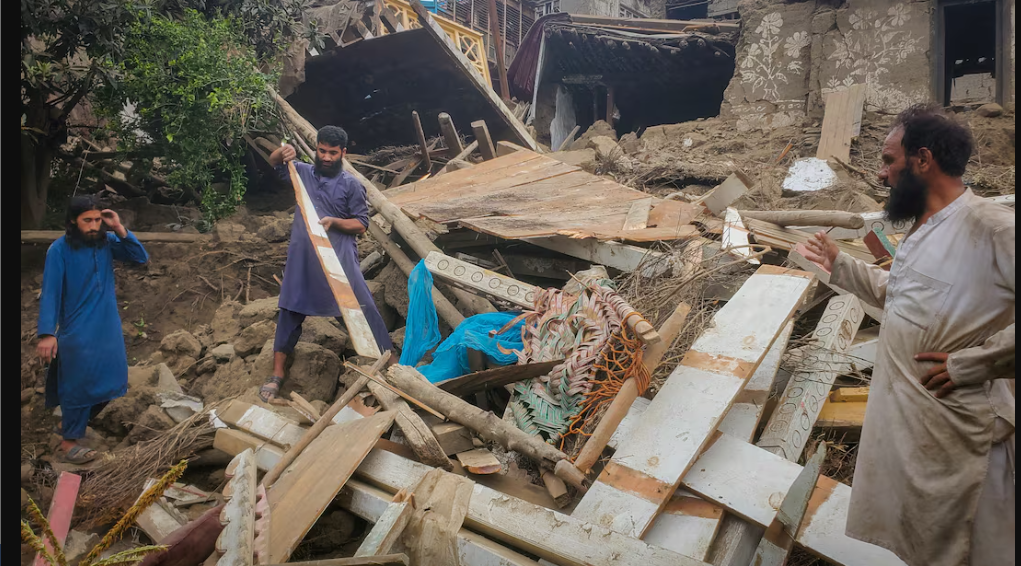
The USGS said the quake hit at 11:47 pm local time, with its epicentre 27 km northeast of Jalalabad in Nangarhar province. At a shallow depth of 8 km, it devastated communities in Kunar province, which officials reported as the worst-hit. In districts like Nur Gul, Soki, Watpur, Manogi and Chapadare, hundreds of homes were damaged or destroyed.
About 20 minutes later, a second tremor measuring 4.5 magnitude occurred in the same region. Jalalabad, approximately 119km (74 miles) from the capital, Kabul, reported widespread shaking, and the earthquake was felt as far away as Islamabad, Pakistan. The Kunar Disaster Management Authority reported casualties in the districts of Nur Gul, Soki, Watpur, Manogi, and Chapadare.
Near the epicentre in the east of Afghanistan, around 800 people were killed and 2,500 injured in remote Kunar province alone, chief Taliban government spokesman Zabihullah Mujahid said. Another 12 people were killed and 255 injured in neighbouring Nangarhar province, he added. “Numerous houses were destroyed,” interior ministry spokesman Abdul Mateen Qani said.
Rescue operations are underway in the remote mountainous areas, but efforts have been hampered by poor communications and narrow, difficult-to-navigate roads in the affected region. The majority of Afghans live in low-rise, mud-brick homes that are vulnerable to collapse. Some of the most severely impacted villages in remote Kunar provinces “remain inaccessible due to road blockages,” the UN migration agency said in a statement.
The Taliban authorities and the United Nations mobilised rescue efforts to hard-hit areas. The defence ministry said 40 flight sorties had so far been carried out. A member of the agricultural department in Kunar’s Nurgal district said people had rushed to clear blocked roads to isolated villages, but that badly affected areas were remote and had limited telecoms networks. “There is a lot of fear and tension… Children and women were screaming. We had never experienced anything like this in our lives,” people said.
The quake, which struck at a relatively shallow depth of eight kilometres, was 27 kilometres from the city of Jalalabad in Nangarhar province, according to the USGS. Nangarhar and Kunar provinces border Pakistan, with the Torkham crossing the site of many waves of Afghan returnees deported or forced to leave, often with no work and nowhere to go.
Women and children are among those injured in Afghanistan’s latest earthquake, but reports suggest far fewer women are receiving hospital care compared to men, media reports said. In Kunar, a highly conservative province, cultural norms may delay women from seeking or receiving treatment, with some families possibly waiting until daylight to take them to hospital. A similar trend was seen after the 2022 Paktika earthquake, when the number of injured women in hospitals rose only days later. Aid workers also note that no female rescuers are currently on the ground.
In Kabul, the capital, health authorities said rescuers were racing to reach remote hamlets dotting an area with a long history of earthquakes and floods. The earthquake was Afghanistan’s deadliest since June 2022, when tremors of magnitude 6.1 killed at least 1,000 people. Images showed helicopters ferrying out the affected, while residents helped soldiers and medics carry the wounded to ambulances. The quake razed three villages in Kunar, with substantial damage in many others, authorities said.
Rescuers were scrambling to find survivors in the area bordering Pakistan’s Khyber Pakhtunkhwa region, where homes of mud and stone were levelled by the midnight quake that hit at a depth of 10 km (6 miles). Military rescue teams fanned out across the two provinces, the defence ministry said in a statement, adding that 40 flights had carried out 420 wounded and dead. “So far, no foreign governments have reached out to provide support for rescue or relief work,” a foreign office spokesperson said.
UN Secretary-General Antonio Guterres added his condolences to those shared by the Taliban government and several nations. “I stand in full solidarity with the people of Afghanistan after the devastating earthquake that hit the country earlier today,” he said. After the initial quake, a series of at least five aftershocks followed throughout the night, with the strongest being one of magnitude 5.2 just after 4:00 am (2330 GMT Sunday).
The United Nations in Afghanistan said it is “deeply saddened” by the situation, even before the death toll rose. In a statement on X, the UN said its teams were already on the ground “delivering emergency assistance and lifesaving support.” “Our thoughts are with the affected communities,” the statement added.
In a statement posted on X, the Prime Minister Narendra Modi expressed support and condolences to those affected by the earthquake. “Deeply saddened by the loss of lives due to the earthquake in Afghanistan. Our thoughts and prayers are with the bereaved families in this difficult hour, and we wish a speedy recovery to the injured,” he wrote. “India stands ready to provide all possible humanitarian aid and relief to those affected,” he added. External Affairs Minister S Jaishankar also expressed “support and solidarity to the Afghan people as they respond to it.” “India will extend assistance in this hour of need. Our condolences to the families of the victims. And our prayers for early recovery of the injured,” he added.
Mr Jaishankar spoke with his Afghan counterpart Mawlawi Amir Khan Muttaqi, offering condolences for the loss of lives in the earthquake. Jaishankar informed that India has already delivered 1,000 family tents to Kabul, and 15 tonnes of food aid are being transported from the Indian mission in Kabul to Kunar province. He added that additional relief supplies would be dispatched from India starting Tuesday and wished for the swift recovery of those injured in the disaster.
Iran’s Foreign Minister Abbas Araghchi has extended support to Afghanistan, pledging humanitarian and medical assistance in the wake of the recent tragedy.
“In these difficult moments and great tragedy, while expressing sincere condolences and solidarity with the great people of Afghanistan and the bereaved families, the Islamic Republic of Iran announces its full readiness to send relief, medical and humanitarian aid,” Araghchi said.
Afghanistan is prone to deadly earthquakes, particularly in the Hindu Kush mountain range, where the Indian and Eurasian tectonic plates meet. A series of earthquakes in its west killed more than 1,000 people last year, underscoring the vulnerability of one of the world’s poorest countries to natural disasters.
In October 2023, western Herat province was devastated by a 6.3-magnitude earthquake, which killed more than 1,500 people and damaged or destroyed more than 63,000 homes. In June 2022, a 5.9-magnitude quake struck the impoverished eastern border province of Paktika, killing more than 1,000 people and leaving tens of thousands homeless. Ravaged by four decades of war, Afghanistan is already contending with a series of humanitarian crises. Since the return of the Taliban, foreign aid to Afghanistan has been slashed, undermining the already impoverished nation’s ability to respond to disasters.
Afghanistan is situated on top of a number of fault lines where the Indian and Eurasian plates meet. These plates collide often, leading to significant tectonic activity in the region. Brian Baptie, seismologist at British Geological Survey, told Science Media Centre, “With India moving towards Eurasia at around 45 mm each year, this collision zone is one of the most seismically active regions of the Earth — accounting for around 15% of all seismic energy released around the world each year. This is an area of very high seismic hazard, with regular earthquake activity spreading across complex fault systems distributed over a wide region.”